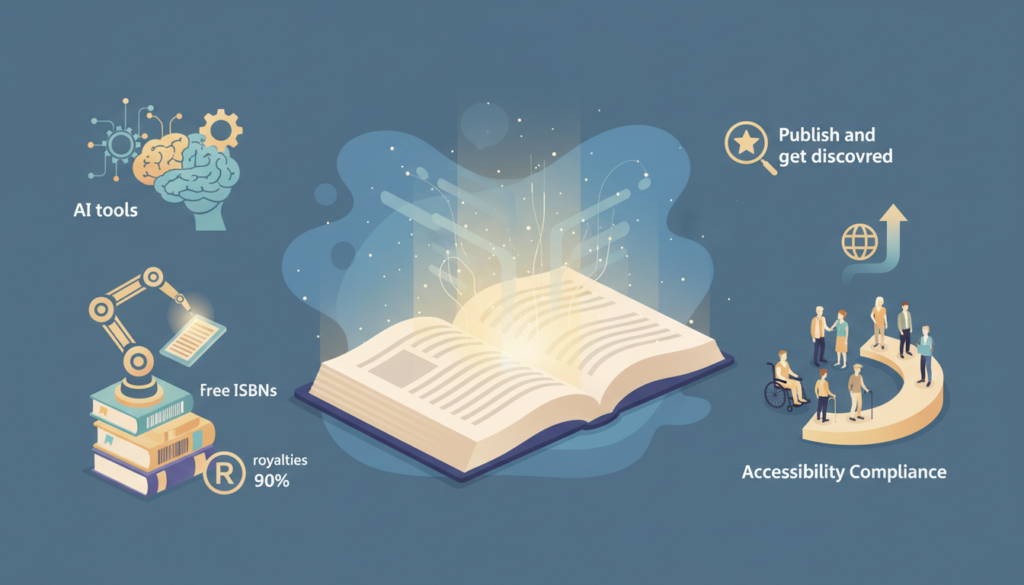
Self-publishing is no longer just about uploading a file and hoping for the best. Ebokio Publishing combines high author royalties, fast review times, and AI-driven discovery and accessibility features so indie authors can publish, be found and reach more readers. This guide explains the practical workflow—what the platform offers, how discovery works, and simple steps you can take to make titles both discoverable and accessible.
What you get: plans, royalties and turnaround
Ebokio offers tiered plans so authors can choose the balance of cost, speed and royalty share that suits them. A Free tier pays 70% of net receipts and supports up to 30 published books plus 10 AI cover generations per month; paid tiers increase author share to 80% on “Premium” (£13.99/month) and 90% on “Pro” (£19.99/month) as listed on the pricing page (pricing)
Turnaround time for human review varies by tier: Paid tiers advertise review within 24 hours, while Free submissions are typically reviewed in 4–6 working days—important to note when planning launches or promotions (how it works)
Other practical details: Ebokio accepts EPUB and DOCX uploads, offers monthly bank payouts with a £30 minimum, and operates a non‑exclusive distribution licence so you keep your rights and can publish elsewhere (features).
Publishing tools that speed the path from draft to product page
Where some platforms treat uploads as a single step, Ebokio provides end‑to‑end tools designed for indie production:
- Writing Studio: planning, in‑editor drafting and a co‑pilot assistant to help generate and refine text.
- AI cover designer: built into the platform for quick cover iterations and to match metadata-driven design cues.
- Real‑time author dashboard: live metrics for sales, reads, royalties and discovery channels so you can act while momentum builds.
- Built‑in reader: with text‑to‑speech and an “Ask This Book” feature that surfaces passages and summaries to readers.
These tools are not just conveniences: they reduce friction at each stage (draft → review → live) so authors can iterate covers, metadata and manuscript quickly and take advantage of the faster review SLA on paid tiers when timing is crucial (features).
How Ebokio’s discovery pipeline works—and how to optimise for it
Discovery on modern storefronts is shifting away from keyword-only search toward conversational and intent-driven systems. Ebokio’s AI Librarian is designed to interpret natural‑language reader queries and recommend titles accordingly; product pages are crawlable so discoverability also benefits external search engines (ebokio storefront).
Practical steps to optimise for this pipeline:
- Write metadata for conversation. Use short, clear description lines that answer reader intent: who the story is for, tone, pace, and unique hooks. The AI Librarian relies on phrases readers naturally use.
- Include structured content inside the EPUB. Properly tagged headings, clear chapter names and embedded descriptive metadata help both TTS and in‑reader Q&A features work better.
- Author Q&A and excerpts. Populate your product page with a short author note and a searchable excerpt so the Librarian has quality passages to reference when readers ask about themes or plot points.
- Monitor discovery signals. Use the real‑time dashboard to watch Librarian impressions, Ask‑This‑Book interactions and completion rates—these indicate whether your metadata is routing readers correctly.
Framing metadata and sample text for conversational queries makes your book easier to recommend by the AI Librarian and more visible in both internal recommendations and external search results.
Accessibility as reach: why making accessible EPUBs matters
Accessible ebooks are not just ethically important—they’re discoverability and revenue levers. Ebokio’s reader supports text‑to‑speech and accessible EPUBs, so structurally sound files perform better for readers who rely on assistive tech and for in‑reader features like Ask This Book (features).
Follow practical accessibility steps backed by industry guidance (for example, WIPO’s accessible ebook recommendations): ensure valid EPUB structure, use semantic headings, include alt text for images and provide clear navigation landmarks. Accessible EPUBs load more reliably in TTS and search within the reader, widening your potential audience (WIPO guidance).
Launch planning: using tiered SLAs and dashboard signals
If you need speed—seasonal tie‑ins, newsletter launches or ads—consider the faster 24‑hour review on Premium or Pro to reduce time‑to‑market. Free reviews typically take 4–6 working days, so shift to a Paid tier when a definitive publication date matters (pricing).
Watch these dashboard metrics after launch:
- AI Librarian impressions: shows how often your title is surfaced for natural‑language queries.
- Ask This Book interactions: indicates whether sample passages answer reader questions and encourage reads.
- Completion rate: signals whether the book keeps readers; low completion suggests editing or pacing work.
Use early feedback to tweak your blurb, cover or first‑chapter hook and re‑queue for a rapid re‑review if necessary.
FAQ — Common author questions
How much of my royalties will I keep on Ebokio?
Royalties depend on your plan: Free pays 70% of net receipts, Premium pays 80% and Pro pays up to 90% of net receipts. Exact payouts are shown in your dashboard and the platform cites net receipt accounting on its pricing pages (pricing).
Is Ebokio exclusive—can I publish the same book elsewhere?
No. Ebokio operates a non‑exclusive distribution licence, so you retain your rights and can publish the same book on other platforms or storefronts (how it works).
What file formats and payout terms should I know?
The platform accepts EPUB and DOCX uploads, supports monthly bank payouts with a £30 minimum, and itemises payment processing charges so authors see how net receipts are calculated (features).
For more detailed walkthroughs—step‑by‑step publishing, worked royalty examples and platform updates—see Ebokio’s guides and blog for practical how‑tos and case studies (guides | blog).