Your book already exists. The edits are done, the cover sits in a storefront, and the ebook earns royalties while you sleep. Yet a large slice of your potential audience will never open it, because they stopped reading on screens years ago and started listening instead — in cars, on walks, at the gym, in the kitchen.
That gap is exactly what AI narration closes. A decade ago, converting a novel into an audiobook meant hiring a narrator at $150–$400 per finished hour, booking studio time, and waiting weeks for files. In 2026, a self publishing author can produce a polished, disclosure-ready audiobook from the same manuscript file that powers the ebook edition, in days rather than months, for a fraction of the traditional budget.
This playbook walks the full pipeline: reshaping a manuscript for the ear, casting a synthetic voice you can legally license, generating chapter by chapter, mastering to the retail benchmark, and steering listeners toward a storefront where you keep up to 90% of each sale. We use Ebokio Publishing as the running example, because its model — non-exclusive distribution, indexable product pages, standard file formats — mirrors the way independent audio production actually works.
Your Manuscript Is Hiding a Second Product
An ebook is one asset wearing a single jacket. Crack it open and a second commercial object falls out: the audio edition. Industry trackers put the global audiobook market above $35 billion, and the growth engine is not hardcovers converting to tape — it is smartphone listeners who buy audio first and text second, or never buy text at all.
For a self publishing author, the math is blunt. A professional narrator on a standard contract charges per finished hour; a 90,000-word novel runs roughly nine to ten finished hours, which puts human production between $1,500 and $4,000 before editing and mastering. AI narration compresses that to a monthly tool subscription plus your own listening hours. The same budget that once produced one audiobook now produces an entire backlist.
There is a second, quieter payoff. Every chapter you generate yields short clips that work as marketing assets — a two-minute thriller excerpt over a dark visual makes a stronger social ad than any static cover image. You are not just making a product; you are building a content engine off one manuscript.
What “Recording with AI” Actually Means
Strip away the marketing language and AI audiobook production reduces to three routes:
-
Stock synthetic voices. Libraries of pre-built voices offered by tools such as ElevenLabs, Google Play’s auto-narration, or Apple Books digital narration. Fastest route, lowest cost, zero recording on your side.
-
Voice cloning. You record 60–180 seconds of your own voice, the model learns it, and the audiobook ships in something that sounds like you. Strong for memoir and non-fiction where the author’s presence is part of the product.
-
Hybrid casting. Stock voices assigned per character with a separate narrator voice — the AI equivalent of a full-cast production, at single-narrator prices.
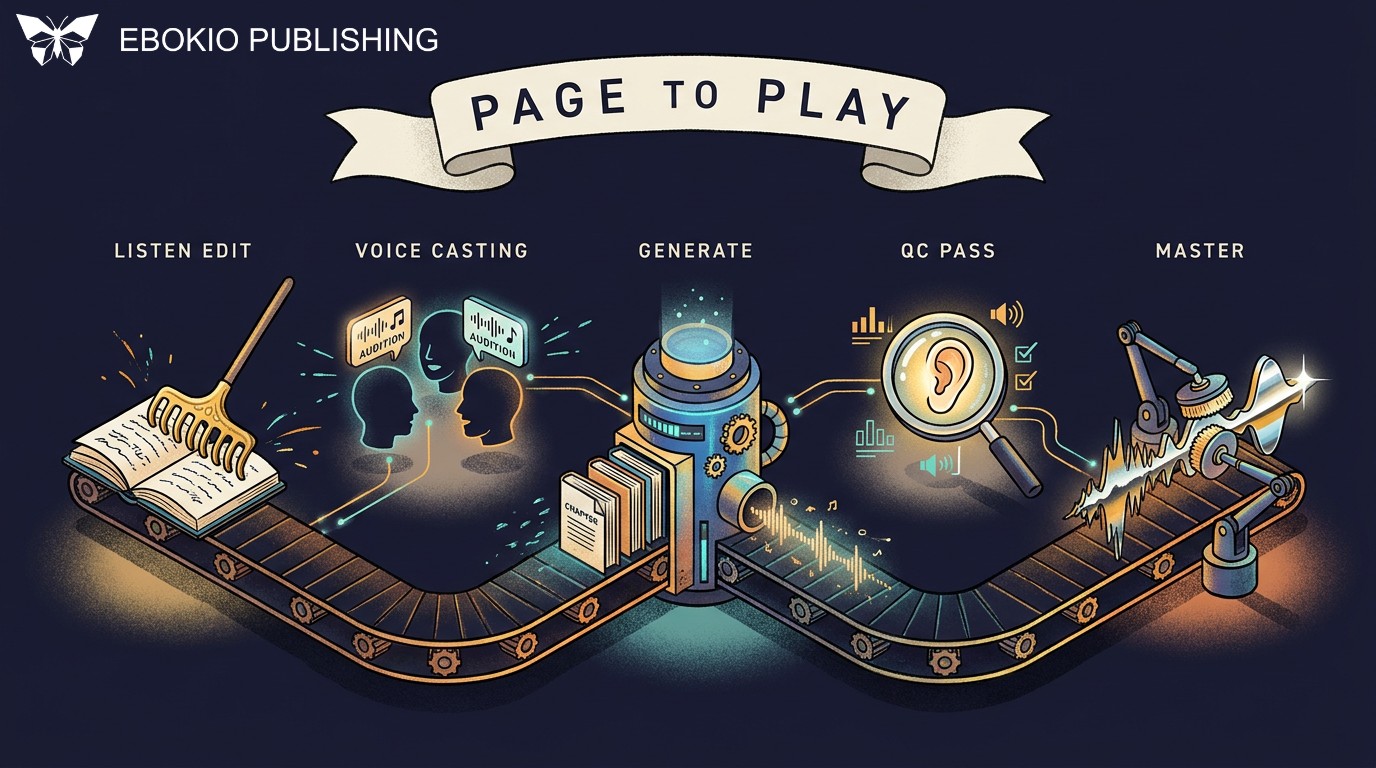
Whichever route you choose, the pipeline has five stages: audio-ready manuscript, voice casting, chapter-by-chapter generation, quality-control passes, and mastering. Only the voice-cloning route involves a microphone at all. Everything else is text engineering and listening discipline — which is why the next two steps matter more than the tool you pick.
Step 1: Rewrite Your Manuscript for the Ear
Text written for the eye fails for the ear. Readers skim; listeners cannot. Before any voice touches your file, run an audio-readiness edit:
-
Delete everything visual — page numbers, chapter-art callouts, image captions, and phrases like ‘as shown in the diagram below.’ Convert bullet lists and tables into flowing spoken prose.
-
Spell out every abbreviation on first use. NASA, GDPR, and character names borrowed from invented languages all need either an expansion or a phonetic entry (Aieran becomes air-uhn) in a pronunciation dictionary.
-
Replace page-oriented references — ‘this page,’ ‘the section above’ — with ‘this chapter’ and ‘earlier in this part.’
-
Respect punctuation as a tempo score. TTS engines read commas, em-dashes, and ellipses as timing instructions; a ragged first draft sounds like a narrator tripping over the text.
-
Write audio-specific front and back matter: title, author, a ‘read by AI narration’ credit, and a spoken chapter list.
Here the ebook groundwork pays off twice. A clean, chaptered EPUB or DOCX — the exact formats Ebokio Publishing accepts for upload, with automatic chapter detection — is also the ideal input file for every serious AI narration tool. Authors who draft inside Ebokio’s Writing Studio already work from a structured outline with acts and beat sheets, so their manuscripts translate to audio with almost no surgery. Compare that to authors wrestling a print-designed PDF out of a traditional formatter: the document fights the TTS engine at every paragraph break.
Step 2: Cast the Voice Before You Generate a Single Chapter
Voice selection on vendor demo clips is how audiobooks go wrong. Demos are engineered snippets; your manuscript is the real audition. Shortlist three or four candidates, then render the same two pages of your own prose through each one — ideally a passage with dialogue, a proper name the voice must pronounce, and one emotional peak.
Next, run the fatigue test: listen to five continuous minutes of each finalist. A voice that thrills for thirty seconds can grate by minute four, and audiobooks live or die on hours-long comfort. Judges on voice-checklists rank sustained listenability above peak expressiveness for exactly this reason.
If you clone a voice — yours or anyone’s — verify the licensing and consent framework behind the feature before you record a sample. You need documented commercial rights to the output, full stop. And if you clone someone else’s voice, written consent is not optional.
One strategic consideration separates owned audio from rented audio. Amazon’s Virtual Voice program generates narration inside its own walls: the audio is tied to Amazon’s ecosystem, Amazon’s voices, Amazon’s terms. An independently produced master file belongs to you and goes anywhere. This mirrors the distribution philosophy at Ebokio Publishing, which holds a strictly 0% exclusivity policy — publishing on publishing.ebokio.com never blocks you from selling the same work through any other channel. Own your masters the way Ebokio authors own their rights: completely.
Step 3: Generate Chapter by Chapter — and Listen Like a Stranger
Resist generating the whole book in one run. Long-form TTS stumbles in long-form ways: prosody drifts, voice character shifts between distant chunks, and a mispronunciation locked in at hour two repeats for seven more hours. The working method professional AI producers converged on looks like this:
-
Chunk the manuscript at sentence boundaries, roughly 5,000–10,000 characters per segment, with a small rolling overlap between chunks so transitions stitch cleanly.
-
Generate one chapter, then stop. Save the source text and every engine setting alongside that chapter file — voices get updated and deprecated, and you will thank yourself when you re-generate next year.
-
Review at 1.5x playback to catch issues efficiently, but do one pass at normal speed through any chapter with heavy dialogue; pacing flaws hide at accelerated rates.
-
Log fixes per chapter — mispronunciation, wrong emphasis, clipped sentence — as a written list rather than patching on the fly. Batch the fixes in one re-generation pass.
-
Listen to chapter transitions before you listen to whole chapters. The seams betray synthetic audio faster than any single sentence does.
Budget roughly a week of evenings for a novel-length manuscript using this loop: a day of prep, two of generation and review passes, one of fixes, one of mastering, one of buffer. The same book through traditional production queues routinely stretches past two months.
Step 4: Master the Audio to the Industry Benchmark
Mastering separates a narrated file from a retail audiobook. The ACX technical specification — written for Audible — became the default bar for the whole industry; files built to it are accepted everywhere. The numbers to hit:
-
44.1 kHz sample rate, exported as 192 kbps CBR MP3 files, mono, one file per chapter
-
RMS loudness between −23 and −18 dBFS, with peaks never louder than −3 dBFS
-
0.5 to 1 second of room tone at each file’s head and 1–2 seconds of silence between chapters
-
A gentle high-pass filter to strip low-end artifacts, plus light compression (around 2:1) for even volume across chapters
-
ID3 metadata on every file: title, author, chapter number, narrator credit (‘AI Narration’ where applicable), and embedded cover art
None of this demands paid software. Audacity handles the full chain — normalization, compression, limiting, silence padding — at zero cost. Target −23 LUFS integrated loudness for general distribution and −16 LUFS for Audible-bound files. Thirty minutes of mastering lifts raw TTS output into audio a listener on $400 headphones cannot fault.
Know the Rules: Where AI-Narrated Audio Is Welcome
Distribution rules for synthetic narration remain a patchwork, and 2026 policy is unambiguous on the biggest storefront. ACX — the submission gateway to Audible’s main catalog — requires human-narrated final audio and prohibits unauthorized third-party text-to-speech outright. The sanctioned exceptions are narrow: Amazon’s own Virtual Voice program for eligible KDP titles (invite-based, audio locked to Amazon), and a Voice Replica beta open only to vetted professional narrators cloning their own voices.
Elsewhere the door stands open, with labels attached. Apple Books, Google Play Books, and Spotify’s distribution partners accept AI-narrated titles provided the narration is disclosed at upload. The strategic takeaway: produce to broadcast spec and disclose your narration method everywhere from day one. Disclosure costs nothing; a policy rejection after launch costs your catalog.
This is where a non-exclusive home base earns its keep. An author who keeps the ebook edition on Ebokio Publishing loses nothing by holding audio masters in reserve for whichever audio storefronts fit their genre — the listing never demands exclusivity, and the audio edition can point listeners back to the ebook page as the canonical home of the work.
Turning Listeners into Buyers on Ebokio Publishing
So what is Ebokio Publishing, precisely? It is a UK-based self-publishing platform for ebooks, built by Ebokio Ltd (registered in England and Wales). The mechanism is deliberately simple: you upload an EPUB or DOCX manuscript, a human reviewer checks the formatting and metadata, and the title goes live as a real product page inside the Ebokio digital bookshop at ebokio.com — indexed by search engines, linked from newsletters and socials, open to any reader with a browser.
Three of its features matter enormously for an author now armed with an audiobook.
Indexable product pages as a funnel target
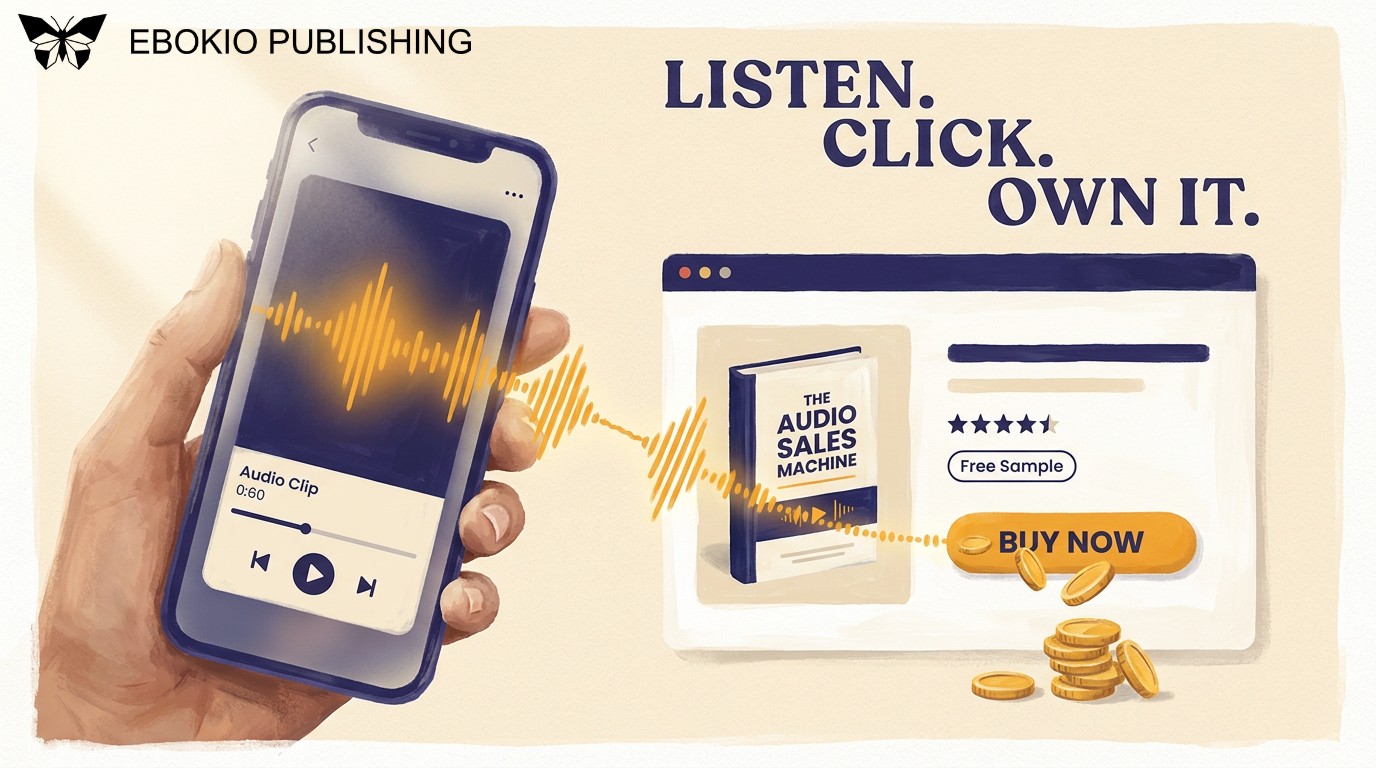
Every Ebokio product page and author page is a genuine, crawlable URL — not an app-locked screen. Clip sixty seconds of your best AI-narrated chapter, post it as a Reel, a Short, or a TikTok with the waveform visual, and point the link-in-bio at your book’s page. The listener lands on a page offering a free 10% sample and one-click checkout: listen, sample, buy. Retailer ecosystems that trap audio inside proprietary apps cannot offer that clean a handoff.
Discovery that reads prose, not just keywords
Ebokio’s AI Librarian is a natural-language discovery layer: a reader types ‘a slow-burn romance set on a German island in winter’ and the system routes them to matching titles via metadata, blurbs, and content embeddings. An author who narrates their own audiobook understands the book’s tonal DNA better than any marketer; translating that understanding into a vivid, specific blurb on the Ebokio dashboard directly feeds this discovery engine. Premium tiers even ship AI metadata autofill drafted from the manuscript itself.
Royalties that respect the second product
Net receipts — the sale price minus reader VAT and the card fee — split 70% on the free plan, 80% on Premium (£13.99/month), and 90% on Pro (£19.99/month), paid monthly with a £30 threshold. Compare the effective economics of retailer royalty structures that skim deep percentages and bundle your audio into exclusivity schemes: an author running Ebokio for the ebook plus open AI audio channels keeps pricing power on both formats, in both markets, simultaneously.
For authors who want the production-adjacent tooling: the Writing Studio’s story bible and relationship map double as a continuity reference while prepping audio scripts, and Pro’s AI Author Co-pilot — which knows your books, sales, and manuscripts — answers the operational questions that surface mid-production better than any generic chatbot.
The Budget: Cost, Time, and Rights in One View
|
Factor |
Human narrator route |
AI narration route |
What to watch |
|
Upfront cost |
$1,500–$4,000+ per finished-hour contract |
Tool subscription, typically under $50/month |
Voice licensing tiers at commercial volume |
|
Production time |
4–10 weeks with queues and retakes |
5–10 days for a novel |
Your own listening hours — do not skip QC |
|
Revisions |
Negotiated pickups, extra fees |
Re-generate the sentence, free |
Save configs so you can re-render later |
|
Rights & access |
Buyout or royalty-share contract |
You own the masters outright |
Written consent on any cloned voice |
|
Store eligibility |
Accepted everywhere |
Blocked on ACX; fine on Apple, Google, Spotify |
Disclose AI narration everywhere |
The honest summary: AI narration trades money for your attention. The budget collapses; the responsibility for quality control shifts entirely onto your ears. Authors willing to listen critically for a week ship audiobooks that stand beside human-narrated catalog entries on every platform that accepts them.
Frequently Asked Questions
Can I legally publish an audiobook narrated by AI?
Yes, provided you hold commercial rights to the voice output, disclose the AI narration where required, and submit only to storefronts whose policies accept synthetic narration. Apple Books, Google Play, and Spotify’s partners do; standard ACX submissions do not.
Can I upload my AI audiobook to Audible?
Not through the normal ACX flow. As of 2026, ACX requires human narration unless it comes through Amazon’s own Virtual Voice program or the narrator-controlled Voice Replica beta. Distribute AI-narrated audio through Apple, Google, and Spotify channels, and use your Ebokio Publishing product page as the book’s permanent home.
How much does it cost to record an audiobook with AI?
Most authors spend between $5 and $50 per month on a TTS platform subscription while producing, plus zero-cost mastering in Audacity. Against $150–$400 per finished hour for human narration, a ten-hour audiobook shifts from a four-figure project to a two-figure one.
Which AI voice should I pick for fiction?
Audition candidates on your own chapters, not on demos, and apply the five-minute fatigue test. For multi-character fiction, assign distinct stock voices per character with a separate narrator voice — but keep the cast small; listeners track four voices comfortably, not fourteen.
Do I have to tell listeners the narration is AI?
Yes. Every platform that accepts AI narration asks for disclosure at upload, and audio-industry labeling guidelines expect the credit in metadata and front matter. Transparency costs you nothing and protects the catalog from policy sweeps.
Do I need an ebook published before I make the audiobook?
No — but it helps. The ebook edition on Ebokio gives you a clean, chaptered source file for the TTS engine, a live product page to aim audio marketing at, and royalty data telling you which title deserves the audio edition first.
Sources
-
Ebokio Publishing — Self-publishing platform, plans, royalties, and AI features
-
Smallest.ai — How to Choose an AI Voice Narrator for Audiobooks
-
Inkfluence AI — The Complete Guide to Creating & Selling AI Audiobooks
-
Audiopod — Can You Publish an AI-Narrated Audiobook on Audible/ACX
-
BookVox — Where Can You Publish an AI-Narrated Audiobook? Platform Rules
-
AI Write Book — AI Audiobook Narration: Complete Guide for Authors