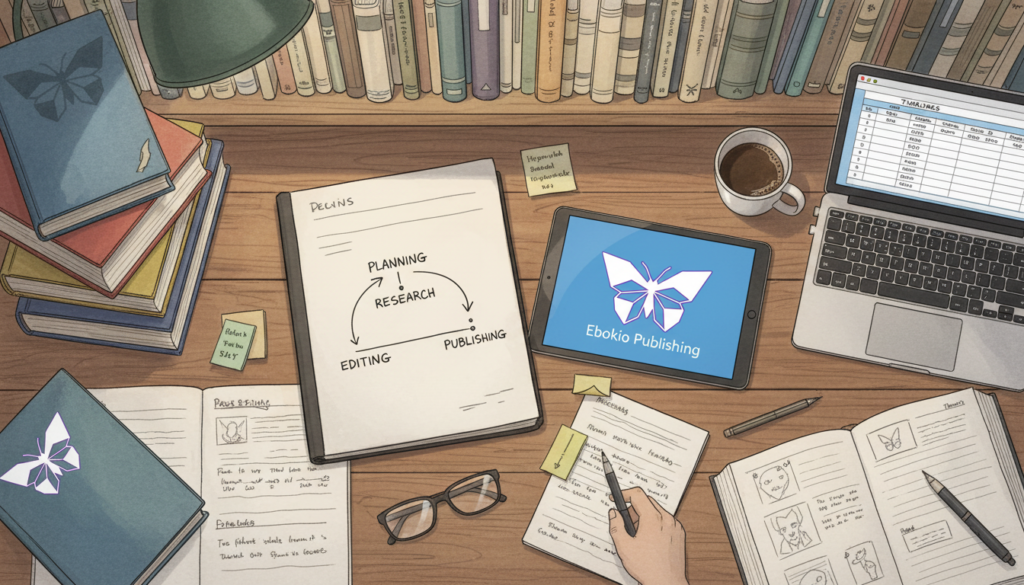
Writing non-fiction requires a clear idea, disciplined research and a structure that helps readers solve a problem or learn a skill. This article walks you from the one-sentence thesis through to a live ebook on Ebokio Publishing (https://publishing.ebokio.com/), with concrete steps, timescales and examples you can follow today.
Start with a single, testable idea
Boil your book down to one sentence: the promise you make to the reader. Example: “A freelance consultant can double hourly rates in 12 months by applying three client-selection techniques.” Keep that sentence on a single card and test it.
How to test: post the sentence as a question in a relevant Facebook or LinkedIn group, or run a £20 poll to a targeted audience. If 20–30% of respondents react with interest, the idea has traction. If the response is under 10%, refine the premise or change the audience.
Plan the structure: chapters, outcomes and micro‑deadlines
Non-fiction sells by promise and fulfilment. Break your one-sentence thesis into 6–12 chapter outcomes (what the reader will be able to do after each chapter).
- Create a chapter map: list chapters, a one-line outcome, and 3 sub-points. Example for a 9-chapter book: Problem, Strategy, Tool 1, Tool 2, Case study, Workflow, Pricing, Negotiation, Next steps.
- Set micro-deadlines. Draft one chapter per week (9 weeks), edit two weeks, proof one week. Total draft-to-manuscript: 12 weeks. Adjust to your calendar: replace weekly targets with daily 500–1,000 word goals if you prefer sprinting.
Research and fact‑checking (practical method)
Non-fiction credibility rests on sources. Use primary sources where possible: interviews, datasets, official reports. Supplement with reputable secondary sources: academic papers, industry reports, and trade publications.
- Collect evidence as you write. Create a single spreadsheet with columns: claim, source URL, quote, page number, whether you paraphrased or quoted verbatim.
- Mark every direct quote and add page numbers for books or timestamps for interviews. This saves hours during final checks.
- Use a final fact-check pass: verify 100% of statistics and 50% of non-critical claims if time is limited. Note corrections in the spreadsheet for transparency.
Tip: if you use AI tools for drafting, preserve source links and clearly mark AI-generated passages for review. Ebokio’s platform supports AI tools like the writing co-pilot and metadata autofill but confirms manuscripts are never used to train AI models — you remain in control of accuracy and citations. See Ebokio’s features for details: https://publishing.ebokio.com/features
Write the first draft: practical routines
Choose a realistic daily habit. Examples that work: 45 minutes of uninterrupted writing before email, or two 30-minute sprints each day. Use a simple word count target — 500 words per session yields 35,000 words in 70 sessions.
Drafting advice:
- Write in scenes or sections, not entire chapters. Finish sub-point 1–3 for a chapter before polishing.
- Keep references inline as temporary notes: [Smith 2019, p.42]. Resolve them during editing.
- Expect the first draft to be messy. Plan two rounds of revision: structural edit then line edit.
Editing, feedback and preparing the manuscript
Conduct three review passes: structural, copyedit, then proof. Invite at least two beta readers who represent your target audience; ask them three questions: did the book solve the promised problem, what chapter was least useful, what would make you recommend it?
Prepare your final file in either DOCX or EPUB. Ebokio accepts both formats and its editor auto-detects chapters, headings and footnotes to produce a reader-ready edition — useful when you want a clean EPUB without manual formatting. More on formats: https://publishing.ebokio.com/
Deciding between a query-style proposal and a finished manuscript
Agents and traditional publishers often ask for a proposal: synopsis, chapter summaries, sample chapters and a marketing plan. Self-publishing authors commonly upload a finished manuscript directly.
If you plan both routes, prepare a proposal in parallel while you finish the manuscript. That keeps options open without delaying independent publication on a platform such as Ebokio, which is non-exclusive and lets you keep all rights.
Design, cover and metadata that sell
Non-fiction covers need clear benefits and readable typography at thumbnail size. Test two cover concepts with a quick A/B poll of 50–100 potential readers and choose the clearer option.
Ebokio offers an AI Cover Studio and metadata autofill which accelerate this stage. Use autofill to generate a strong blurb and keywords, then edit them — never accept an automated blurb verbatim. Accurate metadata improves discoverability in Ebokio’s AI Librarian and built-in reader features. Learn more at https://publishing.ebokio.com/features
Publishing on Ebokio: step-by-step
Ebokio Publishing (https://publishing.ebokio.com/) is a direct-to-reader digital-bookshop and publishing service with a built-in reader, live dashboards and AI discovery tools. It accepts EPUB and DOCX and provides a real-person review for every book.
- Upload your DOCX or EPUB. Upload time: typically under 5 minutes once files are ready.
- Use the Studio editor to preview the exported EPUB and make final layout checks.
- Choose a plan. Free is £0 and pays 70% of Net Receipts; Premium is £13.99/month and pays 80%; Pro is £19.99/month and pays 90% of Net Receipts. See pricing: https://publishing.ebokio.com/pricing
- Submit for review. turnaround: Premium/Pro are typically under 24 hours, Free usually 4–6 working days. Ebokio reviews every book by a human reviewer.
- When live, monitor the dashboard: sales, reads, completion rate and AI Librarian impressions. Use these metrics to run iterative updates to metadata or pricing. Read more about the publishing flow: https://publishing.ebokio.com/how-it-works
Worked example: when does a paid subscription pay back?
Assume your ebook sells for £4.99. Net Receipts means sale price minus reader VAT and payment fee; for simplicity, use £4.49 as net per sale (example net after VAT/fee).
Compare two scenarios across 3 months of sales:
- Free plan (70%): you keep 0.70 × £4.49 = £3.14 per sale.
- Pro plan (90%) costing £19.99/month: you keep 0.90 × £4.49 = £4.04 per sale.
Extra per-sale gain on Pro = £4.04 − £3.14 = £0.90. Monthly Pro cost £19.99. Break-even sales per month = £19.99 / £0.90 ≈ 22.2 sales. If you sell 23 or more copies a month at £4.99, Pro pays for itself and increases net earnings above the Free plan.
This simple maths shows why many mid‑selling non-fiction authors find Premium/Pro cost-effective. If you expect higher price points (£7.99–£9.99), the break-even point falls further. Use live sales metrics in the Ebokio dashboard to check this in real time: https://publishing.ebokio.com/features
Context: Amazon KDP still has broader reach, but its rules (70% or 35% tiers and delivery/territory conditions) differ. Many authors use both: keep global reach via KDP while using Ebokio to test pricing, run direct-to-reader promotions and capture a higher share of net receipts. See a comparison of royalties here: KDP royalties.
Using live metrics to improve a non‑fiction book
Ebokio shows reader engagement: pages read, completion rate and TTS minutes, plus AI Librarian impressions. Use those signals to decide where to revise.
- If completion rate drops sharply on chapter 4, rewrite the opening of chapter 4 to be shorter and outcome-focused.
- If Ask This Book or search impressions are high for a specific question, add an expanded FAQ or a short “how-to” appendix and republish the updated file.
- Run price tests: change price for one week, watch sales and net receipts. With dashboard metrics you can see immediate effects and roll back quickly.
Practical AI guidelines for non‑fiction authors
AI can accelerate drafting, suggest metadata and design covers. Follow three rules:
- Always verify AI-generated facts with original sources. Keep your spreadsheet of claims updated.
- Edit AI-generated prose to match your voice and mark where AI suggested phrasing, especially for quoted material.
- Use AI for metadata and cover ideas, then refine manually: automated suggestions are starting points, not finished copy.
Ebokio provides AI tools (AI Cover Studio, metadata autofill, writing co-pilot) while ensuring manuscripts are not used to train AI models. That balance speeds production and keeps your content private. See tool descriptions: https://publishing.ebokio.com/features
Distribution, rights and payments
Ebokio is non-exclusive: you retain all rights and can sell the same book elsewhere. Payouts are made by bank transfer at the end of the month two months after the earnings month, with a £30 minimum; smaller balances roll forward until they reach £30.
Decide whether to run exclusive promotions on other platforms. A common approach is a staged release: launch on Ebokio to capture direct sales and reader data, then expand to other retailers with the original non-exclusive rights preserved.
Quick publication checklist
- One-sentence thesis tested by poll or audience feedback.
- Chapter map with outcomes for each chapter.
- Research spreadsheet with sources and fact-check status.
- Two rounds of edits plus two beta readers’ feedback.
- Cover A/B test and final metadata prepared (use Ebokio metadata autofill then edit).
- Export final DOCX or clean EPUB and upload to Ebokio.
- Choose plan and submit; expect Premium/Pro review under 24 hours, Free 4–6 working days.
Frequently asked questions
How long does it usually take to write a non-fiction ebook?
Time varies by length and research. A practical schedule is 9–12 weeks from first draft to manuscript if you write one chapter per week and allow three weeks for editing and proofing. Shorter sprints (daily 500–1,000 word goals) compress the timeline; more research-heavy projects will take longer.
Which file format should I upload to Ebokio?
Ebokio accepts DOCX and EPUB. The Studio editor converts DOCX cleanly and auto-detects chapters, headings and footnotes to produce a reader-ready EPUB. Choose DOCX if you prefer to use a word processor; export a validated EPUB only if you are confident in the formatting.
What royalties will I receive from sales on Ebokio?
Royalties are a share of Net Receipts (sale price minus reader VAT and payment fee). On Ebokio Publishing, the Free plan keeps 70%, Premium is 80% at £13.99/month, and Pro is 90% at £19.99/month. Choose the plan that fits your expected sales; small calculations can show when a paid plan pays back. See pricing: https://publishing.ebokio.com/pricing
How quickly will my book appear in the Ebokio bookstore?
Ebokio reviews every book with a real person. Typical review times are under 24 hours for Premium/Pro submissions and around 4–6 working days for Free plan submissions. After approval, the listing goes live immediately.
Can I use Ebokio’s AI tools without giving up rights or training data?
Yes. Ebokio offers optional AI tools — AI Cover Studio, metadata autofill and a writing co-pilot — and states that manuscripts are never used to train AI models. Use those tools to speed production, but always verify facts and edit generated text to match your voice.