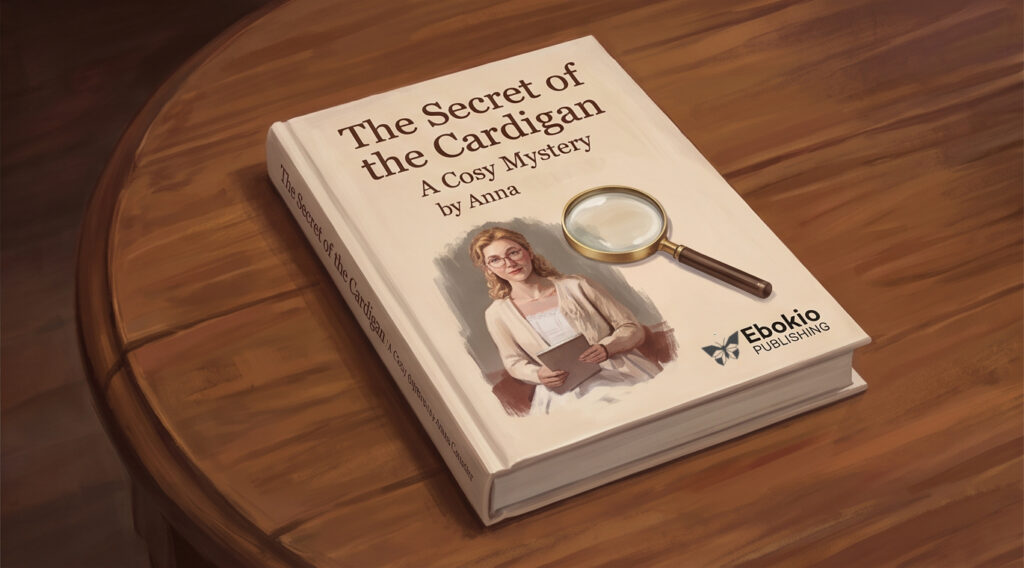
Write a cosy mystery that readers return to, with a reliable series hook and a smooth route from manuscript to marketplace. This guide gives concrete word counts, plotting rhythms, metadata templates, cover rules and a start‑to‑finish Ebokio Publishing workflow you can follow today.
What makes a cosy mystery (and how that affects your choices)
Cosy mysteries are quieter than hardboiled crime. They emphasise an amateur sleuth, a familiar community and a puzzle the reader can solve alongside the protagonist. Violence happens offstage; tone stays light; humour, local colour and recurring characters matter.
Practical consequences for your book:
- Target length: aim for 60,000–75,000 words for a single cosy novel — short enough for readers who prefer fast reads, long enough to plant clues and build relationships (source: GripRoom). GripRoom
- Series potential: design the setting and cast so a sequel is straightforward; readers favour recurring sleuths and a sense of place (source: Reedsy). Reedsy
- Tone and content: keep sex and gore offstage; use cosy tropes such as a bookshop, bakery, or village pub to anchor the tone (source: Wikipedia). Wikipedia
Step 1 — Plan with the cosy blueprint
Start with a one‑page bible. For a cosy series, the bible saves time when you write book two and three.
- Setting note: 150–300 words describing the village/town and two signature locations (e.g. Millbridge Bakery; Willow Street Bookshop).
- Sleuth card: name, occupation, three strengths, two vulnerabilities, and a hobby that explains the sleuth’s access to people or places.
- Series arc: one sentence describing what the sleuth wants across three books (e.g. “Establish a new bookshop that becomes the village hub while solving town secrets”).
- Plot beats: list 10–12 beats — inciting incident, lock of suspects, midpoint reveal, false arrest, clue reversal, final reveal.
Use Ebokio’s Writing Studio to store this bible and create character cards and an outline. The Studio’s project files keep your beats and metadata together so you can export quickly to a draft. See Ebokio’s feature list for Studio tools. https://publishing.ebokio.com/features
Step 2 — Draft with purpose (and an eye on reader behaviour)
Write to scene goals, not just pages. A cosy chapter often ends on a small reveal or a kooky moment that encourages readers to keep turning pages.
- Daily target: 750–1,200 words for steady progress; at 800 words/day you hit 60k in 75 days.
- Chapter length: 1,500–3,000 words. Shorter chapters increase perceived pace and improve completion rates in readers who sample via ebook stores.
- Clue placement: plant the first fair clue in chapter 3–5; the second in the middle; the all‑important payoff clue 2–3 chapters before the reveal. Use one clear red herring every 8–12 chapters.
If you use AI to unblock scenes, use it as a co‑writer, not a voice copier. Ebokio’s Co‑pilot and Muse tools sit inside the Studio so you can draft with assistance while keeping a single project file and ensuring manuscripts are not used to train models. https://publishing.ebokio.com/features
Tip: plan one motif per book (baking, knitting, a bookshop shelf). Motifs make marketing easier and feed the metadata fields you’ll use when publishing.
Step 3 — Nail the cover and thumbnail
Cosy buyers often shop by thumbnails, so readable typography and a simple prop image beat busy collages.
- Thumbnail rule: test at 120×180px. Title must be clear; use one recognisable prop and one consistent colour palette across the series.
- Typography: bold, sans serif for titles; a warm script for a subtitle or series name if it still reads at thumbnail size.
- Series band: add a small, consistent series badge (e.g. “A Millbridge Mystery”) in the same corner to build recognisability for repeat buyers.
Ebokio includes an AI Cover Studio you can use to iterate cover versions quickly. Because it’s integrated, you can swap designs and see final EPUB output immediately — faster than sending files between third‑party designers. https://publishing.ebokio.com/features
Step 4 — Metadata that helps discovery (do more than keywords)
Discovery for cosy readers increasingly uses natural language: “village mystery with baker” or “gentle bookshop sleuth.” Optimise metadata for those conversational queries.
- Title formula: PrimaryTitle — Series Name #N. Example: The Plum Tart Alibi — Millbridge Mysteries #1.
- Subtitle/Tagline: use descriptive phrases readers use. Example: “A village mystery with a baking sleuth.”
- Blurb: first 100 words must sell the hook and setting; include two searchable tags such as “bookshop” or “bakeshop”.
- Categories: choose both ‘Mystery’ and a lifestyle tag where available (e.g. ‘Small town’, ‘Food & drink’).
- Keywords: prefer multi‑word phrases used in conversation — “cozy village mystery”, “women sleuths bookshop”.
Ebokio’s metadata autofill and AI Librarian help translate natural‑language phrases into discovery signals that route readers to your title; this beats old keyword lists because it connects what readers say to the storefront’s recommendation engine. https://publishing.ebokio.com/features
Step 5 — Prepare files and publish fast
Format for EPUB and upload either EPUB or DOCX. Ebokio’s editor exports a clean EPUB and detects chapters automatically, saving you time on reflow issues.
- Final check: internal links, chapter headings, page breaks and front matter (title, copyright, series info).
- Proofing: export EPUB, open it in a reader app and scan the first three chapters for layout or hyphenation problems.
- Upload: choose a plan. Free tier keeps 70% of net receipts; Premium (£13.99/month) keeps 80%; Pro (£19.99/month) keeps 90% — net receipts are sale price minus readers’ VAT and payment fees. https://publishing.ebokio.com/pricing
Every manuscript on Ebokio receives a human review before it goes live. Expect 4–6 working days on the Free plan and under 24 hours on Premium and Pro — useful when you want short lead times for seasonal releases. https://publishing.ebokio.com/how-it-works
Note on rights and payouts: Ebokio is non‑exclusive — you keep your rights and can sell the same book elsewhere. Payouts are monthly by bank transfer, paid at the end of the month two months later, with a £30 minimum; smaller balances roll forward. https://publishing.ebokio.com/
Step 6 — Pricing, promotions and series strategy
Cosy series sell best when the first book is discoverable and subsequent books are full‑price or slightly discounted.
- Intro price: consider a low introductory price for book one to encourage series discovery, then raise price for sequels.
- Bundling: offer book 1 + 2 bundles seasonally (autumn and Christmas often lift cosy sales; K‑lytics shows strong holiday interest). K‑lytics
- Promotion schedule: plan promos around local festivals, bank holidays and bookshop events; update metadata and cover blurb for seasonal tie‑ins.
Ebokio’s real‑time author dashboard shows live sales, reads and completion rates so you can spot whether a first book is converting into series reads and adjust promotions accordingly. Use those signals to decide if a temporary price drop has worked or if you need a cover tweak. https://publishing.ebokio.com/features
Measure what matters — three metrics cosy authors should track
- Completion rate: percentage of readers who finish a book — a low completion rate suggests pacing or tone problems.
- Pages read / reads: how far readers progress; strong early chapter drop‑off means rewrite or tighter opening.
- Series conversion: how many buyers of book one later buy book two — a reliable indicator of long‑term income per reader.
Ebokio provides these engagement signals in the dashboard, not just raw sales rank, so you can make editorial decisions from real reader behaviour rather than guesswork.
Ethics and AI: how to use tools without losing your voice
Use AI for idea generation, titles, alternate openings and cover mockups. Never present AI‑produced writing as the sole voice if you intend to credit a human author. Keep a clear editorial record of changes.
Ebokio’s AI tools are optional and manuscript text is not used to train external models. That lets you experiment while retaining control over rights and creative ownership. https://publishing.ebokio.com/features
Cozy checklist — copy this into your project
- Target word count: 60k–75k words.
- Setting: 2 signature locations and one recurring event (market, book fair).
- Sleuth: amateur with a useful hobby; give them a clear personal stake.
- Clues: first clue by ch.5; payoff clue 2–3 chapters before the reveal.
- Cover: readable at thumbnail size; series badge in same corner.
- Metadata: conversational keywords; series name in title or subtitle.
- Files: final EPUB (or clean DOCX); proof on a reader app.
- Plan promotion: seasonal tie‑ins and an intro price for book one.
Store this checklist in Ebokio’s Studio for quick reuse across books and to ensure consistency in series metadata when you upload new entries.
Frequently asked questions
What word count should my cosy mystery be?
Most indie cosy novels sit between 60,000 and 75,000 words. That length is long enough to place clues and build relationships but short enough to encourage readers to finish and buy the next book. Source: GripRoom. GripRoom
Can I use Ebokio’s AI tools to write my book?
Yes — Ebokio offers optional AI features such as Muse and Co‑pilot to help with drafting and ideas. These tools live inside the Studio so your manuscript stays under your control; Ebokio does not use uploaded manuscripts to train AI models. https://publishing.ebokio.com/features
How long until my book is live on Ebokio?
Every book receives a human review. Typical turnaround is 4–6 working days for Free plan uploads and under 24 hours for Premium and Pro customers. https://publishing.ebokio.com/how-it-works
What royalties and fees will I receive?
Ebokio is transparent about royalties: Free plan keeps 70% of Net Receipts; Premium (£13.99/month) keeps 80%; Pro (£19.99/month) keeps 90%. Net Receipts equals sale price minus the reader’s VAT and payment fee. See detailed pricing on Ebokio. https://publishing.ebokio.com/pricing
Do I give up rights if I publish on Ebokio?
No. Ebokio is non‑exclusive — you retain all rights and may sell the same book elsewhere. Payouts are monthly by bank transfer, paid at the end of the month two months later, with a £30 minimum threshold. https://publishing.ebokio.com/