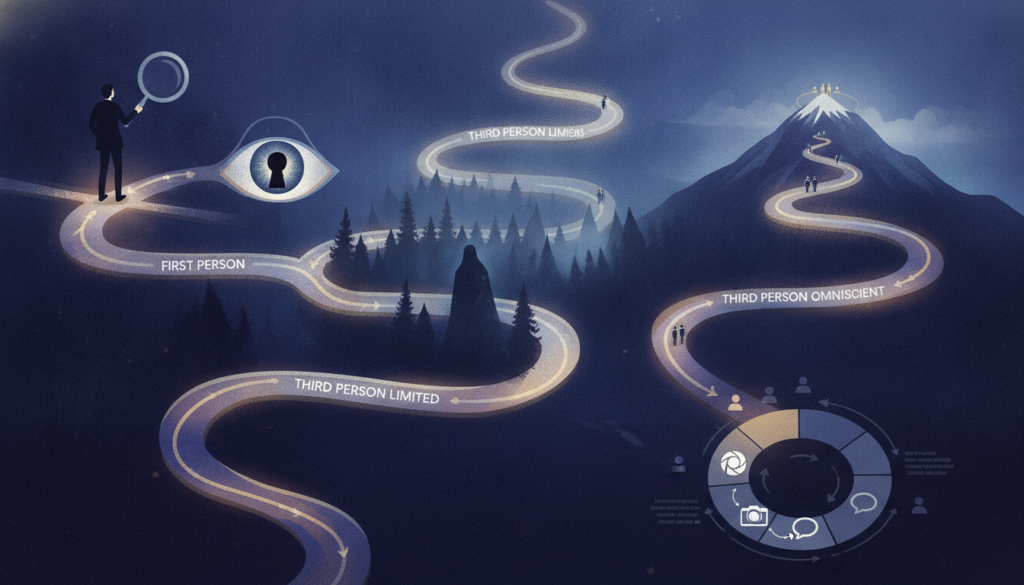
Choosing a narrative perspective is one of the first and most important decisions you make as a fiction writer. The point of view determines how close a reader feels to characters, what information is revealed, how trust is earned or withheld, and how much control you have over tension and surprise. This guide explains the common types of narrators, their strengths and limitations, and gives practical checklists and examples to help you decide which perspective fits your story.
What is narrative perspective (point of view) and why it matters

Narrative perspective—also called point of view (POV)—is the vantage point from which a story is told. It controls who sees events, whose thoughts we access, and the tone or voice of the narration. Writers choose POV to shape reader intimacy, manage information flow, and steer emotional distance. Practical craft guides commonly list first person, second person, third person limited, third person omniscient and third person objective as the main options .
First-person narrator
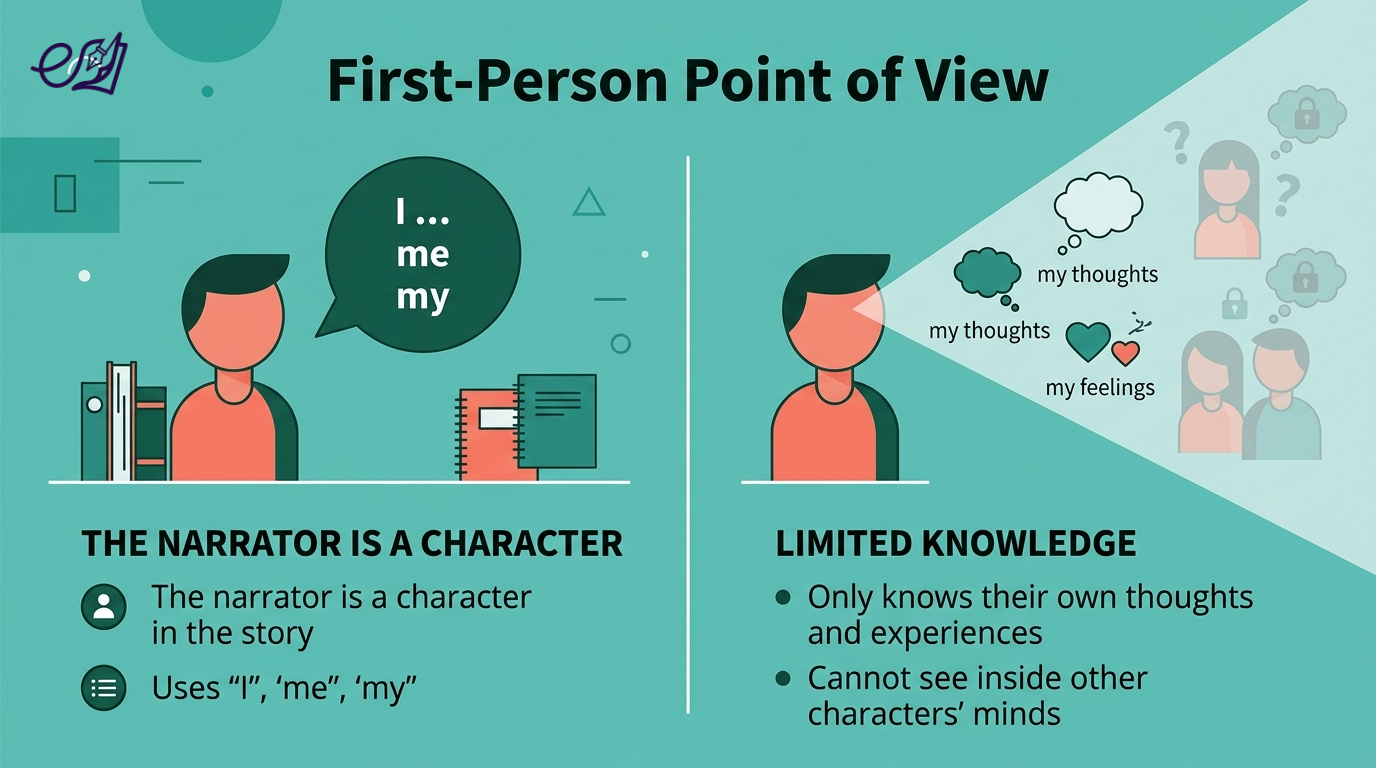
Definition: A character within the story tells events using “I” or “we”. The narrator is inside the action and filters everything through their perceptions and voice.
Key characteristics
-
Strong immediacy and intimacy.
-
Limited to what the narrator knows or observes.
-
Voice-heavy—personality and reliability matter.
Advantages
-
Deep emotional access and empathy with the narrator.
-
Easy to establish a distinctive voice and narrative urgency.
-
Good for unreliable narrators and confessional tones.
Limitations
-
Can only show events the narrator experiences; difficult to depict simultaneous action elsewhere.
-
Risk of filter words and over-reliance on telling rather than showing.
-
Requires a compelling narrator voice to sustain a whole novel.
Mini example
“I found the letter under the teacup, bent and damp. For a moment I thought it was less a message than a trap. After what happened last summer, traps fit the house.”
Works well for
-
Young adult, contemporary literary fiction, memoir-like novels, and tightly focused thrillers.
-
Stories that hinge on a single character’s experience or voice.
Third-person limited (personal)
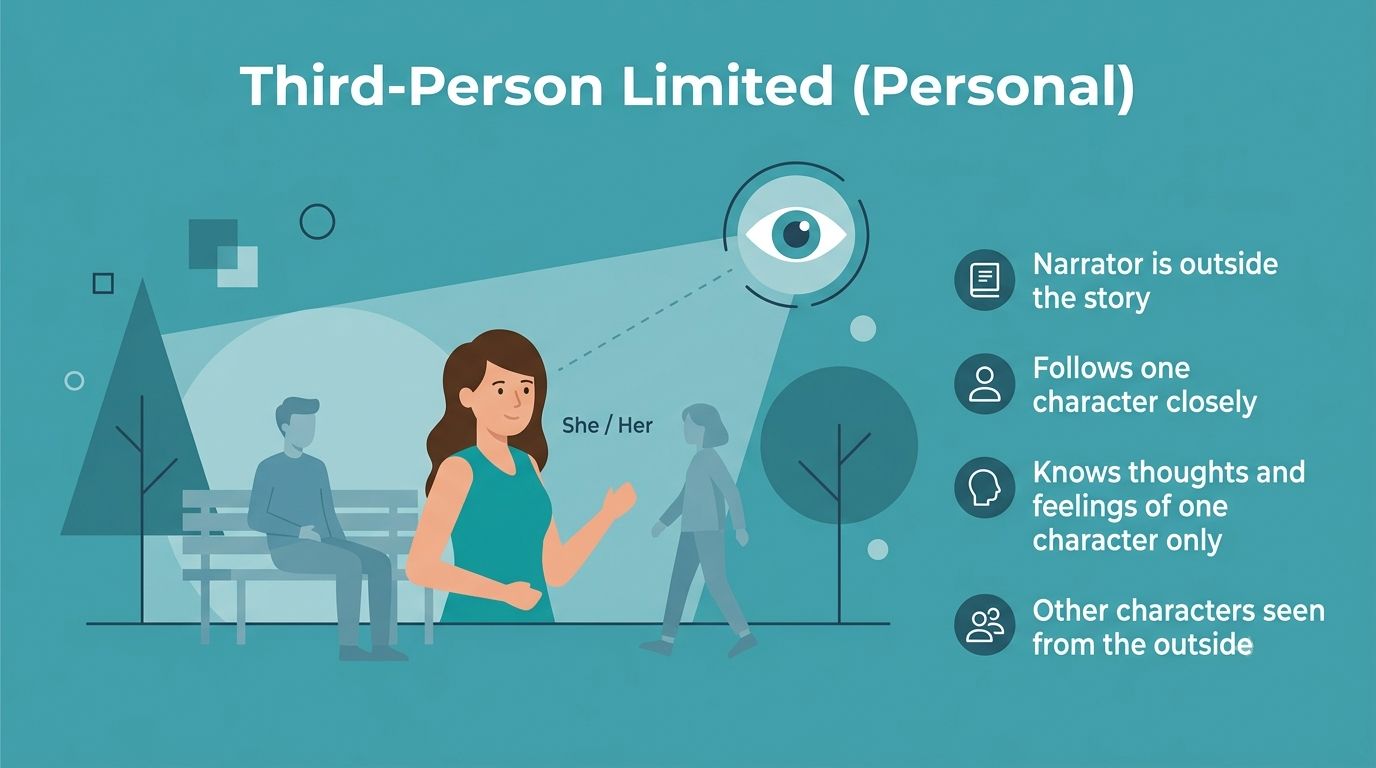
Definition: The narrator refers to characters as “he/she/they” but stays close to one character’s thoughts and perceptions per scene or chapter. Many craft sources call third-person limited the contemporary “workhorse” POV.
Key characteristics
-
Close but flexible: you can be intimate with a character while retaining an external narrator voice.
-
Limit of knowledge equals focal character’s knowledge in a scene.
Advantages
-
Balances intimacy with the ability to move between characters across chapters.
-
Easier to manage exposition and multiple plotlines than first person.
-
Often preferred in contemporary adult fiction and commercial genres.
Limitations
-
If you switch focal characters too quickly, readers may get confused (see head-hopping below).
-
Requires careful control of voice: too close and it feels like first person; too distant and you lose intimacy.
Mini example
“Elias rubbed the rim of his coffee mug and listened for the lift of a footstep. He told himself the noise was only the heating, but the thought of the letter made his back go cold.”
Works well for
-
Most contemporary literary fiction, mystery, romance and mainstream commercial novels.
-
Stories that need close character work but occasional shifts between viewpoints.
Third-person omniscient narrator

Definition: An external narrator with access to multiple characters’ thoughts and wider context—sometimes called a “godlike” view. Historically labelled zero focalization in narratology (Living Handbook of Narratology).
Key characteristics
-
Panoramic knowledge: events, private thoughts, and background can all be revealed.
-
Can shift between characters freely and comment from an outside perspective.
Advantages
-
Ideal for large-cast novels or sweeping epics where readers need a broad view.
-
Allows authorial commentary and irony if desired.
Limitations
-
Risk of emotional distance if not handled with care.
-
Can feel old-fashioned or intrusive if the narrator offers too much commentary.
Mini example
“No one in the village knew the full truth of the night. Some remembered the storm, others the flash of a lantern; only Mara kept the secret in a way that would change all their lives.”
Works well for
-
Epic fiction, historical novels, ensemble dramas, and novels that benefit from a wide-angle view.
-
Books that deliberately use an authorial voice or comic/ironic narration.
Third-person objective (camera-eye) narrator
Definition: The narrator reports only observable actions and dialogue—no direct access to inner thoughts or feelings. This external focalisation is sometimes called an external or objective narrator (Living Handbook of Narratology).
Key characteristics
-
Readers infer motivations from behaviour and dialogue rather than inner commentary.
-
Creates distance and an impression of impartiality.
Advantages
-
Excellent for suspense, drama and stories that benefit from reader interpretation.
-
Can produce a cinematic, reportage-like effect.
Limitations
-
Harder to convey inner emotion and character depth without skilful showing.
-
May feel cold or opaque if used across an entire novel without variation.
Mini example
“The neighbour left the gate open. She stood for a long moment watching the lane, then went inside and locked the kitchen cupboard. No sound came from the bedroom.”
Works well for
-
Crime fiction, cinematic thrillers, modernist or experimental fiction where ambiguity is a feature.
-
Short stories that rely on reader inference.
Multiple perspectives and mixed POV
Using multiple POVs lets you show different sides of events and create dramatic irony, but it requires clear structural rules. Writers often use a single focal character per chapter or label scenes with the character’s name to avoid confusion. Contemporary practice frequently uses alternating limited viewpoints rather than free omniscience to keep intimacy while moving the plot forward (Reedsy).
When multiple POVs help
-
Complex plots with parallel storylines or large casts.
-
Stories that rely on contrasting viewpoints to reveal truth or bias.
How to avoid confusion
-
Limit switches to chapter breaks or clear section breaks.
-
Use consistent labelling (chapter headings, character names) or distinctive voice for each POV.
-
Keep the number of viewpoints manageable—too many can dilute reader empathy.
How to choose the right narrative perspective: practical guidance
Make your choice by answering a few direct questions about your story. These prompts map story needs to POV options and are informed by craft guidance (Jane Friedman) and contemporary practice (Reedsy).
Questions to ask
-
Whose story is it? If one character’s inner life carries the book, consider first person or third-person limited.
-
What should the reader know and when? Use limited POVs to create surprises; omniscience to reveal the full picture.
-
How close should readers be emotionally? First person and close third deliver intimacy.
-
Is the narrator reliable? Unreliable narration often needs first person or a clearly framed voice.
-
Is the narrator inside or outside the action? Decide whether the teller is a witness, participant, or external observer.
Quick decision checklist
-
If the novel is essentially one character’s journey, start with first person or close third.
-
If you need to switch between several main characters, use third-person limited with one focal per chapter.
-
If the novel requires broad context or authorial commentary, consider omniscient carefully.
-
If you want a cinematic, show-don’t-tell feel, test a scene in third-person objective.
-
For commercial market fit, check genre preferences—romance often favours close intimacy, thrillers may prefer tight limited POVs; consult genre guidance and reader expectations (Reedsy).
Common POV mistakes and how to fix them
Knowing what to avoid speeds up revision. Head-hopping (shifting focalisation inside a scene) is the commonest beginner error and is covered in editing resources (editor blog). Other mistakes include revealing knowledge the narrator cannot have and inconsistent tense or voice.
Frequent errors and fixes
-
Head-hopping: Keep one focal perspective per scene. If you must change, use a clear break or new chapter.
-
Unknowable detail: Ask whether the narrator could realistically know, then remove or relocate the information.
-
Tense/voice drift: Read aloud sections and compare narrative voice line-by-line; use beta readers to flag drift.
-
Over-exposition in close POV: Stay inside the character’s sensory impressions; avoid info-dumping the way an omniscient narrator would.
Editing micro-exercises
-
Pick a scene and rewrite it in two different POVs (first person and third limited) to see which gives the right intimacy.
-
Highlight every sentence that reveals a character’s thought—ensure that thought belongs to the scene’s focal character.
-
Run a consistency pass with tools or a fresh reader to catch unintended switches; some AI tools now offer POV-consistency checks but they require human oversight (tool review).
POV and self-publishing production tips
Indie authors often use tools and editorial workflows to maintain POV consistency across drafts. Decide your POV before heavy drafting to reduce rewrites. If you use AI for scene drafts, give the tool a clear POV instruction and check for head-hopping or voice drift; recent tool reviews emphasize the need for human oversight (tool review).
After drafting, use beta readers and line editors to flag POV errors, and include a POV-check in your final proof pass. For publication and pricing help as an indie author, see Ebokio Publishing’s guide on how it works and pricing pages: How it works and Pricing. To explore features that help you publish with consistent formatting and production control, visit Features.
FAQ: Common questions about narrative perspective
Can I switch POV between chapters?
Yes. Switching POV between chapters is a safe, common method for multiple viewpoints—just be consistent about where and how you switch. Label chapters or keep one focal per chapter to avoid confusion. Many modern novels use this effectively (Reedsy).
How many POVs is too many?
There’s no fixed number, but too many viewpoints dilute reader investment. A practical rule: if a viewpoint doesn’t move plot or deepen theme, cut it. Manageable series often limit main POVs to three or four; shorter works should usually stick to one or two.
What about unreliable narrators—how do I use them without confusing readers?
Unreliable narrators work best when the limitations of their knowledge or biases are clear to the reader over time. Frame the unreliability through contrast—other characters’ actions, facts the reader can verify, or narrative hints. Computational research into classifying unreliable narrators is growing, revealing textual cues editors can look for (ACL/ArXiv 2025), but human judgement is still essential.
If you’d like more craft resources, see Ebokio Publishing’s guides for authors and our blog for writing tips: Guides and Blog. When you’re ready to publish, browse ebooks from other indie authors for reference at Ebokio ebooks.