Two authors upload their thrillers in the same week. Both covers look sharp. Both manuscripts went through three rounds of editing. Six months later, one book shows up everywhere a mystery reader might look, and the other has seventeen sales, twelve of them from family. The difference rarely sits in the writing. It sits in the metadata: the structured data that tells every store, search engine, and recommendation system what the book is and who wants it.
Metadata runs the commercial life of an ebook, and most self-publishers treat it as a form to rush through on upload day. This guide treats it as what it actually is: a sales system you build once and maintain for years. We will walk through each field, look at the numbers behind discoverability, and show how the process works on Ebokio Publishing, the UK platform where the metadata you write feeds a real, crawlable storefront, a natural-language discovery tool, and a royalty structure that pays up to 90% of net receipts.
What Ebook Metadata Actually Is
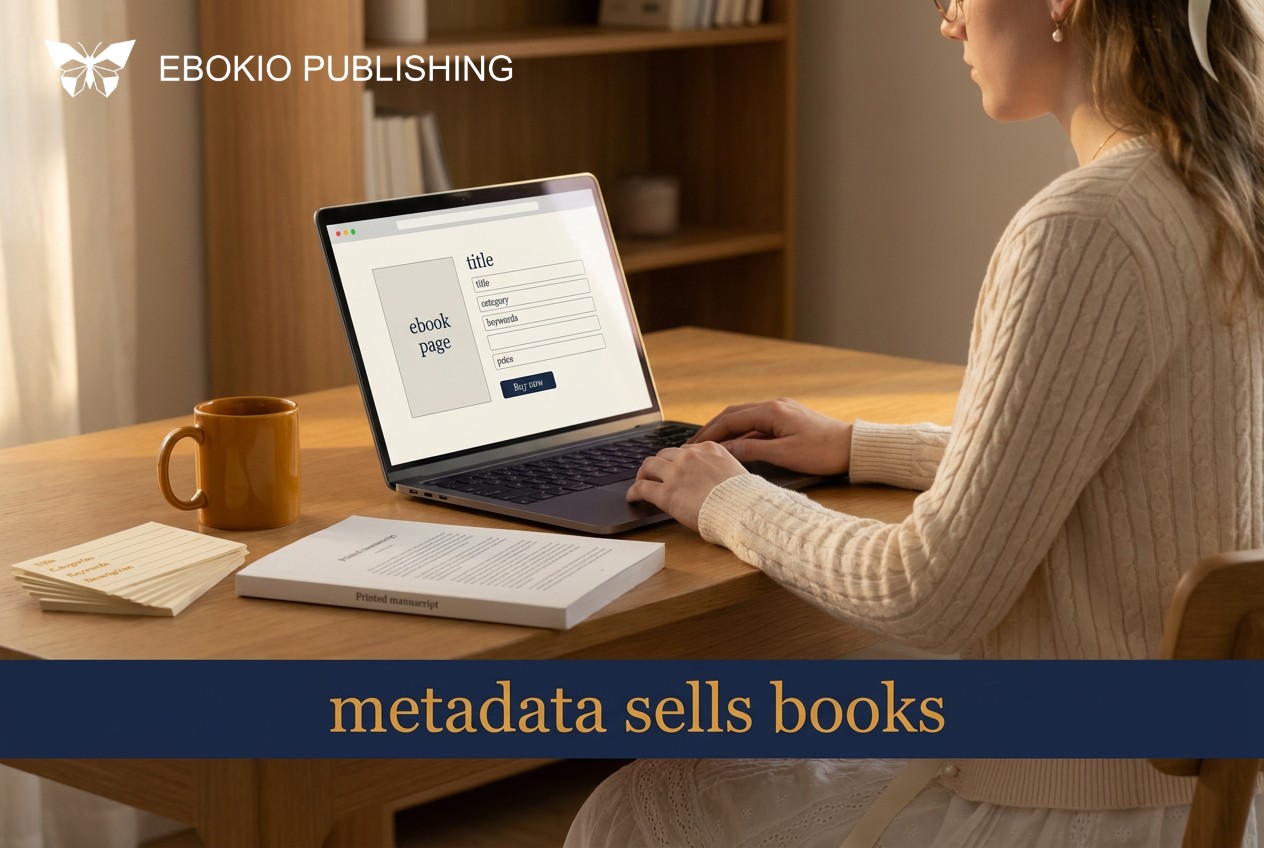
Metadata is every piece of structured information attached to your book that is not the manuscript itself. Title, subtitle, author name, book description, categories, keywords, price, publication date, ISBN, format, series position. Retailers read this data to decide where your book sits on the virtual shelf. Search engines read it to decide whether your product page deserves to rank. Libraries and distributors read it through standardized feeds built on codes like BISAC, the industry classification system maintained by the Book Industry Study Group.
Split it into two layers and the whole system becomes clearer. Visible metadata is everything the buyer can read: your title, your subtitle, your blurb, your author bio. This layer converts browsers into buyers. Invisible metadata works behind the curtain: category codes, keyword fields, technical identifiers. This layer decides whether browsers exist at all. A brilliant blurb that no reader ever loads converts zero percent of nothing. You need both layers working, and that is the specific failure mode of most uploads: authors polish the visible layer for weeks and spend ninety seconds on the invisible one.
The Numbers Behind Discoverability
Metadata work pays in measurable ways, and the evidence keeps stacking up. A study referenced by IngramSpark found that improved metadata can lift book sales by up to 9 percent, driven by sharper BISAC subjects, Thema codes, and keywords. That number matters more than it first appears, because it describes a lift with zero change to the book itself. No rewrite, no new cover, no ad spend. Just better data describing the same product.
The industry classification space your book competes in is enormous. BISAC contains roughly 4,900 subject categories, and publishers who treat it as a dropdown to skim are leaving most of that shelf space unexplored. Five years of indie-publishing data tracked by IBPA’s PubSpot shows the direction of travel: between 2020 and 2025, the share of books carrying three BISAC subjects rose 17 percent, and the share carrying two rose 9 percent. The market has quietly voted for richer metadata, because richer metadata routes more readers to the right title.
One more figure concentrates the point. Industry analysts who track self-publishing outcomes attribute the invisibility of most self-published titles to weak metadata rather than weak content. Readers cannot review, recommend, or re-buy a book they never found. Discovery is upstream of everything else you want from your book, and metadata is the tool that governs discovery.
The Six Fields That Do the Heavy Lifting
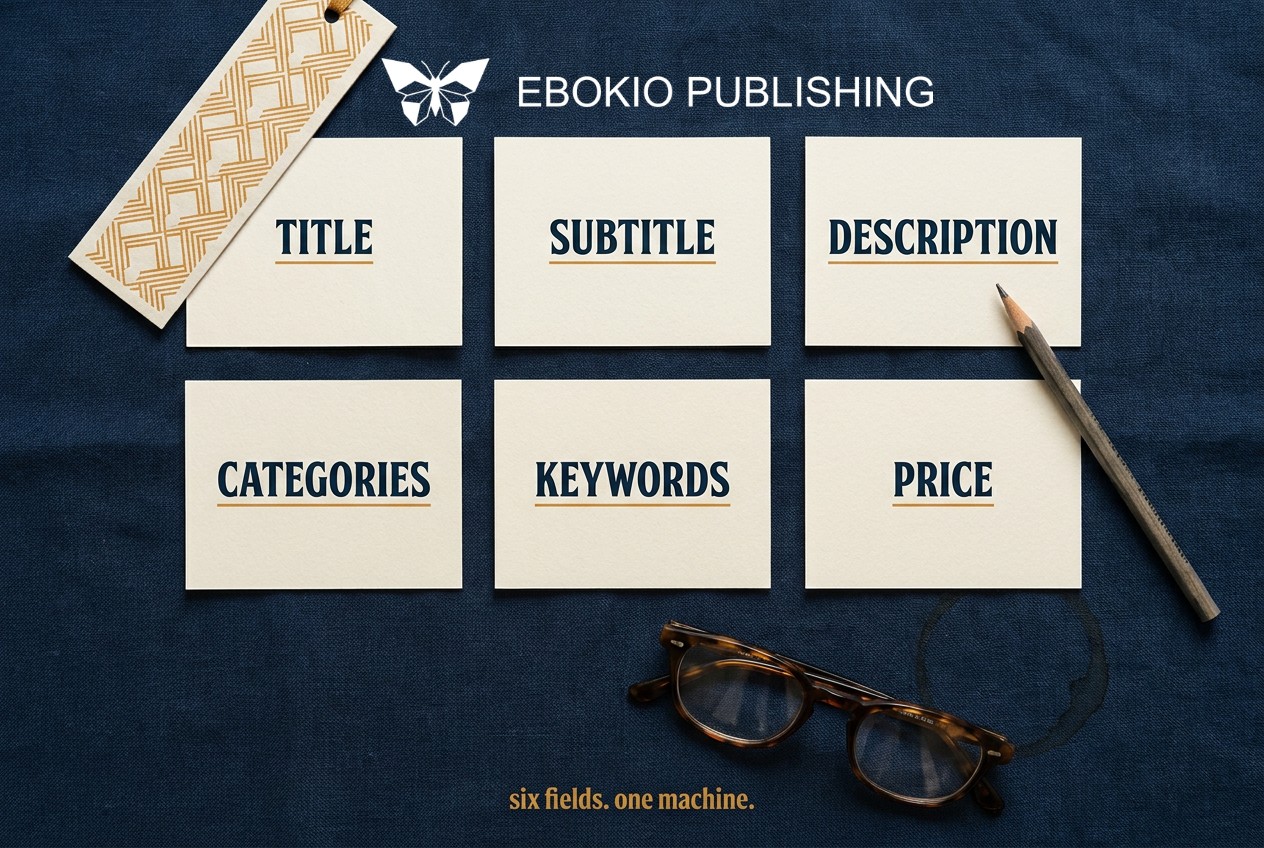
Not every metadata field carries equal weight. Work through these six in order of impact.
1. Title and subtitle
Your title is a metadata field with a marketing job, and your subtitle is pure search real estate. Amazon’s algorithm weights title and subtitle terms heavily, so a nonfiction subtitle that reads “A Field Guide to Difficult Conversations for New Managers” outperforms a poetic one every weekday. Keep the promise accurate: a subtitle that oversells train-and-return readers onto your book teaches every store algorithm to show it less.
2. The book description
The blurb does double duty. It converts the human skimming your page, and it feeds keyword-weighted text to every search system that indexes it. Write the first two lines for the shopper who reads nothing else, fold two or three natural keyword phrases into the body, and close with a direct nudge. Two-to-three-word phrases that pair genre with theme work best: “slow-burn romance,” “Mediterranean diet cookbook,” “cold-case procedural.”
3. Categories and BISAC codes
Categories decide which shelf your book stands on, and shelf placement determines who walks past it. The Book Industry Study Group recommends no more than three BISAC codes per title, ordered by importance, because some retailers only read the first one. Specific beats general: “Fiction / Mystery & Detective / Cozy” reaches buyers who already want exactly your book twice, while “Fiction / General” drops you into a room with millions of competitors and no signal. Never pair a General code with a specific one covering the same ground.
4. Keywords
Keyword fields reward phrases, not words. On Amazon KDP, authors get seven backend slots of up to 50 characters each, and long-tail phrases of three to five words outperform single terms: “cozy mystery series” carries buyer intent that “mystery” never will. Harvest real reader language from autocomplete suggestions, forums in your genre, and the review sections of comparable titles, then score each candidate for relevance, search volume, and competition before you commit a slot.
5. Series information and author data
Series name and volume number look administrative. They are not. Complete series metadata improves read-through, powers the “next in series” prompts retailers show buyers, and links your catalog into a single discoverable unit. Your contributor name must stay identical across every title and every platform, or each store treats your own books as the work of strangers.
6. Price and publication data
Price is metadata too. It feeds comparison filters, promotion eligibility, and the value signal your page sends in the half-second after it loads. Set it deliberately per channel, revisit it with each promotion, and keep your publication and on-sale dates accurate so new-release windows and pre-order mechanics fire correctly.
The Layer Most Authors Forget: Google and the Open Web
Every major ebook retailer keeps its search behavior inside its own store. Your book’s discoverability on Amazon is governed by Amazon’s index, and your metadata does its work behind that retailer’s wall. What many authors never exploit is the open web itself: a product page that Google can crawl, index, and rank pulls in readers who never opened a bookstore app.
This is where platform architecture turns into a sales channel. On Ebokio, every product page is a real, crawlable, indexable URL, and every author gets an equivalent author page. Link to them from your newsletter, your blog, or your socials, and readers land directly on your book with a free 10% sample and one-click checkout. Your metadata does not serve one retailer’s algorithm. It serves every search engine on the internet, and it compounds: each external link you drive to your page strengthens its ranking for the terms your metadata already targets.
Metadata in the Age of AI Discovery
Discovery has a new reader, and it reads fast. AI recommendation tools digest your blurb, categories, and content descriptions to match books against natural-language requests. Ebokio runs this directly through its AI Librarian: a reader types “a slow-burn romance set on a German island in winter” and the Librarian routes them to matching titles using metadata, blurb text, and content embeddings. The books that surface are the ones whose data speaks human.
The implication changes how you write metadata from this year forward. Phrases stitched together for keyword volume read thin to a semantic search system, while a fluent sentence that names setting, tone, trope, and pace gives an AI router everything it needs. “A bleak coastal mystery with a retired detective and no redemption arc” can match ten different reader requests. “Mystery thriller detective bestseller crime” matches none of them well. Write metadata the way a bookseller would describe your book to a customer, and both generations of search technology work for you at once.
Building Your Metadata on Ebokio Publishing, Step by Step
The mechanics matter less than the sequence. Here is how the pieces fit together when you publish through Ebokio Publishing.

Step one: upload. Drop in an EPUB or DOCX file. The platform detects your chapters, headings, footnotes, and table of contents, then rebuilds a clean reader-ready edition automatically. The upload stage takes about two minutes.
Step two: build the product page. This is metadata home. You pick the category, attach cover art, write the blurb, and set the price. Here the two platforms diverge in a way worth stating plainly. On Amazon KDP, you research and type seven keyword boxes by hand, browse category trees alone, and hope your taxonomy guesses hold. On Ebokio, AI metadata autofill reads your actual manuscript and drafts the metadata for you: Premium includes 80 autofills a month, Pro includes 100. The draft is a starting point you edit freely, not a black box you inherit. Manuscript-aware drafting removes the blank-field paralysis that produces most bad metadata, and your judgment still makes the final call.
Step three: human review. Every title gets checked by a person for formatting, metadata, and content rules before it goes live. Free-plan titles are typically reviewed in four to six working days; Premium and Pro titles clear within 24 hours. Compare that with purely automated pipelines where misclassified uploads sail through and sit on the wrong shelf for months before anyone notices.
Step four: measure and iterate. Live sales, reader behavior, and AI Librarian impressions all surface in the author dashboard, and pricing or promotion changes take a click. Because Ebokio is non-exclusive by design, you can run the same title on Amazon, Apple Books, or anywhere else in parallel and treat each channel’s metadata as its own experiment. Royalties run 70% of net receipts on Free, 80% on Premium, and 90% on Pro, paid monthly by bank transfer once you cross the £30 threshold.
Seven Metadata Mistakes That Quietly Kill Sales
· Choosing broad categories for comfort. “General” codes feel safe and reach no one. Specific shelves carry fewer competitors and hungrier buyers.
· Stuffing keyword fields. Repeated stems and loosely related phrases dilute relevance signals and can trigger retailer rejection.
· Naming competitors. Brand and author names in your keyword slots violate most retailer policies and poison your own positioning.
· Writing a blurb for people only. A description with zero searchable language forfeits both store search and AI routing.
· Setting it once and never looking. Category taxonomies update annually, and reader language shifts. Audit key titles at least once a year, especially backlist.
· Promising the wrong book. Metadata that oversells produces returns and one-star reviews, and the algorithms notice.
· Ignoring your own reviews. The phrases buyers use in five-star reviews are proven, high-converting keyword candidates written in native reader language. Mine them.
Frequently Asked Questions
What is ebook metadata in simple terms?
Ebook metadata is all the structured information about your book outside the manuscript: title, subtitle, author name, description, categories, keywords, price, and identifiers like ISBN. Retailers, search engines, and recommendation systems read this data to decide where your book appears and who sees it. It is the difference between a book that exists and a book that gets found.
How many categories should I choose for my book?
Follow Book Industry Study Group guidance: no more than three BISAC codes per title, ordered by importance. Some retailers only read your first code, so make your primary category the most specific accurate shelf available. Industry data shows titles carrying two or three codes have grown steadily since 2020, because richer classification routes more readers to the right book.
How often should I update my metadata?
Audit your metadata at least once a year, and immediately after any of three events: a genre taxonomy update, a sustained drop in impressions, or a wave of reviews that describes your book in language different from your keywords. Backlist titles benefit most, because reader vocabulary and category structures shift while old metadata stays frozen.
Should keywords appear in my book description too?
Yes, when they fit naturally. Two-to-three-word genre-plus-theme phrases like “slow-burn romance” or “coastal crime series” belong in your blurb, your subtitle where honest, and your dedicated keyword fields. Prioritize dedicated fields for high-value phrases you cannot work into prose, since most retailers limit keyword space.
Does Ebokio fill in my metadata automatically?
Ebokio Premium and Pro include AI metadata autofill that reads your manuscript and drafts categories, blurbs, and descriptive data for your product page: 80 uses a month on Premium, 100 on Pro. You review and edit every field before submission, and a human reviewer checks the final metadata before your book goes live. The free plan gives you full manual control of the same fields.
Can I publish on Ebokio and Amazon at the same time?
Yes. Ebokio takes a non-exclusive distribution license only, so selling there never blocks you from Amazon, Apple Books, Kobo, or your own site. You keep your rights, can pull a title at any time, and set pricing per channel. Many authors use the arrangement as a live experiment: different metadata per platform, same book, measurable results.
Sources
1. IngramSpark — Study Finds Improved Metadata Could Boost Sales by Up to 9%
2. IBPA PubSpot — What 5 Years of Data Shows: Trends in Book Discoverability for Indie Authors
3. Firebrand Technologies / Metadata Minute — Common Publisher Questions About BISAC Codes
4. Author Media — Why Your Book Isn’t Selling: Metadata with Dave Chesson
5. BookBee — Metadata for Indie Authors: The Invisible Engine Behind Your Sales
6. ISBNdb — Book Metadata: Examples, Standards & Sources for Book Data
7. Iwrity — Self-Publishing Metadata Guide: KDP, Categories & Keywords