Somewhere between “Once upon a time” and “Studies show,” most writing advice draws a hard line down the middle of literature and tells you to pick a side. Fiction on the left. Nonfiction on the right. Choose, commit, never cross.
That line was drawn by bookshops, not by writers. It exists so a store knows which shelf gets your book — not so you know which book to write. For a self-publishing author, the fiction-versus-nonfiction question is not a philosophy exam. It is a business decision about the promise you make to a reader, the audience already waiting for that promise, and the craft required to keep it.
This guide pulls the divide apart, looks at what the market data actually rewards, and maps both sides onto a practical self-publishing workflow — including how Ebokio Publishing, a UK self-publishing platform with a digital bookshop attached, treats the two sides differently under one roof.
Who Drew the Line, and Why It Still Exists
The fiction/nonfiction split is a logistics tool. Bookstores needed to know where to shelve a title, libraries needed cataloging rules, and publishers needed imprints with clear marketing lanes. The label answers a retailer’s question: where does this go?
It never answered the writer’s question: what am I actually making?
Plenty of celebrated books expose the weakness of the border. Truman Capote called In Cold Blood a “nonfiction novel.” Memoir survives on scene, dialogue, and pacing — the toolkit of the novel. Historical fiction carries bibliographies. Yet the label still matters, because for a self-publishing author it does its real work at two moments:
-
A reader types “cozy mystery” or “beginner’s guide to sourdough.” The label routes the search before your cover ever appears.The search moment.
-
Retailers, recommendation engines, and discovery tools sort your book by category and metadata before any human judges the writing.The classification moment.
What the Market Actually Rewards
Strip away the ideology and the divide becomes a set of numbers — and the numbers refuse to crown a winner.
Fiction is the current growth engine of the global trade. NielsenIQ’s international market tracking for 2025 found fiction driving revenue growth in 15 of the 19 territories analyzed, while nonfiction expanded in only seven. In the United States, the Association of American Publishers reported adult fiction revenue climbing 3.9% to $7.1 billion in 2025, with adult nonfiction growing just 1.6%. Circana BookScan data for the first half of 2026 shows adult fiction up 5.7% in unit sales while adult nonfiction fell 5.8%.
Nonfiction, though, is quietly changing format rather than dying. UK data from Nielsen BookData shows nonfiction print sales at their lowest level since 2014 — yet print fell below 75% of the segment’s total sales for the first time, with audiobook revenue nearly doubling over five years. The nonfiction reader has not vanished. The nonfiction reader put on headphones.
Self-publishing economics add a second layer. Reported genre-level data shows romance as the highest-earning self-published genre by median book income — roughly $31,725, about three times mystery and thriller — while business and practical nonfiction monetizes through higher prices ($9.99–$14.99 per ebook versus $2.99–$4.99 for genre fiction) and through what the book generates beyond its own sales: consulting, courses, speaking, authority.
Read those figures honestly and the conclusion flips the usual debate. Fiction buys you volume and binge-reading series economics. Nonfiction buys you margin and a book that works as a credential. Neither is “the right side.” They are two different machines, and you are choosing which machine you want to run.
The Books That Refuse the Label — and Why That Matters Now
The fastest-growing territory in publishing is the border itself. Narrative nonfiction borrows the novel’s scene-building. True crime structures investigation like a thriller. Autofiction and memoir blur the witness and the narrator. Historical novels arrive with source notes.
These hybrids survive only when the author understands what each side promises:
-
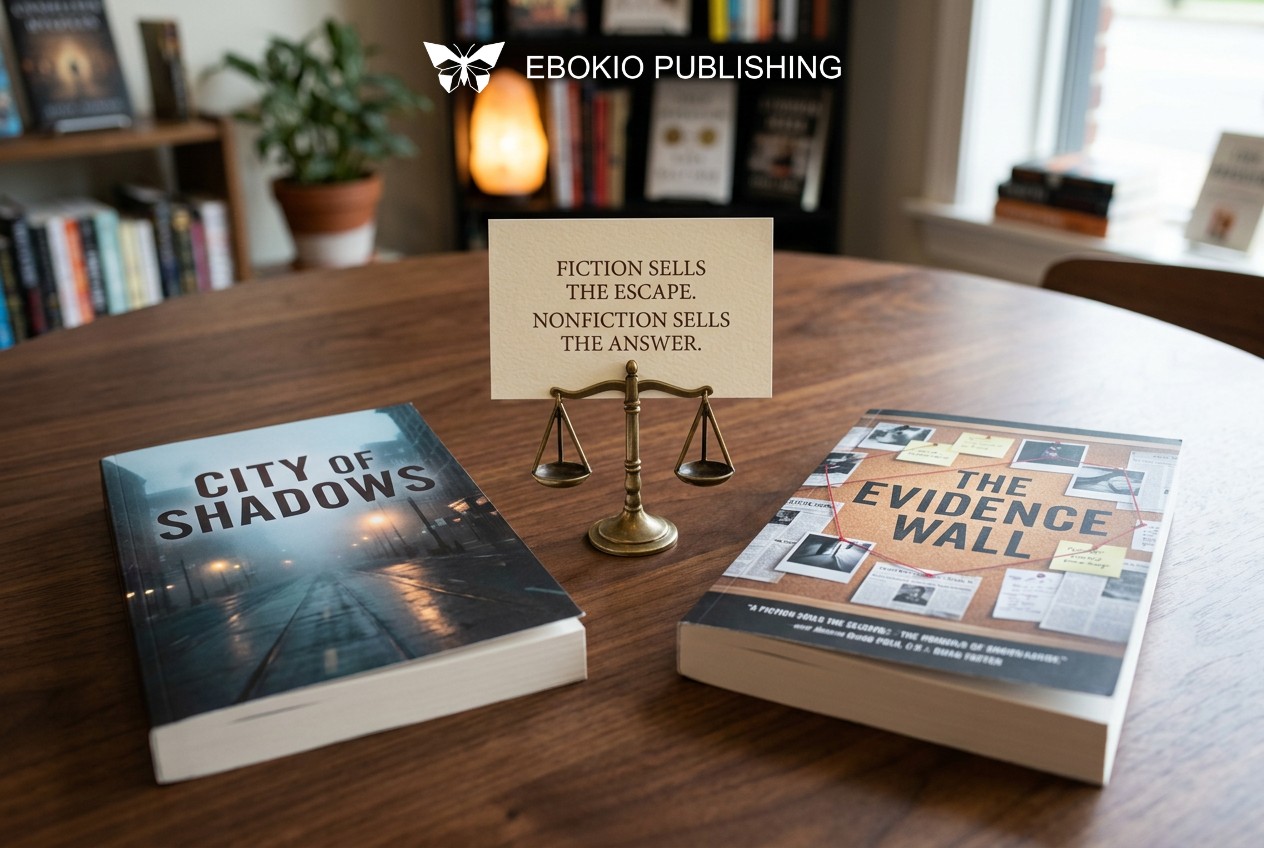
The reader buys immersion — tension, voice, a world that holds. Break immersion and the contract breaks.Fiction promises an experience.
-
The reader buys an outcome — a skill, an answer, a verified account. Overclaim and the contract breaks.Nonfiction promises a result or a truth.
-
The memoir that invents scenes it presents as fact, or the “true story” with manufactured dialogue, breaks two contracts in one failure.A hybrid promises both at once.
For self-publishers, this is not an academic distinction. The promise determines your blurb, your categories, your pricing, and the readers a discovery engine will route to your work. A book marketed as fiction but written as a lecture will be abandoned. A guide marketed as inspiration but thin on method will be refunded. The label on the shelf matters far less than the promise on the page.
What Each Side Demands From You as a Self-Publisher
Choosing a side means inheriting its workload. The honest comparison:
Dimension |
Fiction |
Nonfiction |
|
Reader promise |
Immersion and emotional payoff |
A result, a skill, or verified insight |
|
Sales pattern |
Slow build; series and backlist economics; binge readers |
Faster early traction; evergreen search demand; steady long tail |
|
Typical ebook pricing |
$2.99–$4.99 (genre market norm) |
$9.99–$14.99 (value-priced expertise) |
|
Craft risk |
Structure, pacing, character — a broken story cannot be footnoted |
Authority and accuracy — an unsupported claim erodes all trust |
|
Marketing engine |
Blurb, cover signal, series page, trope-based discovery |
Table of contents, problem keywords, author credibility |
|
Revenue beyond the book |
Sequels, box sets, read-aloud and audio adaptations |
Consulting, courses, speaking, professional positioning |
One Platform for Both Sides: How Ebokio Publishing Handles the Divide
Ebokio Publishing is a UK-based self-publishing platform for ebooks operated by Ebokio Ltd, registered in England and Wales. You upload a manuscript as EPUB or DOCX, a human reviewer checks formatting, metadata, and content rules, and the approved title goes on sale as a real product page inside the Ebokio digital bookshop at ebokio.com — where readers browse, buy, and read. You keep your rights, the listing is never exclusive, and you earn 70%, 80%, or 90% of net receipts depending on your plan (Free, Premium at £13.99/month, or Pro at £19.99/month), paid out in GBP on a monthly cycle.
What makes the platform relevant to the fiction-versus-nonfiction question is that its tooling maps onto the distinct demands of each side instead of treating every upload as the same product.
For the fiction author: a studio that thinks in story
The Writing Studio — included with every account, including the free tier — gives fiction writers a living story bible, a visual relationship map between characters, and outline templates built on acts and beat sheets. You plan the whole book, draft it in the same editor, and publish from the same place. On most retail platforms — Amazon KDP included — the “toolchain” is an upload form and a formatting checker; planning, structure, and continuity live in third-party apps you pay for separately. Ebokio moves that work inside the platform, so the story architecture and the storefront share one workspace.
Muse, the AI assistant inside the Studio (100 assists/month on Premium, 300 on Pro), drafts against your story bible rather than generic prompts — which is the difference between suggestion and continuity.
For the nonfiction author: metadata that sells the answer
Nonfiction lives or dies on classification, and this is where the label from Section 1 does its real work. Ebokio’s AI metadata drafting (80 fills/month on Premium, 100 on Pro) reads your manuscript and proposes categories, blurbs, and positioning — the exact surface where a nonfiction title wins or loses its reader. Compare that to writing category strategy by hand in a retailer’s upload wizard, guessing at browse paths designed for a catalog millions of titles deep. A curated bookstore with manuscript-aware metadata gives a specialist title a cleaner route to its niche than a slot in an unfiltered mega-catalog.
For the hybrid author: discovery that speaks human
Ebokio’s AI Librarian lets readers describe what they want in natural language — “a slow-burn romance set on a German island in winter,” or “a practical guide to freelance taxes in the UK” — and routes them to matching titles using your metadata, blurb, and content embeddings. Hybrids benefit most here: a memoir that reads like a thriller, or a history told as narrative, no longer depends on one rigid category checkbox. The reader describes an experience; the Librarian finds the promise. Conventional storefront search, built on keyword matching inside fixed genre trees, struggles with exactly these cross-shelf books.
Two structural policies matter to both sides. First, 0% exclusivity: where Amazon’s KDP Select locks an ebook to one storefront for ninety-day stretches in exchange for promotional tools, Ebokio never asks you to choose — you can sell the same title there, on Amazon, and on your own site simultaneously, keeping each channel’s pricing under your control. Second, every product page and author page is a real, indexable, crawlable URL with a free 10% sample and one-click checkout — link to it from your newsletter or social channels and readers land directly on your book, an advantage over app-shell catalogs whose pages exist only inside their own interface.
Explore Ebokio Publishing and start with the free tier →

A Five-Question Test for Choosing Your Side
If you still have not committed, answer these in order. Stop at the first question you cannot pass.
-
Does the book keep one promise? Write it in a single sentence. If the sentence contains “and also,” draft two books.
-
Who is already searching for it? Check category bestseller lists and search suggestions. A reader who cannot be named cannot be found.
-
Which economics fit your goal — volume or margin? Fiction builds a backlist that sells in waves; nonfiction sells at higher prices to smaller, urgent audiences.
-
Can you carry the craft risk? A novel demands structure; a guide demands authority. Write toward the risk you can survive.
-
Does your platform serve both? The answer matters if your next book crosses the border. On Ebokio Publishing, a fiction backlist and a nonfiction title share one dashboard, one reader base, and one payout line.
FAQ: Fiction, Nonfiction, and Self-Publishing
Q: Which sells better for self-published authors — fiction or nonfiction?
A: It depends on the model. Gere fiction (romance, thriller, fantasy) leads on volume, with romance the highest-earning self-published genre by median book income. Nonfiction sells at two to three times the price per copy and often earns more through the opportunities the book creates — consulting, courses, authority — than through unit sales alone.
Q: Can I publish both fiction and nonfiction under one name?
A: Technically, yes. Strategically, ask whether the audiences overlap. A thriller writer publishing a guide to plot structure can serve both readers with one name and one author page. A romance writer publishing tax advice should consider a pen name — not for secrecy, but to keep discovery signals clean.
Q: Do bookstores treat narrative nonfiction or memoir as fiction?
A: No. Retail categories place memoir, true crime, and narrative history on the nonfiction shelf even when the prose uses novelistic technique. The classification follows the truth claim, not the style. This is why your categories, blurb, and metadata must state the promise clearly.
Q: Does Ebokio Publishing accept both fiction and nonfiction?
A: Yes. The bookstore carries fiction and literature, mystery, suspense, romance, poetry, and non-fiction categories, and the same four-step process applies to both: upload, design your product page, pass human review, and go live — with review completed within 24 hours on Premium and Pro plans.
Q: Do I keep my rights when I self-publish on Ebokio?
A: You do. Ebokio takes only a non-exclusive distribution license to sell and deliver your book. You can remove a title at any time and sell it anywhere else in parallel — there is no exclusivity requirement on any plan.
Sources
-
Publishers Weekly — Publishing Sales Hit $32.5 Billion in 2025 (AAP year-end report)
-
Publishers Weekly — Print Book Sales Flat in First Half of 2026 (Circana BookScan)
-
Nielsen BookData 2025 analysis — UK fiction growth, nonfiction digital shift (via Chytomo)
-
Authors Publishing House — How Much Do Self-Published Authors Make in 2026?