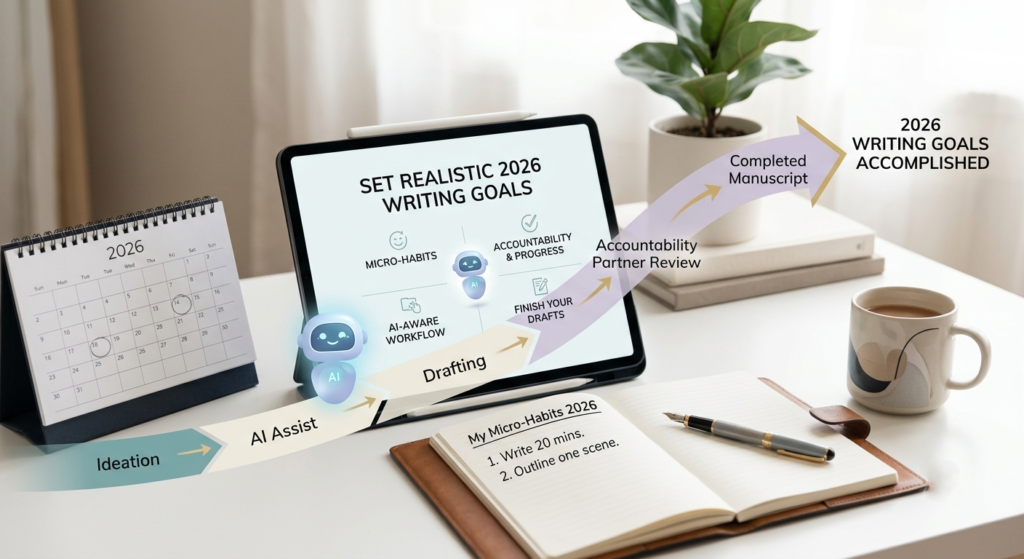
Setting realistic writing goals for 2026 means balancing ambition with daily habit, clear milestones and the smart use of tools — including AI. This guide gives practical templates, troubleshooting tips and ethical checks so your targets are achievable and future‑proof.
Start with a reliable baseline
Before setting targets, audit recent months. Log your average words per hour, realistic daily minutes, and common distractions. Use that baseline to create targets you can actually hit: small wins beat dramatic but unsustainable leaps.
How to measure your baseline
-
Track three weeks of writing sessions (time, words, context).
-
Calculate median words/hour and median minutes/session.
-
Set a conservative starting goal at 70–80% of that median.
Prefer micro‑goals and consistency over marathon bursts
Research and writing‑centre guidance consistently show that short, regular sessions (15–30 minutes or one page/day) produce more output long‑term than sporadic binges. See the PLOS rules for productivity for the evidence behind micro‑habits (PLOS).
Sample micro‑goal templates
-
Working parent: 15 minutes morning, 300 words evening, 4× week.
-
Busy professional: 30 minutes lunch sprint, 500 words/session, 5× week.
-
Full‑time writer: two 90‑minute deep sessions, 1,500–2,000 words/day.
Build an AI‑aware workflow (use, but don’t rely on, AI)
Generative AI can speed ideation and drafting but requires oversight to protect voice and originality. Recent studies document distinct co‑writing stages where AI helps most: ideation, outlining and summarising — while human authorship remains crucial for final drafting and voice (Co‑Writing with AI).
Practical blended plan (6–12 week cycle)
-
Weeks 1–2: Use AI to generate 5 premise variants and three scene outlines.
-
Weeks 3–8: Draft 10–20k words unaided, using 30–60 minute daily micro‑sessions.
-
Weeks 9–10: Use AI for scene summarisation and revision suggestions; edit manually for voice.
-
Week 11: Run originality checks and prepare disclosure notes if needed.
Accountability, community and replacements for NaNoWriMo
Since centralised organisers changed in 2025, writers now find accountability through local groups, online sprints and community‑led events. If you miss NaNoWriMo’s structure, run a micro‑NaNo: set a 30‑day 25k target, schedule daily sprints, and recruit 3 accountability partners.
Ethical checklist for AI‑assisted goals
-
Note where AI contributed (ideas, outlines, phrasing).
-
Run originality checks and edit for voice and factual accuracy.
-
Follow publisher or platform disclosure requirements where applicable.
-
Keep a log of AI prompts and edits for transparency and revision history.
Scaling and auditing progress
Audit monthly: compare planned vs actual words/time, then increase targets by a fixed percentage (e.g., 5–10% per month) if you consistently meet goals. Use submission milestones (complete draft, first revision, beta reads, submission) rather than a single completion date to stay motivated.
FAQ — common 2026 questions
How many words per day should I aim for?
There’s no universal answer. Start from your baseline: if you average 300 words in 30 minutes, aim for 210–240 words/day (70–80%) to build consistency, then ramp up.
Should I use time‑based or word‑count goals?
Use both. Time goals (minutes/session) are flexible and reduce pressure; word goals give measurable output. Pair them: 30 minutes = target 300–500 words depending on your baseline.
Are month‑long challenges still useful in 2026?
Yes — but locally run sprints and community challenges now replace single global organisers. They deliver accountability and momentum if you design manageable targets and schedule daily sprints.
Conclusion
Realistic 2026 writing goals combine a measured baseline, micro‑habits, accountable milestones and cautious use of AI. Audit, iterate and scale slowly — and explore ebooks and reading tools on Ebokio to support research, inspiration and editing workflows via our ebooks, the Ebokio reader and membership options like Ebokio Plus.