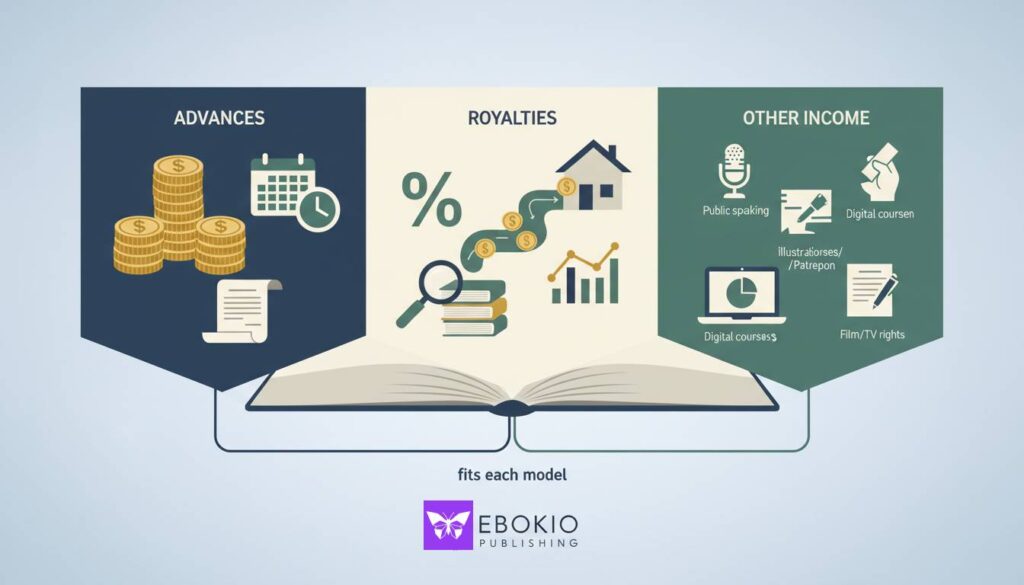
Authors earn from a mix of advances, royalties and ancillary income. Which stream matters most depends on your route: traditional deals rely on advances and print royalties, while self‑publishing shifts the emphasis to per‑unit revenue, direct sales and diversified income. This guide gives clear, useable examples and shows how Ebokio Publishing supports each path.
What an advance is — and how it affects earnings
An advance is an upfront payment from a publisher against future royalties. The author keeps the advance but does not receive further royalty payments until the advance has “earned out” — that is, until accumulated royalties equal the advance amount. Advances vary widely.
Typical ranges (trade publishing):
- First novels and mid‑list authors: commonly a few thousand pounds.
- Established authors or competitive bids: tens of thousands or higher, depending on the deal and rights sold. (Industry guides show trade print royalties commonly 7–15% and advances remain a feature of traditional deals.) Source: Publishers Weekly
Practical point: an advance smooths income early on but is unpredictable. Self‑publishing removes advances but gives you immediate control of pricing, promotion and a larger share of each sale.
Royalties: the mechanics and a worked example
“Royalty” loosely means the money an author receives per sale. Different terms appear in contracts: gross receipts, net receipts and list price. Net receipts are the sale price minus VAT and payment processing fees; Ebokio reports royalties as a percentage of net receipts to the author.
Platforms and publishers treat royalty shares differently. Compare three common models with worked examples for a UK eBook sold for £4.99 (example fee assumptions align to how platforms present net receipts):
-
Ebokio Publishing (direct store):
- Net receipts = sale price minus reader VAT and payment fee (itemised on the sale).
- Royalty rates: Free plan 70% of net receipts; Premium £13.99/mo = 80%; Pro £19.99/mo = 90%. Source: Ebokio Publishing
- Worked example (assume VAT + payment fee reduce £4.99 to net receipts £4.20):
- Free plan (70%): author gets £2.94.
- Premium (80%): author gets £3.36, cost £13.99/month.
- Pro (90%): author gets £3.78, cost £19.99/month.
-
Amazon KDP (example headline):
- KDP offers up to 70% for eligible eBooks but with restrictions on price and territory; fees and delivery charges can apply. Source: Amazon KDP
- Worked example (if KDP pays 70% of a comparable net figure of £4.20): author receives £2.94 — similar to Ebokio Free in this simplified comparison, but KDP rules on eligibility and distribution differ.
-
Aggregator / distributor model (typical):
- Aggregators like Draft2Digital or others take a distribution/commission cut after retailer fees, leaving the author a smaller share than a direct store. Aggregator pages explain their net vs list calculations. Source: Draft2Digital
- Worked example: if aggregator and retailer cuts reduce net receipts to £3.80 and aggregator takes a 20% commission, author receives £3.04 — lower than Ebokio Pro example.
Two conclusions from the numbers above: 1) headline royalty shares matter only after VAT and payment fees are removed; 2) on a direct store model like Ebokio you keep more of the net sale price, particularly on Premium/Pro plans where you can reach 80–90% of net receipts. Ebokio details
Tip: run the same worked example for your target price and expected VAT rate. Small changes in VAT or payment fees alter what you receive per sale; higher per‑unit revenue compounds across volume.
Other income streams authors should develop
Unit sales make up a large slice of many authors’ income, but diversification matters. Here are common additional streams with practical notes.
- Audiobooks: growing fast — audiobooks were around 10% of the UK consumer market in 2025. Producing audio can create a new revenue stream, either via audio aggregators or direct sales. Source: Publishers Association
- Subscriptions and library lending: read‑per‑page and subscription pools pay differently from unit sales. Include these estimates in your annual income forecast rather than treating them as equivalent to an ebook sale.
- Direct sales and mailing lists: selling through your own pages or direct storefronts gives the highest take per sale and retains customer data. Ebokio positions itself as a direct‑to‑reader store and author dashboard that helps with discovery and reporting. Ebokio features
- Licensing, translations and rights sales: these can be lump sums or royalty arrangements and are a potential high‑value source if your work attracts foreign or other media interest.
- Ancillary services: speaking, courses and Patreon/Subscriptions add recurring revenue outside the book ecosystem.
How Ebokio Publishing supports income generation
Publishing.ebokio.com is a direct author storefront and publishing platform created for authors who want a high share of net receipts and control over rights. Key practical features:
- Royalties: Free plan 70%, Premium £13.99/mo 80%, Pro £19.99/mo 90% of net receipts. Source: Ebokio pricing
- Non‑exclusive: you always retain rights and can sell the same book elsewhere. Source: Ebokio Publishing
- Payouts: monthly earnings paid by bank transfer at the end of the month two months after the sales month; minimum £30, smaller balances roll forward. Itemised bank charges are shown. Source: Ebokio Publishing
- Format support: upload EPUB or DOCX; the built‑in Studio editor exports a clean EPUB. ISBNs are optional; Ebokio does not issue ISBNs. Source: Ebokio features
- Review SLA: a real person reviews every book — Free plan around 4–6 working days, Premium/Pro under 24 hours. Source: Ebokio Publishing
- AI tools (optional): AI Cover Studio, metadata autofill and an AI Author Co‑pilot; manuscripts are never used to train AI models. Source: Ebokio features
Because Ebokio is non‑exclusive and offers an integrated toolset, authors can run production, cover design and sales from a single dashboard without surrendering rights or dealing with separate vendors.
Practical steps to maximise earnings on Ebokio
- Decide your plan based on volume. If you expect steady sales, calculate when the monthly fee is offset by the higher royalty share (e.g., moving from 70% to 90% increases per‑sale income by ~28% on the worked example above).
- Price strategically. Test two prices over time and track conversion in the Ebokio dashboard; small price changes can materially affect revenue.
- Use the AI metadata autofill and Cover Studio on Premium/Pro to reduce time to market and improve discoverability.
- Capture reader emails from purchase confirmations where permitted so you can drive repeat sales and crowd promotions outside marketplace algorithms.
- Monitor payout statements monthly. Ebokio itemises fees and bank charges; reconcile with your records and plan for the two‑month payout lag and £30 minimum. Learn how payouts work
Note: platforms differ on the definition of “net receipts”. Ebokio shows the VAT and payment fee deductions clearly on each sale, which simplifies accounting and tax reporting.
Tax and administrative steps for UK authors
HMRC treats literary income as taxable. Keep records of advances, royalty statements and direct sales. If your annual income requires it, register as self‑employed and submit Self Assessment.
- Report literary income on your tax return and keep invoices/statements for at least six years; HMRC guidance explains how royalties are treated. Source: GOV.UK / HMRC
- Collective societies such as ALCS distribute certain types of secondary royalties; register if relevant.
Practical accounting: export monthly statements from Ebokio, include the two‑month payout timing in cashflow forecasts and treat platform fees and bank charges as deductible business expenses where applicable.
Comparing Ebokio to other routes at a glance
- Traditional publisher: potential advance + distribution, but lower per‑unit royalties and less control over rights and pricing. Advances are unpredictable but can be large; print royalties typically 7–15%. Source: Publishers Weekly
- Amazon KDP: high reach and algorithmic discovery, up to 70% on eligible sales but with platform rules and distribution implications. Source: Amazon KDP
- Ebokio: direct store, high royalty shares (70–90% of net receipts depending on plan), non‑exclusive rights, integrated AI tools, and transparent payouts — a strong option for authors prioritising control and per‑unit revenue. Ebokio pricing
Frequently asked questions
How much will I get paid per sale on Ebokio?
Payment per sale depends on your plan and the book’s net receipts (sale price minus reader VAT and payment fee). Ebokio pays 70% on the Free plan, 80% on Premium (£13.99/mo) and 90% on Pro (£19.99/mo). Use your net receipt (itemised on each sale) and multiply by your plan percentage to calculate exact income. Ebokio pricing
When and how does Ebokio pay out earnings?
Earnings are paid by bank transfer at the end of the month two months after the sales month. There is a £30 minimum payout; balances under £30 roll forward until the threshold is met. Ebokio itemises bank charges on your statement. Source: Ebokio Publishing
Do I have to be exclusive to use Ebokio?
No. Ebokio is non‑exclusive — you retain all rights and can sell your book elsewhere while using Ebokio as a storefront. This lets you combine direct sales with distribution channels or other marketplaces. Source: Ebokio Publishing
How should I report book income to HMRC?
Report literary income on your Self Assessment. Keep records of advances, royalty statements and direct sales. HMRC guidance explains literary profits and the treatment of royalties; register as self‑employed if required and retain supporting documentation for tax purposes. HMRC guidance
What formats and production options does Ebokio accept?
Ebokio accepts EPUB or DOCX uploads and includes a Studio editor that exports a clean EPUB. ISBNs are optional and Ebokio does not issue ISBNs. Every book receives a human review before publication; Premium and Pro get under‑24‑hour review SLA. Ebokio features