Choosing where to publish is one of the biggest decisions an independent author makes. This guide compares Kindle Direct Publishing (KDP) and Ebokio Publishing across royalties, distribution reach, discovery, author control, formats, payouts and speed-to-market so you can weigh net income against audience access and long-term control.
Headline royalties and the net-per-sale trade-off
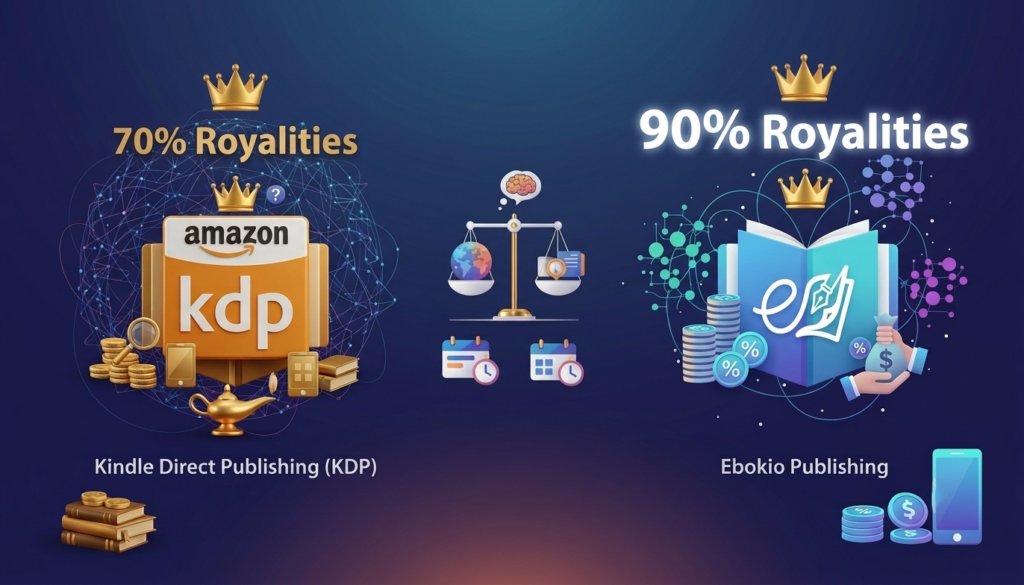
Royalties are often the deciding factor. KDP has two headline ebook royalty rates: 70% (when price and marketplace conditions are met) or 35% otherwise; print royalties depend on list price minus printing cost and marketplace rules (KDP earnings). Ebokio’s pricing tiers offer higher headline shares for direct-store sales: Free plan 70%, Premium £13.99/mo 80%, Pro £19.99/mo 90% (platform pages show tiered royalties) (Ebokio Publishing).
Practical example: a £4.99 ebook sold on Amazon at 70% gives an author ~£3.49 before VAT and currency effects; on Ebokio at 90% the author keeps ~£4.49. The difference grows with each sale, but Ebokio’s higher split applies primarily to sales made through its own storefront, while KDP’s reach across Amazon marketplaces often brings higher volume. For print, KDP’s royalty equals royalty rate × (list price − printing cost), making pricing and print cost management important for margins (KDP print royalties).
Ebokio vs Amazon KDP, line by line
|
Feature |
Ebokio |
Amazon KDP |
|---|---|---|
|
Top royalty rate |
Up to 90% (Pro) ✓ |
70% (within list-price band) |
|
Delivery / file fee |
None ✓ |
Per-megabyte delivery fee on the 70% tier |
|
Exclusivity |
Never — always non-exclusive ✓ |
Non-exclusive, unless you enrol in KDP Select |
|
Payout currency |
Your bank’s own currency |
Multiple currencies |
|
Manuscript review |
Human review (under 24h on Premium) ✓ |
Mostly automated |
|
Built-in AI tools |
AI cover studio, metadata, co-pilot ✓ |
None built in |
|
Marketplace reach |
Curated UK-based bookstore |
Global Amazon marketplace |
|
Print / paperback |
Ebook-first (print on roadmap) |
Paperback & hardcover print-on-demand |
|
ISBN |
Optional — bring your own; never required |
Free Amazon ISBN, or bring your own |
Distribution reach and exclusivity
KDP’s biggest advantage is Amazon’s global storefronts and integrated Kindle ecosystem, including optional enrolment in KDP Select (Kindle Unlimited), which requires digital exclusivity for the ebook in exchange for potential KU earnings. KU pays from a monthly Global Fund based on Kindle Edition Normalized Pages (KENP); KENPC v3.0 governs measurement as of mid‑2026 and the June 2026 Select Global Fund was $67.0 million (KDP Select and KENPC).
Ebokio is a direct-to-reader bookstore with crawlable product pages and first‑party discovery features; it emphasises making each title discoverable on its own real product page and uses its own AI-driven discovery tools. That means authors get a higher net per sale when readers buy directly, plus SEO-indexable listings that can appear in web search results (Ebokio Publishing, Ebokio store).
When to choose reach vs. higher per‑sale income
-
Choose KDP for maximum exposure, global Amazon storefront presence, and customers who already shop Kindle and Amazon devices.
-
Choose Ebokio for higher net-per-sale on direct purchases, crawlable product pages that support web discovery, and tighter control of store presentation.
Discoverability and reader features
Amazon’s discovery is powered by its massive sales and engagement signals: category placement, algorithms, Kindle Store features and the buy box dynamics. KDP titles live inside Amazon’s ecosystem, which can surface books to readers at scale.
Ebokio pitches a different discovery model: AI librarians, indexing that helps titles show up in web searches, and reader-facing features such as text-to-speech and AI-driven “Ask This Book” or chapter summaries that improve reader engagement and perceived value. For authors looking to build direct relationships and use site-level SEO, Ebokio’s indexable product pages and first-party discovery are strong advantages (Ebokio features).
Speed to market and file formats
Time-to-live matters when you want to launch quickly. Ebokio advertises rapid upload-to-live times (average claims of around five minutes from manuscript upload to live product) and supports EPUB and DOCX uploads with automatic formatting and a downloadable buyer file (Ebokio Publishing).
KDP typically processes new ebooks within 24–72 hours, although times vary by file complexity, review queues and whether the book is submitted for enrolment in KDP Select. KDP supports EPUB and MOBI-derived workflows and offers print-on-demand for paperback and hardcover via its Print service.
Rights, exclusivity and ISBNs
Rights language and exclusivity are crucial. KDP requires exclusivity for KDP Select (digital exclusivity for the enrolled ebook), but otherwise publishing on KDP does not transfer ownership of your rights. Ebokio states it takes a non-exclusive distribution licence and does not demand exclusivity, letting authors sell elsewhere while benefiting from Ebokio’s features (How it works).
ISBNs are another area of confusion. If you accept a free ISBN from a platform, check the platform’s terms — some free ISBN offerings limit which store listings you can control. Authors who want full portability often buy their own ISBNs so metadata and imprint control remain entirely theirs (see independent ISBN guidance as context).
Payouts, VAT and tax handling
Payment cadence and thresholds differ. KDP pays monthly, with marketplace-specific thresholds and payment methods (bank deposit, wire, etc.). Kindle Unlimited reporting is finalised close to the middle of the following month for page-read royalties (KDP reporting).
Ebokio pays monthly to bank accounts and shows payout thresholds (examples: bank minimums around £30 and higher limits for other methods); the platform handles VAT remittance for applicable sales and lists supported payment methods (cards, Apple Pay, SEPA) on its site (Ebokio Publishing).
Platform tools, analytics and author control
KDP offers sales dashboards, report exports and promotions such as price changes and limited-time discounts. KDP Select gives access to Kindle Unlimited and promotional programmes within Amazon.
Ebokio markets additional AI and discoverability tools, auto-formatting, direct-store analytics and enhanced product pages. The platform emphasises author control over the storefront presentation and metadata, and claims discovery lifts for AI-indexed titles. For authors who prioritise first-party analytics and marketing control, Ebokio can be compelling (Ebokio guides).
Which is best for your goals? A short decision guide
-
If your priority is maximum reader reach and print-on-demand access to Amazon’s vast customer base, KDP is the default choice.
-
If your priority is maximising net income per direct sale, owning the customer relationship, and benefiting from SEO-indexed product pages and AI discovery, Ebokio is worth testing—especially if you can drive initial traffic to your store.
-
Many authors adopt a hybrid approach: use KDP for Amazon reach and print, and also sell through Ebokio to capture higher-margin direct sales and to experiment with reader-facing features.
Practical tips for publishing on both platforms
-
Use distinct ISBN strategies: buy your own ISBNs if you want complete control over metadata and retailer listings.
-
Optimise metadata for each platform (Amazon keyword fields vs site-level SEO on Ebokio). Ebokio’s crawlable pages reward search optimisation; Amazon’s internal algorithms reward conversion and engagement.
-
Track per-sale net income by platform and tally promotional costs—higher royalty rates only matter if you can reach buyers.
-
Consider KDP Select only if KU’s per-page economics are clearly beneficial for your title type; monitor KENPC and monthly fund size to estimate potential earnings (KDP Select).
FAQ
Which platform pays more: Amazon KDP or Ebokio?
It depends on channel and plan. For direct-store ebook sales, Ebokio’s tiers (up to 90% on Pro) usually give authors a higher net per sale than KDP’s standard ebook rates (70% or 35%) (Ebokio Publishing, KDP earnings). However, KDP can deliver much larger sales volume because of Amazon’s reach; the right choice depends on whether you prioritise per-sale revenue or audience scale.
Do I lose rights when I publish on either platform?
No. Publishing on KDP or Ebokio does not transfer copyright. KDP Select requires temporary ebook exclusivity while enrolled; Ebokio takes a non-exclusive distribution licence so you can list elsewhere (Ebokio how it works, KDP Select).
How quickly will my ebook go live?
Ebokio advertises very fast publish times (platform claims average upload-to-live measured in minutes) and supports EPUB/DOCX auto-formatting (Ebokio Publishing). KDP often takes 24–72 hours for new listings, longer if reviews or formatting issues occur.