How to Build an Author Network That Sells Books
Most books do not fail on the page. They fail in the silence that follows publication — the week a title goes live and nothing moves, because nobody was waiting for it.
Selfpublishing removed the gatekeeper. It did not remove the need for other people. The acquisitions editor who once championed a manuscript has been replaced by a scattered crowd: readers who message a friend, an author who mentions you to their mailing list, a librarian who builds a display, a podcaster short of a guest for Thursday. Nobody assembles that crowd for you. Assembling it is networking, and it is the most portable skill in an indie career, because it carries from your first title to your eleventh.
This guide covers how to build a network from nothing, how to keep it alive without turning into a nuisance, and how to wire it into the platform you publish on. The examples use Ebokio Publishing. Ebokio is a UK-registered ebook publisher and bookshop: you upload an EPUB or DOCX, a human reviewer checks the file and the metadata, and the finished book goes live on ebokio.com, where readers browse and buy. The unusual part is that the author dashboard sits on top of that shop rather than beside it, which changes what networking can do for you. The full feature list covers the mechanics; this article covers the people.
What networking means when you publish yourself
Strip away the conference-badge imagery and networking is one thing: a set of people who will act on your behalf without being paid to.
That definition is useful because it is measurable. You can count the people who would open your email. You can count the ones who would forward it. Everyone else is an acquaintance.
Four things travel through a network, and each behaves differently:
Attention. Somebody points their readers at your book. This is the currency most authors chase first and understand least, because borrowed attention only converts when the audience overlaps.
Access. Somebody opens a door — an anthology, a festival panel, a bookshop event, a private group with 4,000 readers of exactly your subgenre.
Information. Somebody tells you what a market pays, which service to avoid, why sales dropped in July. Indie publishing changes fast enough that a well-connected author is operating on newer information than an isolated one.
Credibility. Somebody vouches for you. The cheapest form of trust available to a new author.
A network that delivers only attention is a promotion swap. A network that delivers all four is a career.
The four circles of an author network
Picture your network as four rings, ordered by how close they sit to your work. Most authors overinvest in one ring and neglect the rest.
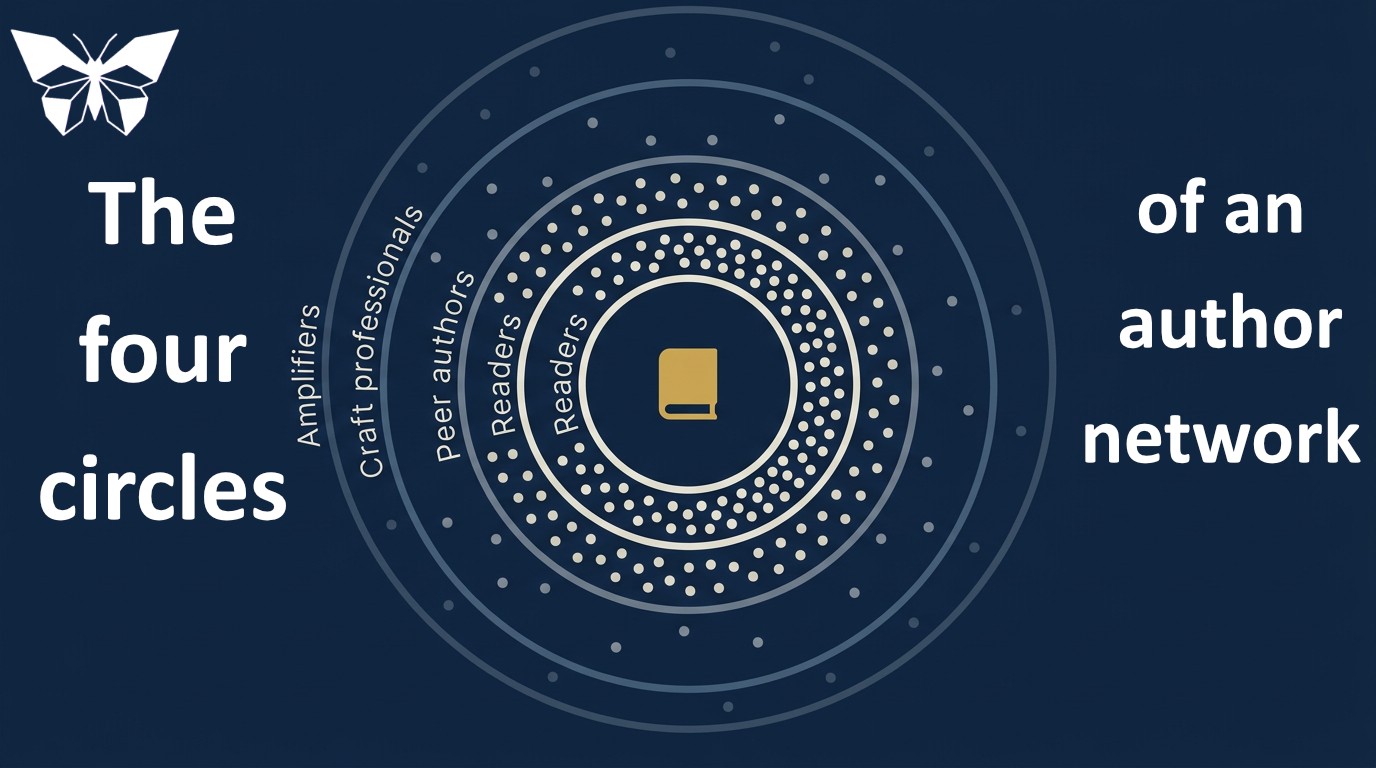
Circle one: readers you can reach again
A reader who finished your book and cannot be contacted is a dead end. The whole business of indie publishing rests on converting a one-time buyer into someone you can reach at your next launch.
Three routes matter. A mailing list, which you own. A follow on the store where you sell, which you half-own. A social account, which you rent.
Ebokio handles the second route inside the shop itself. Every published title gets a live product page on ebokio.com carrying the cover, the blurb, a sample reader and a link to your author profile, and every author gets a storefront page in the Ebokio authors directory — bio, photo and complete catalogue in one place. Titles can be grouped into a series with the read order displayed, so a reader who finishes book two is shown book three rather than left to guess.
Compare that to the Goodreads Author Program, which many writers treat as their reader hub. Goodreads gives you a profile, followers and a review feed, and none of it sells a copy: a reader who follows you there has to leave the site, find a retailer and search for you again. Ebokio collapses those steps. The profile, the follow and the buy button occupy the same page, so interest converts where it is created instead of leaking out through a referral link. Readers who follow you are notified when you release, which turns a browsing visitor into a standing audience for the next book.
Amazon’s Author Central works on the same split — a profile page separate from the store listing, tied to an account that also governs your royalties. Ebokio ties your public identity to your revenue in one dashboard, and lets you run up to ten author and contributor profiles on a Premium plan, which matters if you write across genres under different names.
Circle two: authors who write what you write
Peer authors are the highest-yield relationships in indie publishing, and the most misunderstood. New writers assume other authors are competitors. Readers of your genre are not a fixed pool being divided. A romantasy reader finishing your book wants another one that night, and they will take a recommendation from the author they just finished over any advertisement.
Peers give you cross-promotion, honest pricing data, warnings about bad contractors and co-writing opportunities. They also give you the thing money cannot buy — a second opinion from someone who has already made the mistake you are about to make.
Find them where they discuss craft and business rather than where they broadcast. That means genre associations, private forums and small group chats.
Circle three: the people who make the book good
Editors, cover designers, proofreaders, translators, narrators, formatters. Treat these as relationships, not transactions. An editor who has worked on four of your books catches things a first-time reader never will, and will quote you honestly on the fifth. A designer who understands your series will keep the visual identity consistent without a brief.
Ebokio reduces how many of these people you need at the start. The Writing Studio carries a story bible with character and location profiles, a visual relationship map that labels the ties between your cast, and outlines built on five frameworks — Save the Cat, the Hero’s Journey, Three-Act, 7-Point and Romancing the Beat. Muse, the AI brainstorming partner, is grounded in your own story bible rather than in generic prompts: ask about a character and the answer comes back with that character’s history. It runs in the browser and as a Windows app, and the editor you draft in is the editor you publish from, so there is no export step between the two. Cover Studio generates cover variations from a prompt or a reference image, and you own the output of every generation you trigger. Manuscripts are never used to train a model. None of this replaces a good structural editor. It does mean you can arrive at that editor with a cleaner draft, which lowers the invoice.
Circle four: the amplifiers
Book bloggers, BookTok and Bookstagram accounts, podcast hosts, newsletter curators, librarians, festival programmers, local journalists. They have audiences and a permanent shortage of material.
This is the ring where cold outreach still works, because supplying material is the job. It is also the ring where authors damage themselves fastest, by sending identical pitches to two hundred addresses.
Fix your landing zone before you shake a single hand
Every introduction ends the same way: the other person looks you up. What they find in the next thirty seconds decides whether the introduction was worth anything.
Audit that landing zone before you start meeting people.
-
Does your author page carry a current photo and a bio that says what you write, not how long you have been writing?
-
Is every title you have published listed in one place, in order?
-
Can a stranger buy the book in two clicks from the page they landed on?
-
Does the sample let them read enough to commit?
Ebokio’s author storefront answers all four by default, which is the practical argument for centring your presence there rather than on a personal site nobody visits twice. The books, the profile, the samples, the reviews and the buy button share one address. When somebody meets you at a fair and types your name into a phone, that is what they should find.
Verified buyer reviews sit on the same page. Reviews from confirmed purchasers carry weight that unverifiable ones do not, and they accumulate against your name rather than against a single retailer’s listing. If you are building a review strategy from scratch, the complete 2026 review playbook covers the twelve-week schedule and the legal limits in detail.
Where to meet other selfpublishers
Associations worth the subscription
The Alliance of Independent Authors is the obvious first membership. It is a non-profit operating in more than 100 countries, with a private member forum, a vetted directory of editors and designers, and a watchdog desk that names predatory services. Membership tiers run from Associate for beginners through to Authorpreneur for established author-businesses.
Genre bodies are narrower and often more useful. The Crime Writers’ Association runs a dedicated self-published author membership route with its own eligibility checklist. The Romantic Novelists’ Association admits independent authors and hands out an Indie Champion award. Membership in a genre body puts you in a room where everyone is writing for the same reader.
Online rooms
Reddit’s r/selfpublish is blunt, busy and free, and it will tell you when your cover is wrong. Discord servers organised around a subgenre tend to produce closer relationships than Facebook groups, because the conversation is continuous rather than algorithmic. Newsletter-swap platforms such as BookFunnel and StoryOrigin exist to match authors with compatible lists.
One correction worth making: NaNoWriMo, for two decades the default on-ramp into writing communities, closed in 2025. Its regional groups largely survived it and now run independently on Discord and Meetup. If you are looking for a local writing circle, search for the successor group rather than the parent organisation.
Fairs and festivals
Trade fairs are not for selling books. Very few selfpublishers sell a single copy at one. They are for meeting people who will still be useful in three years. The London Book Fair returns 16–18 March 2027 at ExCeL London, with an Author HQ stage given over to the author side of the business. Frankfurter Buchmesse runs 7–11 October 2026 with Czechia as guest of honour, and remains the place rights get traded — worth a visit once your catalogue is deep enough to sell translation rights.
Smaller regional festivals and genre conventions produce better contact-per-pound returns for a working author, and the queue for coffee is shorter.
Cross-promotion: the mechanics that move copies
Cross-promotion fails when authors treat it as a favour rather than a fit. The reader does not care that you and the other author are friends. They care whether the recommended book resembles the one they enjoyed.
Four formats that hold up:
Newsletter swaps. You feature their book, they feature yours. Match on subgenre and heat level, not on list size. A swap with a 900-subscriber list of exact-match readers beats one with 9,000 mixed subscribers.
Series funnels. Make the first book in a series free or cheap, then let the series do the work. On Ebokio, free titles earn no royalty but function as an entry point into the paid catalogue, and one-click promotional pricing lets you run a percentage discount or a free window without unpublishing and re-uploading. Set the promotion, tell your swap partners the dates, and let them point their readers at a live price.
Joint box sets. Several authors, one collection, one launch. Every contributor promotes it, and every contributor’s readers meet the others. Ebokio’s series grouping and read-order display keep the individual titles discoverable after the set comes down.
Shared launch teams. Two authors with overlapping readers can build one advance-reader group and use it for both. Under the FTC’s rules on consumer reviews and testimonials, free copies exchanged for honest reviews are fine; paying for ratings is not, and reciprocal review swaps between authors breach most platform terms. Keep the arrangement clean.
None of this works if your platform locks you in, or if promotional pricing costs you money. KDP Select buys its promotional tools with 90 days of exclusivity, which rules out any partner selling elsewhere; outside a fixed price band, the royalty drops to 35%, and the 70% option carries a per-megabyte delivery charge. Kobo Writing Life is non-exclusive but applies the same shape of price band — 70% inside it, 45% outside — so a 99p promotion is taxed for being cheap. Ebokio has no exclusivity period, no minimum term, no price bands and no delivery fees, which means a free or discounted title still pays the same rate on every full-price sale beside it. The KDP comparison, the Kobo comparison and the 2026 ebook distribution guide set out the trade-offs in full.
Use your dashboard as networking intelligence
This is the part most networking advice skips, and it is where a store-native platform earns its keep.
Ebokio’s author dashboard reports sales by day and hour, reads, and — this is the unusual one — the AI Librarian searches that surfaced your book. The AI Librarian is the shop’s natural-language discovery tool: a reader describes what they want in a sentence, in English, French or German, and it returns matching titles from the live catalogue. Your dashboard shows you those sentences. Every chart exports to CSV.
Read that data as a transcript of how your readers describe your book when no marketing copy is guiding them. Four things fall out of it:
-
Who to approach. If readers keep arriving through phrases about slow-burn workplace romance, you know which newsletters, groups and authors share your audience. Pitch those, skip the rest.
-
What to say. Use the readers’ own phrasing in your pitch to a blogger or podcaster. It describes the book better than your blurb, because it came from someone who had no stake in selling it.
-
When to move. Sales-by-hour data tells you when your readers buy, which is when a swap partner’s email should land.
-
Where else to look. Searches arriving in French or German are a signal that your subject travels. That is the moment to talk to a translator, or to an author who already works in that market.

Amazon’s reporting gives you units and royalties. It does not tell you what a reader typed before they found you. That gap is the difference between guessing at your audience and reading their words.
The etiquette that keeps a network alive
Some rules, learned expensively by other people:
Give first, and give something specific. Not “let me know if I can help.” Send the contact. Write the review. Share the launch. Vague offers cost nothing and are worth nothing.
Never open with an ask. The first message that arrives from you should not contain a request. This single rule separates authors with networks from authors with contact lists.
Be legible. When you introduce yourself, say what you write and who reads it, in one sentence. “I write cosy mysteries set in Cornish fishing villages” gives someone something to work with. “I’m a writer” does not.
Follow up once, then stop. One polite nudge after ten days. No second nudge.
Stay visible between launches. Authors who surface only when they have something to sell train their network to ignore them. A comment in a forum thread, an answer to a beginner’s question, a share of someone else’s release — these are cheap and they compound.
Keep the receipts private. Sales figures, contractor rates, personal circumstances shared in a private group stay there. One breach ends your access to every room worth being in.
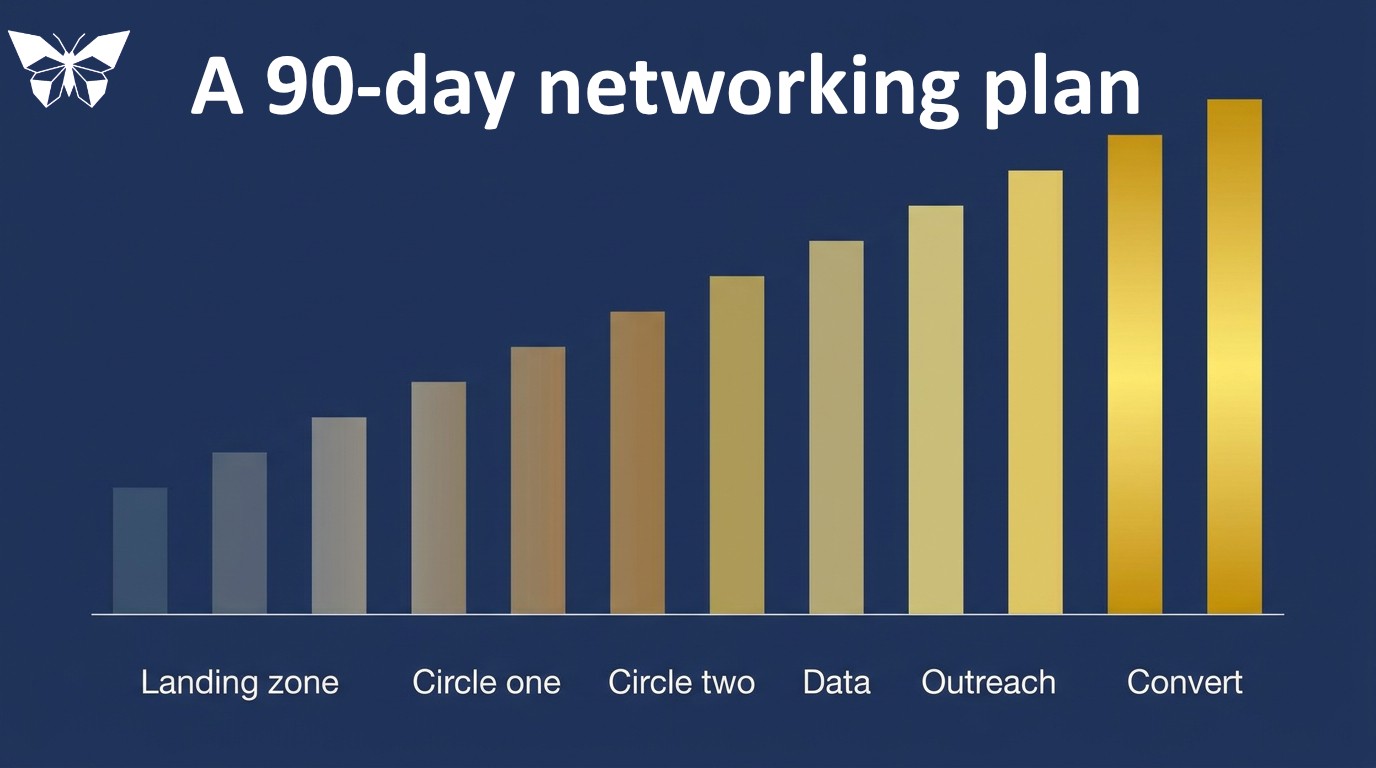
A 90-day networking plan
|
Weeks |
Focus |
Concrete actions |
|---|---|---|
|
1–2 |
Landing zone |
Publish or update your Ebokio author profile: photo, one-sentence positioning, full catalogue, series order set. Audit every buy path. |
|
3–4 |
Circle one |
Add a newsletter sign-up to your back matter. Set your first promotional price window. Ask existing readers for verified reviews. |
|
5–6 |
Circle two |
Join ALLi and one genre association. Introduce yourself in three online rooms. Read for a month before you post about your own book. |
|
7–8 |
Data |
Export your dashboard CSV. List the ten AI Librarian phrases readers used. Build a target list of newsletters, groups and authors matching those phrases. |
|
9–10 |
Outreach |
Twenty personalised messages, split between peer authors and amplifiers. Lead with something useful. Track replies in a spreadsheet. |
|
11–12 |
Convert |
Book two newsletter swaps. Pitch one podcast. Line up a launch team of ten readers for the next title. |
Ninety days will not produce a large network. It produces a working one, and working beats large.
Mistakes that quietly shrink your network
Broadcasting instead of talking. Posting your buy link into a group you have never contributed to reads as spam, because it is.
Chasing size over fit. A 50,000-subscriber list in the wrong genre converts worse than 500 in the right one.
Treating peers as rivals. The authors nearest your genre are your best allies. Guarding your reader list from them costs you more than it protects.
Letting a good contact go cold. A relationship left untouched for eighteen months is a stranger with a familiar name. Two messages a year keeps it alive.
Building on rented ground. A platform can change its algorithm, suspend your account or close. Keep the assets you own — your list, your author page, your catalogue — at the centre, and treat social platforms as roads leading to them.
Frequently asked questions
Where do I start if I have not published anything yet?
Set up the page people will land on, then read. Claim your author profile, write a bio that names the genre you write in, and spend a month inside two or three communities without mentioning yourself. You will learn the etiquette, and the people you eventually approach will recognise your name.
How do I find authors in my genre to partner with?
Work backwards from the shelf. Look at the also-boughts and recommendation lists attached to books like yours, then check which of those authors are independent — an indie author has a personal site, a newsletter and no imprint on the copyright page. Twenty names is enough to start.
Is email or social media better for author networking?
Email for anything you want a decision on, social for staying visible. Direct messages on a social platform get lost, and the platform can remove your account and the relationships stored inside it. Move a promising contact to email early.
How many newsletter swaps should I run around a launch?
Three to five in the launch week, spread across separate days. More than that and you are pushing the same readers repeatedly, which flattens the effect and annoys the lists you borrowed.
What should the first message to another author say?
Name their book and the specific thing in it you admired, say in one line what you write, and offer something before you ask for anything. Three or four sentences. Long introductions read as pitches.
How much time should networking take?
Two to three hours a week, held consistently, outperforms a burst before every launch. Most of it is reading rooms and answering other people’s questions.
I’m an introvert. Is this still possible?
Yes, and written networking suits introverts. Forums, email and direct messages let you think before you answer. Most durable indie relationships are built in text, not at parties.
Do I need a large following before I approach other authors?
No. Offer something other than reach — a beta read, a formatting fix, an honest review, an introduction. Reach is one currency among several, and the slowest to acquire.
Does networking still matter once I’m selling well?
More. Established authors trade information about advertising costs, market shifts and rights deals that never appear in public. The network becomes your intelligence service.
Can I network effectively if I publish on more than one platform?
Yes, and non-exclusivity makes it easier, because you can promote alongside authors on any store. Ebokio’s terms are non-exclusive with no minimum period, so publishing there closes no doors.
What does it cost to start on Ebokio Publishing?
Nothing. The Free plan publishes up to 30 books at 70% of net receipts, with the Writing Studio included and a 4–6 working day review. Premium is £13.99 a month for 80% and a 24-hour review, Pro is £19.99 for 90% and a priority queue. No ISBN is required; the platform assigns its own identifier and accepts an existing ISBN if you have one. The royalty calculator shows the numbers before you commit.
Start with a page people can find
Networking in selfpublishing is unglamorous and cumulative. Nothing you do in week one will show up in your sales report. By month six, the pattern is unmistakable: authors with a network launch to an audience, and authors without one launch into a void.
Begin with the thing everyone will look at. Put your catalogue, your bio and your buy buttons on one page a stranger can reach in a single click, then start meeting people who write what you write.
Create a free Ebokio Publishing account — 70% royalties, no exclusivity, no upfront cost — and get your author page live before your next conversation. If you want the mechanics of the publishing process first, how it works walks through upload, review and launch, and the self-publishing guide covers the ground before that.
Sources
Ebokio Publishing platform pages, checked 31 August 2026:
External sources:
-
The Alliance of Independent Authors — membership tiers, member forum, watchdog desk and vetted services directory.
-
The Crime Writers’ Association: self-published author membership — eligibility route for independent crime writers.
-
The Romantic Novelists’ Association: join — membership routes and the Indie Champion award.
-
r/selfpublish on Reddit — open community for craft, pricing and cover feedback.
-
BookFunnel — delivery and group promotion tools for author cross-promotion.
-
StoryOrigin — newsletter swap and review-copy matching for authors.
-
Publishers Weekly: NaNoWriMo nonprofit shutters — confirmation of the 2025 closure.
-
The London Book Fair — 16 to 18 March 2027, ExCeL London, Author HQ programme.
-
Frankfurter Buchmesse — 7 to 11 October 2026, guest of honour Czechia.
-
US Federal Trade Commission: Consumer Reviews and Testimonials Rule, questions and answers — what is permitted when exchanging review copies.