A practical guide for indie authors planning ebook self publishing in 2027 — discovery, royalties, and control — with Ebokio Publishing at the centre.
What changes for indie authors as 2027 approaches
Three pressures now decide who thrives in self publishing 2027: how readers discover books, how much of each sale the author keeps, and whether the author still owns the relationship after checkout.
Search behaviour is shifting. Google’s AI Overviews and AI Mode put answer-style summaries above traditional results. Bookishelf’s 2027 trends report cites a Pew Research Center study of 900 US adults’ browsing in March 2025: people clicked a normal result on 8% of visits that showed an AI summary, against 15% when no summary appeared. For authors, being named accurately in conversational answers matters as much as ranking a blog post. Joanna Penn framed this as generative and answer-engine optimisation: rich metadata and plain-language descriptions of what a book is about — not keyword stuffing alone (Creative Penn, January 2026).
At the same time, more indie authors sell outside a single retailer’s walls. Penn cites a Written Word Media survey from December 2025 in which 30% of authors said they already sell direct and another 30% planned to start in 2026. Bookishelf’s 2027 outlook lands on the same owned assets: the newsletter, which it calls the channel authors own, and direct sales (Bookishelf, November 2026).
Royalties and rules on the big platforms keep moving too. From 7 July 2026, Amazon KDP widened the 70% ebook royalty band on Amazon.com from $2.99–$9.99 to $2.99–$12.99 (£1.77–£12.99 on Amazon.co.uk). KDP says the old $9.99 ceiling had stood since 2007. Since 21 September 2026, KDP has also capped new title creation at two per format per week, and it has required disclosure of AI-generated content since 2023. That is useful context. It is not a reason to hand every reader relationship to one store.
The 2027 author who wins owns a crawlable product page, stays free to sell everywhere else, and meets readers who describe books in natural language. That is the job Ebokio Publishing was built to do.
What “self publishing 2027” actually means now
A decade ago, “self-publishing” often meant upload-to-Amazon and hope the algorithm noticed. Heading into 2027, the phrase covers a fuller stack: manuscript tooling, a real bookshop page, payment rails, discovery that understands sentences (not only seven keywords), and payouts that land in the author’s bank.
Industry round-ups from autumn 2026 point to the same cluster of pressures. Wrote a Book and KoJi Launch track KDP’s weekly title cap and the end of ACX’s legacy audiobook royalty model at the close of 2026 (Wrote a Book, October 2026; KoJi Launch KDP outlook). Freyja Publishing describes AI translation and narration as everyday options, each with its own disclosure rules, and notes that more authors now sell direct (Freyja Publishing trends). Bookishelf adds the search side: AI answers are taking clicks away from classic results (Bookishelf).
Ebokio’s focus stays on the ebook storefront and discovery layer. Its own FAQ describes the platform as ebook-first: no paperbacks or print-on-demand yet (print is on the roadmap), and audiobooks sit outside the core product. What Ebokio solves for ebook self publishing is sharper: get a manuscript into a curated digital bookshop, keep rights, keep non-exclusivity, and give readers a way to find the book by describing it.
What Ebokio Publishing is (and is not)
Ebokio Publishing is a UK self-publishing platform for ebooks. Authors upload an EPUB or DOCX. A human reviewer checks formatting, metadata, and content rules. Once approved, the title goes on sale as a real, crawlable product page in the Ebokio digital bookshop at ebokio.com. Readers browse, buy, and read in Ebokio reader apps.
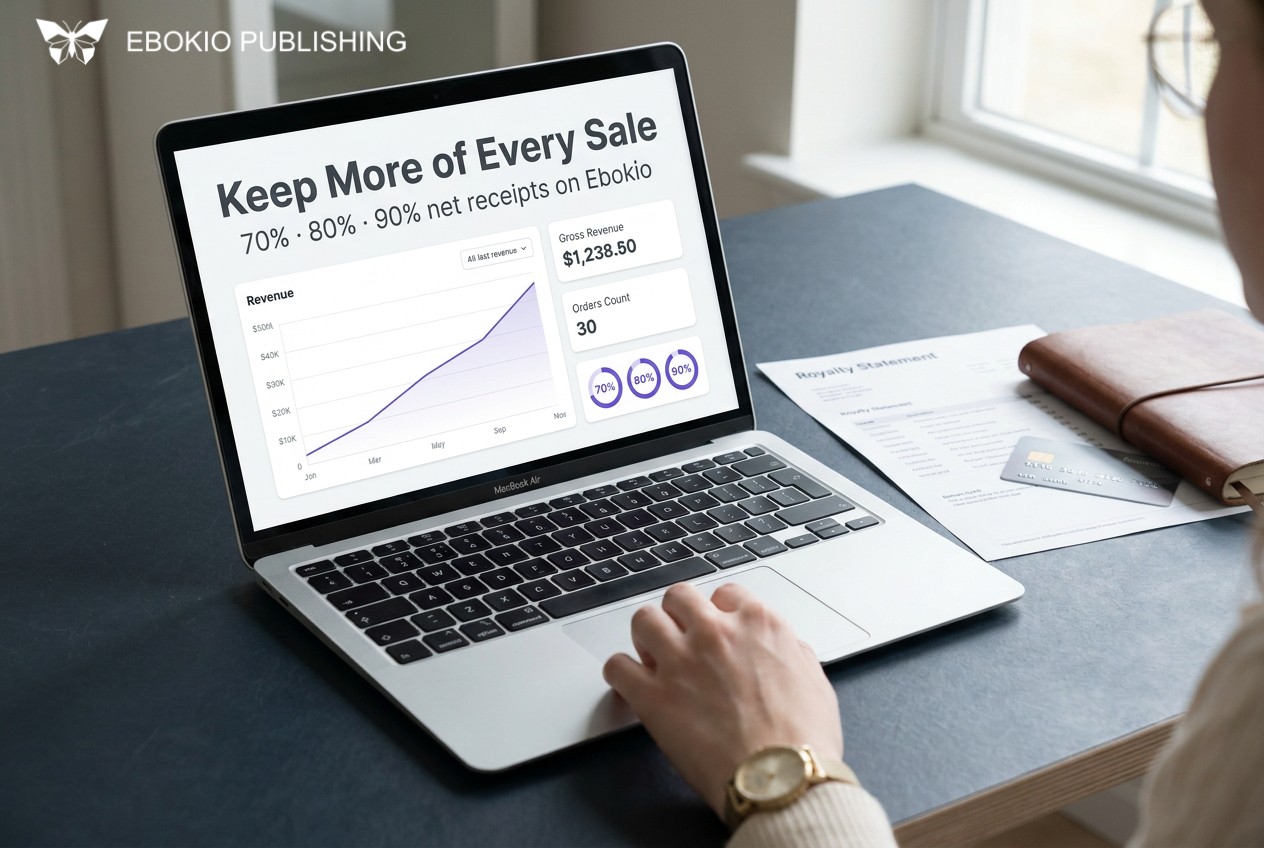
Authors keep their rights. Distribution is never exclusive. Royalties are 70% on Free, 80% on Premium, and 90% on Pro — of net receipts (sale price minus the reader’s VAT and the card-processing fee). Payouts go by bank transfer at the end of the second month after the earning month, with a £30 minimum, and arrive in the currency of the author’s bank. There are no setup, listing, or storage fees. Writing Studio, cover tools, and the author dashboard come with every account, including the free one.
The Free plan costs nothing, needs no card, and allows up to 30 published books. Premium (£13.99 a month) and Pro (£19.99 a month) remove the book limit, raise the royalty rate, and add larger AI allowances (Ebokio pricing).
That definition matters because many “self-publishing” tools are either distributors that push files into other shops, or retailer dashboards that trade reach for exclusivity. Ebokio is a bookshop with a publishing pipeline attached: you publish into a store readers already use, without locking the same ebook out of Amazon, Apple Books, or your own site.
From manuscript to bookstore: the Ebokio pipeline
Upload and packaging
On publishing.ebokio.com, you drop an EPUB or DOCX. The platform auto-detects chapters, headings, footnotes, and tables of contents, then formats, validates, and packages a clean reader-ready edition plus a downloadable file for buyers. You set title, blurb, categories (up to three), tags, cover, and price — from £0.99 — or let the AI metadata autofill draft them from the manuscript for you to edit. No PDF gymnastics. The full sequence is laid out on the How it works page.
Product page and author page
Every title ships with an indexable URL: a real product page, not a buried dashboard preview. Readers get a free sample — the author decides how much of the book it covers — and one-click checkout (cards, Apple Pay, Link) with multi-currency pricing. Author pages sit beside the books, so a newsletter link or social post can land someone straight on your shelf. For 2027 discovery — where AI systems and humans both need stable, crawlable facts — those URLs are the difference between “somewhere on a retailer” and “a page the web can cite.”
Human review before go-live
Ebokio does not dump raw uploads into the shop. A person reads each book against formatting, metadata, and content rules. Typical turnaround: Free in 4–6 working days; Premium under 24 hours; Pro under 24 hours with a place in the priority queue. If something fails review, Ebokio emails what tripped it and you resubmit in one click. That curation is a feature, not friction. Retailers fighting AI spam with weekly title caps prove the same point from the other direction: volume without standards floods shelves. Ebokio keeps the bookstore readable for humans and matchable for the AI Librarian.
Once approved, the title is live, crawlable, and shareable. You track status in the dashboard and get a notification on approval. You can swap the cover, edit the description, replace the file, or change the price later, and existing buyers can re-download the latest version free.
Writing Studio: the publishing stack starts before upload
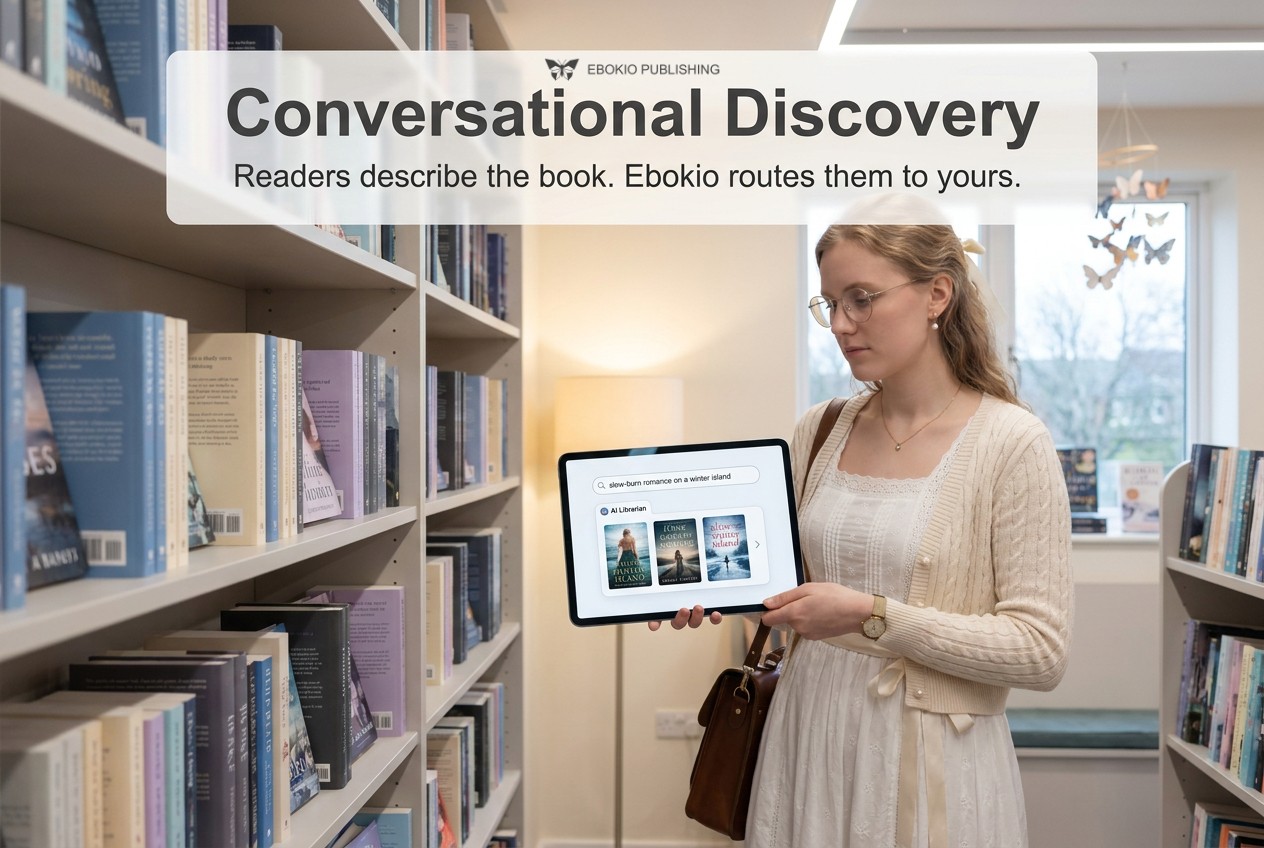
Many self-publishing platforms only start once the manuscript is finished. Ebokio’s Writing Studio treats planning as part of the same stack you will publish from, and it is free on every plan.
You get a living story bible for characters and locations, a visual relationship map, an outline in acts, chapters, and beats, a corkboard, and beat-sheet frameworks such as Save the Cat, Hero’s Journey, and Three-Act. Word goals and streaks sit alongside. Muse, an AI brainstorm partner grounded in your own story bible, runs on Premium and Pro (Writing Studio). Then you write in the same editor you use to publish. That removes the classic indie fracture: one tool for drafting, a second for formatting, a third dashboard for retail upload — each with its own metadata drift.
For series authors heading into 2027, consistency of names, places, and tone is not only craft. It is discovery fuel. The AI Librarian and product pages lean on accurate titles, blurbs, and categories. Drafting inside the same system that will package those signals reduces mismatched facts between manuscript and storefront.
AI Librarian vs keyword-stuffed retailer shelves
Retail keyword fields still matter on large marketplaces. They were designed for typed search boxes and category trees. Readers using AI search increasingly type full questions: “a locked-room thriller on a frozen Baltic island,” “quiet literary fiction about sibling estrangement,” “practical finance for freelancers in the UK.”
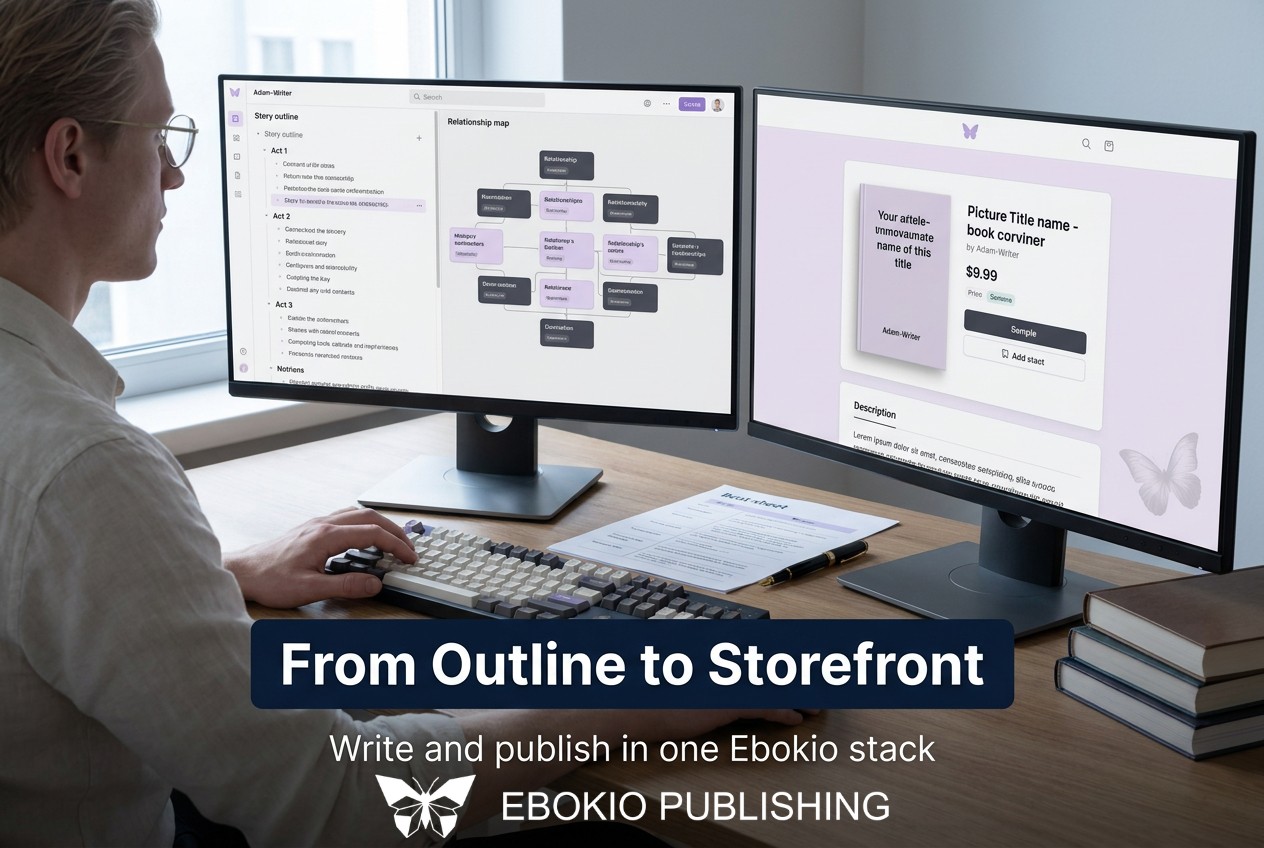
Ebokio’s AI Librarian is built for that behaviour. Readers describe what they want in natural language, and it routes them to matching titles. Ebokio’s FAQ says it works from lightweight metadata embeddings — title, blurb, and categories — and that manuscripts are never used to train any model. Every book is indexed automatically, with a one-toggle opt-out. That makes the blurb your main lever, not a race to fill seven keyword slots. Joanna Penn’s 2026 predictions stressed that AI-powered search rewards detailed, conversational descriptions of books (Creative Penn). Book marketing trend reporting for 2027 makes the same practical point: keep name, series order, and book facts identical and clear so answer engines get them right (Bookishelf).
Compare that to a crowded retailer shelf where ads and lookalike titles fight for the same short keyword. On Ebokio, discovery insights in the author dashboard show whether readers arrived via AI Librarian, deals, genre browsing, or direct links, and which AI Librarian searches surfaced the book. You can improve the blurb and metadata against that data instead of guessing which keyword string moved the needle.
Verified buyer reviews, author follows, and new-release notifications close the loop. Discovery is not only “find the book once.” It is “find the author again when the next title ships.”
Royalties, payouts, and plans — honest numbers
Ebokio publishes the royalty math without fog:
-
Free plan: 70% of net receipts
-
Premium plan: 80% of net receipts
-
Pro plan: 90% of net receipts
Net receipts mean the sale price minus the reader’s VAT and the card-processing fee (Ebokio’s FAQ puts that fee at roughly 2.9% + 25p). Refunds and chargebacks also come out, per the Publisher Agreement. Ebokio is the merchant of record: it collects VAT at the reader’s country rate and remits it. Royalties are paid gross, with no tax deducted unless the law requires withholding. The processing fee is shown on every sale.
A worked example from Ebokio’s FAQ: a £9.99 sale to a UK reader (0% ebook VAT, about £0.54 in fees) earns about £6.61 on Free, £7.56 on Premium, and £8.50 on Pro. You can run your own prices through the free royalty calculator.
Payouts: each calendar month’s earnings are paid by bank transfer at the end of the second month after it (January earnings arrive at the end of March). Minimum payout £30; balances below that roll forward. Funds arrive in your bank’s own currency, and any bank or intermediary transfer charge appears as its own line. PayPal is listed as coming soon. No setup fee, no listing fee, no storage fee. You can switch tiers any time.
How this compares when authors look at KDP
Amazon’s July 2026 change widened the 70% ebook royalty band on Amazon.com to list prices up to $12.99, with equivalent bands in other marketplaces. That helps authors who price longer works and box sets inside that band. Existing books keep their current royalty option until the author changes it (KDP eBook List Price Requirements; Wrote a Book). KDP also confirms that delivery costs still apply to the 70% option.
Three structural differences favour Ebokio for authors who want a 2027-ready stack. First, Ebokio’s top tier pays 90% of net receipts with no price bands and no per-megabyte delivery fee eating into long, image-heavy files. Second, KDP’s 70% option for sales to customers in Brazil, Japan, Mexico, and India requires KDP Select enrolment, which means ebook exclusivity; Ebokio never requires exclusivity. Third, Ebokio will not discount your book or put it in a promotion without your consent. The two bases are not identical, so compare per-sale earnings at your own price. Ebokio is open about the trade-off: it is a curated bookstore, not a marketplace the size of Amazon. You can keep Amazon for reach, keep Ebokio for owned product pages and conversational discovery, and set pricing per channel yourself.
Non-exclusivity vs locked-in ecosystems
KDP Select can be a rational choice for some genres and launch windows. It also concentrates risk: one account issue, one algorithm shift, one exclusivity rule change, and your ebook retail path narrows. Autumn 2026 coverage of KDP’s title caps (two new titles per format per week: the creation limit took effect on 21 September 2026 and the submission limit on 5 October) shows how quickly a single ecosystem can reshape author behaviour (Wrote a Book, October 2026; KoJi Launch).
On Ebokio Publishing, exclusivity is never required. Sell the same ebook on Amazon, Apple Books, or your own site in the same week. Pricing per channel stays your call. That matches the advice Freyja Publishing gives: retailers and social platforms change their rules, so owning reader contact still protects you (Freyja Publishing).
Ebokio’s product and author pages give you that owned path without forcing you to build a full Shopify stack on day one. Link them from your newsletter. Bring traffic you already earned. Let the AI Librarian catch readers who arrive through the bookshop itself.
Dashboard, reader engagement, and promotions
The author dashboard sits behind the bookstore. Four views matter for running a title like a small product, not a lottery ticket:
-
Live revenue and royalties — net earnings, take rate, and payout schedule as orders arrive.
-
Reader engagement — pages read, completion rate, text-to-speech minutes, and Ask-This-Book questions per title.
-
Discovery insights — AI Librarian, deals, genre browsing, or direct traffic.
-
One-click promotions — percentage deals and free runs on Premium and Pro, with ranking movement visible in real time.
Engagement metrics change how you revise. A high sample-to-purchase rate with low completion may point to a pacing issue in the middle. Strong AI Librarian impressions with weak conversion may point to a blurb or cover mismatch. Many retail dashboards centre on sales and page reads. Ebokio also surfaces completion and reader questions so you can iterate the book and the page.
Checkout supports cards, Apple Pay, and Link, with multi-currency pricing. Because Ebokio acts as merchant of record and handles the reader’s VAT, you do not need your own payment processor or a tax registration in every reader’s country to sell there.
A practical 2027 publishing checklist on Ebokio
Use this as a launch sequence, not a motivational list:
-
Draft or finish in Writing Studio (or import EPUB/DOCX) so chapter structure and metadata stay aligned.
-
Write a conversational blurb that answers what the book is about, who it is for, and what it feels like — language an AI Librarian (and a human) can match.
-
Set price with net-receipt royalties in mind; test channel-specific prices if you also sell on Amazon or elsewhere.
-
Submit for human review; choose Free (4–6 working days), Premium (under 24 hours), or Pro (under 24 hours, priority queue) based on launch timing.
-
On go-live, copy the product URL into your newsletter, site, and social bios. Point clicks at the free sample, sized to end on a strong hook.
-
Watch discovery insights weekly for the first month. Improve blurb, categories, and promotions against actual AI Librarian and deal traffic.
-
Invite verified buyers to review; ask readers to follow you for release notifications.
-
Keep the title non-exclusive. Parallel retail listings remain allowed — use them for reach, not as your only home.
Self publishing 2027 rewards authors who treat the storefront as infrastructure. Ebokio supplies that infrastructure with a bookshop attached.
The short version
If discovery is moving toward natural language, if royalties need to stay high without exclusivity, and if a crawlable product page beats a buried retailer SKU, start on Ebokio Publishing. Upload the manuscript. Pass human review. Sell in the digital bookshop. Keep your rights. Keep every other channel open.
FAQ: self publishing 2027 and Ebokio Publishing
Who owns the rights to my book on Ebokio?
You do. Ebokio takes a non-exclusive distribution licence to sell, deliver, and serve the book through the storefront and reader apps. You can pull a title down at any time and sell the same ebook elsewhere in parallel. Readers who already bought it keep access.
Is Ebokio exclusive? Can I still use Amazon KDP?
No exclusivity, ever. Sell on Amazon, Apple Books, or your own site at the same time. One catch sits on Amazon’s side: KDP Select requires ebook exclusivity, so a book enrolled there cannot also be sold on Ebokio or any other store. Stay out of Select and you can run wide retail plus an Ebokio storefront for owned links and AI Librarian discovery.
What royalties does Ebokio pay?
70% of net receipts on Free, 80% on Premium, and 90% on Pro. Net receipts are the sale price minus the reader’s VAT and the card-processing fee. Payouts are monthly bank transfers at the end of the second month after the earning month, £30 minimum, in your bank’s currency.
What formats can I upload?
EPUB and DOCX. Ebokio auto-detects chapters, headings, footnotes, and tables of contents, then packages a clean reader-ready edition and a downloadable file for buyers. PDF uploads are not supported. You do not need an ISBN; if you own one, you can add it.
What is the AI Librarian?
A natural-language discovery tool inside Ebokio. Readers describe the kind of book they want, and it routes them to matching titles using metadata embeddings built from the title, blurb, and categories. Every book is indexed automatically, and you can opt out with one toggle in Settings.
How fast does a book go live?
After human review: typically 4–6 working days on Free, under 24 hours on Premium, and under 24 hours via the priority queue on Pro. You can track status in the dashboard and receive a notification when the title is approved.
Are there setup or listing fees?
No. No setup fee, no listing fee, no storage fee, and no card needed for the Free plan. Writing Studio, cover tools, and the author dashboard are available on every account. Premium (£13.99 a month) and Pro (£19.99 a month) are optional upgrades for higher royalties and larger AI allowances.
Does Ebokio replace Amazon for self publishing in 2027?
It does not have to. Think of Ebokio as the non-exclusive bookshop and publishing stack you control, while large retailers remain optional reach channels. For authors who want to own their storefront, a strong 2027 setup is “Ebokio plus wide” rather than “one retailer only.”
Sources and references
1. Ebokio Publishing — official self-publishing platform: https://publishing.ebokio.com/
2. Ebokio Publishing — FAQ (royalties, payouts, formats, review times, AI Librarian): https://publishing.ebokio.com/faq
3. Ebokio Publishing — Pricing and plan comparison: https://publishing.ebokio.com/pricing
4. Ebokio Publishing — How it works: https://publishing.ebokio.com/how-it-works
5. Ebokio Publishing — Writing Studio: https://publishing.ebokio.com/studio
6. Ebokio — Publisher Agreement (net receipts, payouts, licence): https://publishing.ebokio.com/legal/publisher-agreement
7. Joanna Penn — 2026 Trends and Predictions for Indie Authors and the Book Publishing Industry (The Creative Penn, 5 January 2026): https://www.thecreativepenn.com/2026/01/05/2026-trends-and-predictions-for-indie-authors-and-the-book-publishing-industry-with-joanna-penn/
8. Bookishelf — Book Marketing Trends 2027 (4 November 2026): https://www.bookishelf.com/book-marketing-trends-2027/
9. Wrote a Book — Self-Publishing News October 2026 (updated 4 November 2026): https://wroteabook.org/self-publishing-news-october-2026/
10. Freyja Publishing — Self-Publishing Trends (October 2026 edition): https://freyjapublishing.com/self-publishing-trends-2026/
11. KoJi Launch — KDP Trends 2027 (11 October 2026): https://kojilaunch.com/kdp-trends-2027/
12. Amazon KDP — eBook List Price Requirements (70% band $2.99–$12.99 effective 7 July 2026): https://kdp.amazon.com/en_US/help/topic/G200634560