A novel wants two years and a high tolerance for doubt. A flash story wants an afternoon. That gap usually gets sold as a shortcut, which misses the point. The real advantage of writing short is that you finish things, and finished things can be arranged, priced and sold. A half-written novel can only be apologised for.
Thirty finished flash pieces are a book. Not a warm-up, not a portfolio — a book, with a spine of its own, a price and a product page. The craft of getting there is the interesting part, and so is the part nobody writes about: the economics of short work are strange, and the store you choose decides whether a slim, cheap, beautifully made collection pays you or quietly punishes you for its own size.
This is a guide to both halves. How flash fiction actually works on the sentence, and how to turn a folder of small stories into a self-publishing ebook that behaves like a real title.
What flash fiction actually is
Flash fiction is a complete narrative told in under a thousand words. That ceiling is a convention rather than a law, and it comes with a family of tighter forms underneath it, each with its own name and its own arithmetic.
• Six-word story — six words, no more.
• Dribble, also called the minisaga — fifty words.
• Drabble — one hundred words exactly, a count that came out of science fiction fandom and stuck.
• Micro fiction — usually under three hundred words. The Bath Flash Fiction Award, which has run three rounds a year since 2014, caps entries at three hundred and pays £1,000 to its winner.
• Flash fiction — up to a thousand words. SmokeLong Quarterly, one of the form’s founding online journals, publishes “flash narratives up to 1000 words” and pays $100 for an accepted story.
• Novella-in-flash — between six thousand and eighteen thousand words, built from standalone shorts that accumulate into one arc. Bath runs a dedicated award for it and publishes the winners as individual books.
The form also has a civic life. National Flash Fiction Day has run in the UK every June since 2012 and reaches its fifteenth edition on 13 June 2026, with a microfiction competition, a print anthology, and FlashFlood, an online journal that publishes continuously through the twenty-four hours of the day itself.
The label is newer than the thing it names. Flash fiction was coined in 1992, when James Thomas, Denise Thomas and Tom Hazuka put out Flash Fiction: 72 Very Short Stories and gave editors a word they could print on a submissions page. Before that, magazines said “short short story” — Cosmopolitan was running them under that banner in the 1920s, and Somerset Maugham published Cosmopolitans: Very Short Stories in 1936.
Go back further and the form loses its novelty entirely. Aesop’s fables, the Panchatantra and Jataka tales, Zen koans, the Nasreddin stories: all of them do what flash does, which is deliver a whole moral or emotional event in a space you can hold in your head at once. István Örkény called his One-Minute Stories. Augusto Monterroso wrote “El Dinosaurio” in a single sentence. Lydia Davis, Amy Hempel, Diane Williams, Jamaica Kincaid and Naguib Mahfouz have all worked at this length without treating it as a stunt.
The baby shoes problem
Every flash fiction article you have ever read opens with six words about unworn baby shoes and credits them to Hemingway. The attribution is almost certainly false, and it is worth knowing why, because the real history is a better lesson than the myth.
Versions of the line appear in a classified advertisement in the St. Louis Globe-Democrat in 1883 — “FOR SALE–Cheap–A $40 baby carriage; never been used” — when Hemingway had not been born. A 1906 variant reads “For sale, baby carriage; never been used.” In 1910 the Spokane Press ran a piece headlined “Tragedy of Baby’s Death is Revealed in Sale of Clothes.” A 1917 issue of the trade journal The Editor sketched a story built around little shoes that were never worn. Hemingway’s name only enters the record in 1989, in John De Groot’s play Papa, twenty-eight years after his death, attached to an anecdote about a lunchtime bet that nobody has ever documented. The full documentary trail is public, and it has been for years.
The lesson underneath the correction: the line works because it is a found object. It is the shape of an advertisement, and the grief is entirely in what the advertiser could not bring themselves to write. That is the actual mechanism of flash — not brevity, but the load-bearing absence.
How a short story carries its weight
A flash story has to do three jobs at once with a fraction of the usual budget. Understanding which job each sentence is doing is most of the craft.
Enter after the door has closed. A novel can afford the drive to the hospital. Flash starts in the corridor. The inciting incident belongs in the reader’s inference, not on the page — you write the consequence and let them reconstruct the cause. Ask of your first line: what has already happened that makes this sentence necessary?
Make the title do structural work. In a three-hundred-word story, a title is not decoration. It is roughly a third of your setup budget, granted for free, outside the word count. “The Last Time He Called It Home” installs a whole timeline before the first paragraph begins. Writers who title flash as an afterthought throw away the cheapest exposition available to them.
Plant one object twice. The most reliable engine in short fiction is an image that appears early, means one thing, then reappears at the end meaning something else. A key on a hook. A jar of buttons. Nothing about the object changes; what changes is what the reader now knows. This gives a small story the sensation of an arc without spending words on one.
Restrict yourself to one decision. Flash tolerates a single choice, a single turn, one movement through time. Two time-jumps in six hundred words usually reads as summary. One reads as depth.
Under-resolve the ending. A short story that ties itself off feels like an anecdote. The endings that stay with people either swerve — the last line reframes everything above it — or widen, pulling back to a slightly larger frame and stopping. Neither explains. Resist the closing sentence that tells the reader what they just felt.
Then there is the mechanical pass, which sounds mundane and is where most drafts are actually won. Read the piece aloud. Cut ten per cent. Every adverb, every stage direction, every sentence that restates the previous one in gentler terms. Flash punishes throat-clearing more than any other prose form, because there is no second scene to recover in.
Drafting a collection without losing the thread
Writing thirty small stories is not thirty small projects. Somewhere around piece eleven you will notice recurring weather, a street you keep returning to, a name you have used twice without meaning to. Those accidents are the book announcing itself, and they are easy to lose if your drafts live in thirty separate documents.
The Writing Studio inside [ebokio Publishing](https://publishing.ebokio.com/) is built for exactly this problem, though it was designed with novels in mind. The story bible keeps characters and locations in one place with their traits, arcs and notes, which for a linked collection becomes a register of who has already appeared and where. The relationship map lets you drag your cast onto a canvas and name the links between them — siblings, rivals, debts, secrets — and in a collection those named links are frequently the only connective tissue the book has. The outline board holds chapter briefs on a corkboard you can reorder, which is the single most useful tool a flash writer can own, because arrangement is the entire second draft.
Progress tracking matters more at this length than people expect. A daily word goal, a ring that closes, a streak heatmap where days off do not break the chain: at eight hundred words a day, thirty pieces takes about five weeks. Seeing that is the difference between a folder and a manuscript.
Muse, the Studio’s brainstorming partner on Premium and Pro, is grounded in your own story bible rather than the open web — you ask it about your fourth character’s silence, not about flash fiction in general. That distinction is the point. Generic chat assistants answer from everything ever written; Muse answers from what you have written. Ebokio also states plainly in its FAQ that manuscripts are never used to train any model, its own or a third party’s, which is a commitment most writing tools decline to make in that language.
From a folder of stories to a book
A collection is sequenced, not compiled. Treat it like an album.
Open with your most legible piece, not your best one. Your best story assumes a reader who has learned your rules. Nobody has learned them yet on page one. Lead with the piece that teaches those rules quickly, and place the strongest work at position three or four, once trust exists.
Vary the lengths deliberately. Three 150-word pieces followed by a 900-word piece reads as a change of gear. Twenty stories of identical length read as a formal exercise, however good each one is.
Build hinges. Two or three pieces that share an object, a minor name or a location turn a folder into a book. The reader does not need it explained; they need it noticed.
Close with the second-best piece and a quotable last line. The final sentence of a collection gets screenshotted, quoted in reviews and pasted into your product description. Choose it on purpose.
On length: twenty-five to forty pieces, landing somewhere between twelve and twenty-five thousand words, makes a collection that feels substantial without padding. If your stories are genuinely connected — a single narrator, one town, one year — you are writing a novella-in-flash, which is a recognised form with its own competitions rather than a book that came up short of being a novel.
Title the book after an image inside it. Not a theme, not an abstraction. An object the reader will meet on page forty and recognise.
The part nobody warns you about: short books and price bands
Here is where the economics turn against short fiction, and where most guides stop paying attention.
A flash collection is a low-priced product by nature. Readers will pay £1.49 or £1.99 for twenty small stories and hesitate at £4.99, no matter how good the stories are. That instinct is reasonable, and it collides directly with how the largest ebook retailer structures its payments.
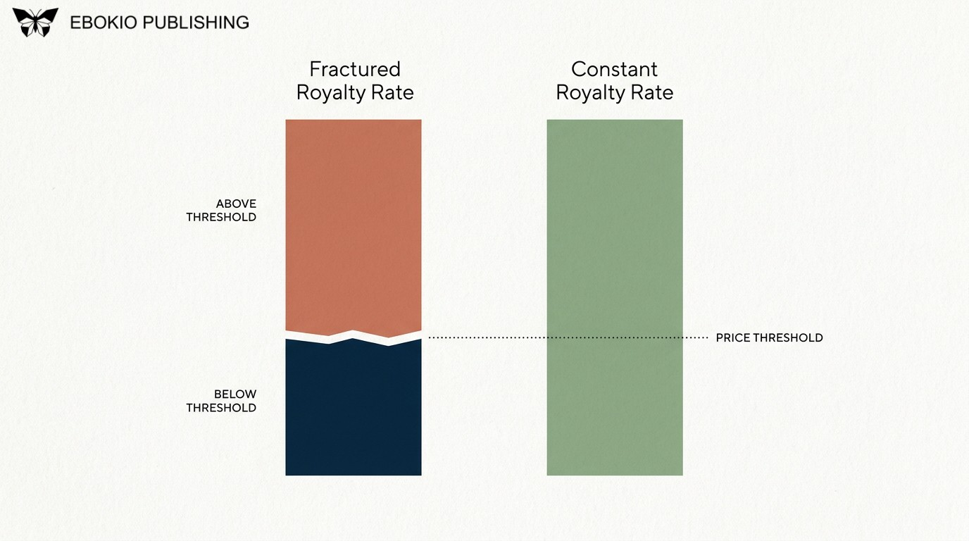
Amazon KDP offers two royalty rates. The 70% rate is only available when your list price sits between $2.99 and $12.99 in the US, or £1.77 and £12.99 in the UK. Price below that floor and you drop to 35%. The 70% option also deducts a delivery cost calculated per megabyte — $0.15/MB in the US store, with a one-cent minimum — before your share is worked out. Both figures come straight from Amazon’s own royalty documentation and list price tables.
For a text-only flash collection the delivery fee is close to irrelevant; the file is tiny. The price band is the problem. Price your collection where readers of short fiction actually buy — £0.99, £1.49 — and Amazon halves your rate for the privilege. To reach the higher rate you have to price the book above where its own audience is comfortable, which suppresses sales to protect a percentage. That is a bad trade, and it is structural rather than accidental.
Ebokio Publishing applies one rate to every price. Free authors keep 70% of net receipts, Premium keeps 80%, Pro keeps 90% — where net receipts means the sale price minus the reader’s VAT and the card-processing fee. There are no price bands, no per-megabyte delivery charge and no rate cliffs. The pricing floor is £0.99, so a 99p collection earns the same percentage as a £9.99 novel. On a £9.99 UK sale ebokio’s own worked example puts the author’s share at roughly £6.61 on Free, £7.56 on Premium and £8.50 on Pro.
The subscription tiers cost £13.99 a month for Premium and £19.99 for Pro, which are worth doing arithmetic on rather than guessing about — the royalty calculator compares net-per-copy across KDP, Kobo, Apple, Google, Draft2Digital and ebokio side by side, and the ebook price calculator proposes a launch price from genre and goal. Both are free and run in the browser without an account. The pricing page has the full tier breakdown, and Ebook Royalties Explained walks through the mechanics if the term “net receipts” is new to you.
Payouts run on a two-month cycle: January’s earnings arrive at the end of March, by bank transfer, in your local currency. The minimum payout is £30 and anything below it rolls forward. Royalties are paid gross, without tax deducted unless the law requires withholding. None of it is exclusive. You keep your rights, you can list the same collection on Amazon the same week, and you can unpublish from the dashboard at any time and leave with your files.
Getting the file ready and getting it live
Ebokio accepts EPUB and DOCX, and takes the second one seriously rather than as a fallback. On upload it reads chapter structure, table of contents, page count and any embedded cover, cleans up the formatting quirks Word leaves behind, and audits embedded fonts and images before you go any further. For a flash collection this matters: your file is likely thirty short chapters produced by heading styles in Word, and that is precisely the structure the importer is looking for.
Two free tools are worth running before you upload anything, whichever platform you end up on. The DOCX to EPUB converter produces a validated EPUB 3 from a Word manuscript, pulling chapters from heading styles and preserving images. The EPUB checker runs the same pre-flight that stores run — container, navigation, missing files, metadata, DRM and image weight. If you are undecided about which format to build in, EPUB vs DOCX covers the trade-offs.
Inside the manuscript editor you get per-chapter ornaments, drop caps and custom title pages on the paid tiers, plus a live device preview. Ornaments are a small feature that matters disproportionately for this genre: thirty stories separated by nothing but a page break read as a run-on document, while thirty stories separated by a consistent mark read as designed. Submission checks flag anything missing — cover, blurb, price, categories — before you can submit, and Premium and Pro add a grammar and spelling pass.
Then a person reads it. Ebokio runs human review on every title: formatting, metadata and content rules, checked by a reviewer who sends specific feedback if something is wrong, with one-click resubmission and no fresh wait in the queue. Free authors wait four to six working days, Premium is under twenty-four hours, Pro sits in a priority queue. Most large platforms lean on automated validation instead, and the difference is one of kind rather than speed — a machine confirms your file opens, a reader confirms your book looks finished. For a first collection that second opinion is worth a few days.
No ISBN is required. Ebokio is not an ISBN agency and does not assign one, but you can enter your own if you want to remain publisher of record, and every title gets an internal identifier regardless. Do You Need an ISBN? covers when it is genuinely worth buying one.
Covers can be uploaded or generated in the Cover Studio from a prompt, with up to four variations per click on Pro and reference-image guidance if you have a look in mind. You own the output. For flash collections, a single strong object photographed or painted against flat colour outperforms illustrated scenes — the book has no single plot to depict, so the cover should promise a mood and a texture instead.
The sample problem, and a setting that fixes it
This is the trap that catches first-time collection publishers, and almost nobody mentions it.
Ebook stores give readers a free sample, usually a fixed percentage of the file. On a novel, ten per cent is the first chapter — a hook, a cliffhanger, an argument for buying. On a flash collection, ten per cent is three complete stories, beginning to end, with their endings intact. Twenty per cent can be eight of them. You have handed a browsing reader a satisfying free experience with no unresolved question pulling them toward checkout.
Ebokio’s built-in reader lets the author set the preview percentage per title. On a collection you turn it down — enough to show two or three pieces and establish the voice, not enough to constitute a meal. On a novel you turn it up. That is one control, and for short fiction it is the difference between a sample that sells the book and a sample that substitutes for it.
Being found
Discovery for short fiction is difficult because the audience does not search the way novel readers do. Nobody types “flash fiction collection” into a store search bar; they type something closer to a feeling.
Every ebokio title is indexed automatically by the same engine behind the storefront search and the AI Librarian, a natural-language layer that routes readers who describe what they want rather than name it. “Short sad stories about leaving home” is a query that returns nothing useful in a keyword field and returns your book here. You can opt a title out in settings if you would rather not be indexed.
Metadata still does work. You get up to three categories and an unlimited number of tags. Amazon gives you three categories and seven keyword slots, and those seven slots are where most short-fiction listings suffocate — “flash fiction”, “short stories”, “micro fiction” and “very short stories” alone consume more than half of them. Ebokio’s AI metadata autofill reads the manuscript and drafts a blurb, categories and keywords for you to edit rather than invent from a blank field. The author dashboard then reports sales by day and hour, read metrics including completion rate, which search terms surfaced your book, and a CSV export if you want to work in a spreadsheet. Completion rate is the number to watch on a collection: if readers stop at story seven, story seven is in the wrong place, and you can replace the file and republish without losing the page or the reviews.
Premium and Pro can schedule free promotional runs, which suits short fiction unusually well — a 99p collection given away for a weekend is a cheap, low-friction introduction to a writer nobody has read yet.
A thirty-day plan that actually finishes
Days 1–5. Write five pieces, one a day, no editing. Set the story bible up as you go: names, places, weather. Do not decide what the book is yet.
Days 6–20. Fifteen more pieces at one a day, using the recurring elements you noticed in week one. Somewhere in here the book will tell you what it is about. Believe it.
Days 21–24. Ten more, written deliberately to fill gaps — a longer piece for pacing, two very short ones, a hinge story that connects two others.
Days 25–27. Arrangement. Print them. Spread them out. Reorder on the corkboard. Read the sequence aloud in order and listen for the point where energy drops.
Days 28–29. Cut ten per cent from every piece. Fix the titles, all thirty of them, properly. Write the blurb.
Day 30. Cover, categories, tags, price, preview percentage, upload. Sign up takes about ninety seconds, publishing on the free plan costs nothing and requires no card, and how it works walks the five stages end to end. Then submit and let a human read it.
Thirty days is aggressive and it works because flash removes the excuse. There is no chapter twelve to be stuck in. There is only today’s small story, and then the next one.
Frequently asked questions
How many words is flash fiction, exactly?
Under a thousand is the working definition, and the tighter forms have fixed counts: fifty words for a dribble, exactly a hundred for a drabble, three hundred for most micro-fiction competitions, six for a six-word story. Journals set their own ceilings — SmokeLong stops at a thousand, Bath Flash Fiction at three hundred — so check the guidelines before you cut to fit a number you half-remember.
How many stories do I need for a collection?
Twenty-five to forty pieces, roughly twelve to twenty-five thousand words. Fewer than twenty reads thin at any price. If the stories share a narrator or a setting and run six to eighteen thousand words in total, you have a novella-in-flash, which is a recognised form with its own awards rather than a book that came up short.
Can I publish stories that magazines have already run?
Usually yes, but read your contract. Most literary journals take first serial rights for a defined window and return them afterwards; some ask for a credit line in any reprint. Publishing on ebokio is non-exclusive and always has been, so it adds no further restriction of its own — your rights stay yours, permanently.
What should I price a flash collection?
£0.99 to £2.99 is where short fiction sells. On ebokio the floor is £0.99 and the royalty percentage is identical at every price, so you can price for the reader instead of pricing to clear a threshold. Amazon’s 70% band starts at £1.77 in the UK and $2.99 in the US, which forces a choice between your rate and your market. How to Price an Ebook covers the trade-offs in more detail.
Do I need an ISBN?
Not to publish on ebokio. It does not issue ISBNs and does not require one; every title receives an internal identifier. Buy your own only if you want to be publisher of record or plan to distribute into channels that insist on one.
Will a short book annoy readers?
Only if the listing hides its length. State the piece count and word count in the blurb and you convert the objection into a selling point — “twenty-eight stories, none longer than four pages” is a promise, not an apology. Short-form readers are looking for exactly that.
Can I publish on ebokio and Amazon at the same time?
Yes. There is no exclusivity at any point and no lock-in period. You can unpublish from the dashboard whenever you like and keep your files and your rights. If you are weighing platforms, Best KDP Alternatives in 2026 sets the options against each other.
When do I get paid?
Each month’s earnings pay out at the end of the month two months later — January’s sales arrive at the end of March — by bank transfer in your local currency. The minimum payout is £30, and balances below that roll into the following month.
Does my manuscript have to be an EPUB?
No. DOCX uploads are fully supported and imported cleanly, with Word’s formatting quirks tidied automatically. If you would rather hand over a finished EPUB, the free converter and checker will build and validate one before you submit.
Sources
1. Flash fiction — Wikipedia. https://en.wikipedia.org/wiki/Flash_fiction
2. “For sale: baby shoes, never worn” — Wikipedia. https://en.wikipedia.org/wiki/For_sale:_baby_shoes,_never_worn
3. SmokeLong Quarterly, Submission Guidelines. https://www.smokelong.com/guidelines/
4. Bath Flash Fiction Award. https://www.bathflashfictionaward.com/
5. National Flash Fiction Day (UK). https://www.nationalflashfictionday.co.uk/
6. Amazon KDP, Digital Book Royalty Options. https://kdp.amazon.com/en_US/help/topic/G200634500
7. Amazon KDP, Digital Book Pricing Page (list price tables). https://kdp.amazon.com/en_US/help/topic/G200634560
8. Ebokio Publishing — home. https://publishing.ebokio.com/
9. Ebokio Publishing — Features. https://publishing.ebokio.com/features
10. Ebokio Publishing — Writing Studio. https://publishing.ebokio.com/studio
11. Ebokio Publishing — How It Works. https://publishing.ebokio.com/how-it-works
12. Ebokio Publishing — Pricing. https://publishing.ebokio.com/pricing
13. Ebokio Publishing — FAQ. https://publishing.ebokio.com/faq
14. Ebokio Publishing — Free Tools. https://publishing.ebokio.com/tools
15. Ebokio Bookstore. https://ebokio.com/ebooks