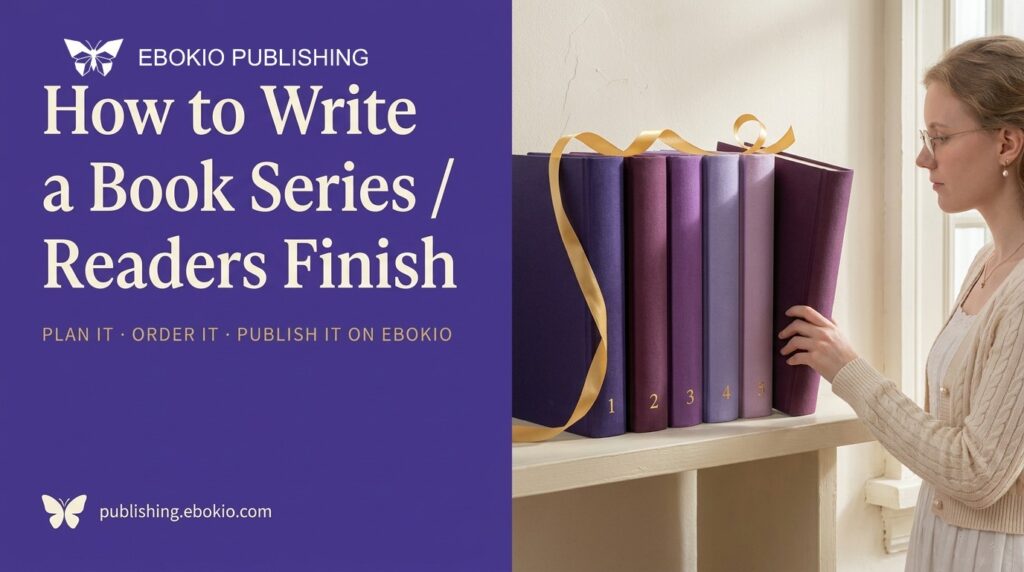
In April 1957, an eleven-year-old American boy named Laurence Krieg wrote to C.S. Lewis with a family dispute. He wanted to reread the Narnia books starting with The Magician’s Nephew, the story of Narnia’s creation. His mother wanted publication order, starting with The Lion, the Witch and the Wardrobe. Lewis took the boy’s side, then added that the order perhaps did not matter very much.
That polite reply outlived its author. After HarperCollins took over publishing in 1994, numbering the seven books in story-time order became the worldwide standard, and the debate still runs. Scholar Peter Schakel argued in the journal Mythlore that the original sequence shapes how the books work on a first-time reader.
Here is the lesson for anyone learning how to write a book series: if you don’t decide how readers move through your books, someone else will. A publisher. A retailer’s algorithm. A fan wiki. This guide walks through the decisions underneath every series — its type, its spine, its bible, its name, its reading order, its price ladder, and the one number that tells you whether it works — and shows how to run each of them on Ebokio Publishing.
What Ebokio Publishing is
Ebokio Publishing is a UK self-publishing platform for ebooks. You upload a manuscript as EPUB or DOCX, a human reviewer checks it, and the book goes on sale as a product page in the Ebokio digital bookshop at ebokio.com. Readers browse, buy and read there, in a built-in reader on web and mobile.
Three things make it a strong home for series authors:
• Planning, writing and selling share one workspace. The Writing Studio — story bible, relationship map, outline and goals — runs in the same editor you publish from. There is no export step between draft and storefront.
• The terms suit a growing catalogue. You keep 70%, 80% or 90% of net receipts depending on your plan. Publishing is non-exclusive, so each volume can sell on other stores the same week.
• A series is a built-in object. You group titles into a series from the book editor, and the storefront shows a series card with the reading order and prompts to continue.
Each of these returns below, at the step where it matters.
Step 1: Choose the kind of series before the plot
“Series” covers three different machines. Pick yours early, because it decides how much each book is allowed to resolve.
The arc series. One story told across several volumes. Every book has its own climax, but the central conflict closes only in the last one. Harry Potter works this way. Readers must start at Book 1, and you owe them an ending.
The episodic series. A recurring lead — a detective, a vet, a drifter with a code — faces a fresh problem in each book. Lee Child’s Jack Reacher novels are the classic case. A reader can enter at Book 6 and leave satisfied. Character and voice hold the series together, not plot.
The shared-world series. Different leads, one setting. Romance writers use this all the time: one small town, one family of siblings, one book per sibling.
One question settles which you’re writing: What does a reader lose by skipping Book 2? If the answer is “the plot stops making sense,” you have an arc series. If it’s “a few running jokes and a side character’s backstory,” you have an episodic or shared-world series. The answer shapes your outline, your blurbs, and the “ordered or unordered” choice retailers will ask you to make later.

Step 2: Write the last page of the series first (roughly)
You don’t need the final chapter in prose. You need one sentence. “The heir takes the throne and loses her brother.” “The detective learns who framed her father.” Write it down before Book 1’s first draft.
Then work backward and give every volume two questions:
1. A book question — raised and answered inside that volume. Will they catch the arsonist? Will the expedition reach the pass?
2. A series question — pushed forward but left open. Who hired the arsonist? What waits beyond the pass?
A book that answers neither reads like filler. A book that answers both too completely kills the urge to buy the next one. Aim for a finished meal with one door left ajar.
The Ebokio Writing Studio handles this layer well. Its outline breaks a book into acts, chapter briefs and a corkboard you can reorder, and it ships five complete beat sheets: Save the Cat, Hero’s Journey, Three-Act, 7-Point and Romancing the Beat. Lay a framework over each volume, then mark which beats carry the series question. A useful habit is to give the series question its own colour in every outline, so you can see at a glance when Book 3 has forgotten it.
Most writing apps hand you a blank page and a folder tree. That’s enough for one novel. Across five, the structure has to be visible, and a corkboard tied to proven frameworks exposes the gaps before you spend a year drafting the wrong book. For a deeper look at building the setting itself, see our guide on how to build your fictional world before you write.
Step 3: Build a series bible that grows with the books
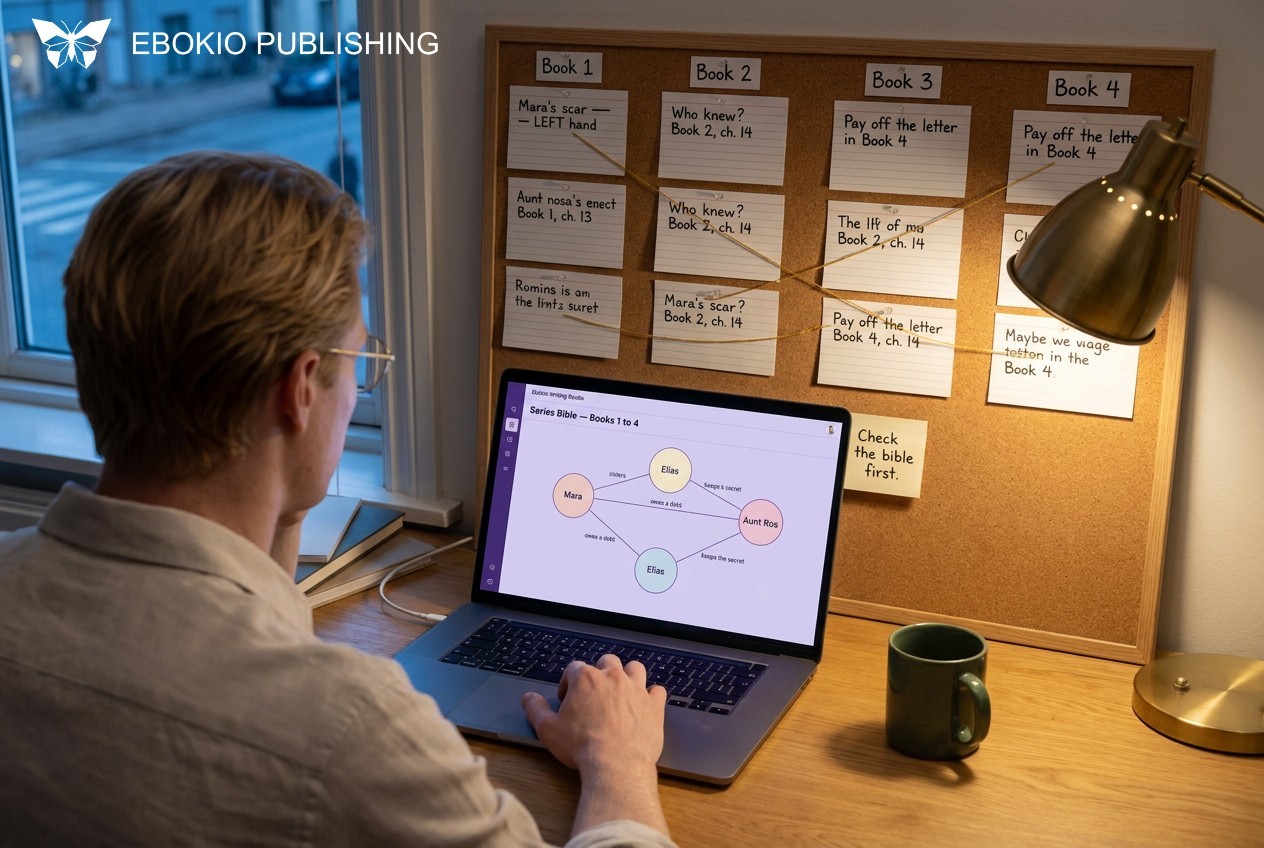
Readers remember what authors forget: eye colour, the dog’s name, which brother is older, how many days the ride to the capital takes. A series bible is the single reference that holds those facts, so Book 4 never contradicts Book 1.
A working bible covers:
• Characters: names and nicknames, appearance, age in each book, relationships, and what each person knows and when they learned it.
• Places: geography, travel times, seasons, the layout of rooms you return to.
• Rules: what magic costs, what the technology can’t do, which laws bind the police in your town.
• Timeline: every dated event, including backstory you only hinted at.
• Open threads: each unresolved question, where it was planted, and where you plan to pay it off.
• Style notes: recurring phrases, chapter-title format, who gets point-of-view chapters.
Author and former agent Nathan Bransford described his series bible as the thing that saved him once his memory ran out of room. The opposite trap is a bible so detailed you stop opening it. Track what a sharp reader would catch. Skip the rest.
Many authors keep their bible in a spreadsheet or a notes app, apart from the manuscript. Every lookup means switching windows, and every new fact has to be copied across by hand. In Ebokio’s Studio, the bible is the source the other tabs read from. Characters and locations hold traits, arcs and notes, plus AI-painted portraits on Premium and Pro. The relationship map lets you drag your cast onto a canvas and name each link: sisters, estranged, owes money to, secretly married. Across a series, that map becomes a record of how alliances shift from book to book.
Paid plans add Muse, a brainstorming partner grounded in your own bible rather than the open internet. Ask why a character would betray her brother in Book 3, and it answers from the history you’ve recorded. It doesn’t write the book for you. Ebokio frames it as a thinking partner and asks authors to declare any AI involvement before publishing.
Step 4: Name the series for the books you haven’t written
Sue Grafton built one of crime fiction’s best-known series on the alphabet, from A Is for Alibi through Y Is for Yesterday. She died in 2017 before writing Z, and her family announced the series would end at Y. The concept was brilliant marketing inside a container with a fixed size.
Before you commit to a naming scheme, stress-test it:
• Does it cap the count? Alphabets, rainbow colours and days of the week all run out.
• Does it survive a change of direction? A name built around “murder” fits badly if Book 5 turns into a heist.
• Is it searchable? A distinctive name makes your books easy to find; a generic one buries them. Our guide to ebook metadata covers how names and keywords feed discovery.
• Can it hold a sub-series? Shared worlds often split into separate arcs later.
Then use the name exactly the same way, every time. On Amazon KDP and Kobo Writing Life, series linking depends on matching text across titles, and Kobo’s own help page tells authors to enter the identical series name on every book. A stray hyphen or an extra “The” can leave a volume stranded outside its series.
On Ebokio, grouping happens inside the book editor: you place titles into a series instead of retyping a label and hoping it matches. That removes a whole category of error.
Step 5: Make Book 1 sell Book 2
Read-through — the share of Book 1 readers who go on to buy Book 2 — is mostly won or lost in the last ten pages of Book 1 and the first ten of Book 2.
End with resolution plus a pull. Close the book question in full. Then, in the final chapter, move the series question one step: a letter arrives, a name surfaces, a door opens. In an episodic series, a cliffhanger that leaves the main plot hanging feels like a broken promise. Arc-series readers tolerate more tension, but they still expect a real climax.
Write the back matter on purpose. After “The End,” readers decide in seconds. Give them:
1. The title and cover of the next book.
2. A one-paragraph hook written for someone who has just finished this book, not for a stranger.
3. A direct link to the next book’s product page.
Every Ebokio product page and author page is a real, indexable URL, so the same link works inside the ebook, in your newsletter and on social media.
Open Book 2 for two audiences. Returning readers want momentum; new arrivals need their bearings. Reintroduce characters through action rather than summary. One clean line of context per returning character is usually enough.
Let the sample do its job. On KDP, the preview readers see is generated for you. On Ebokio, you set how much of the book is free to preview, down to the percentage. For Book 2, a longer sample lets a returning reader slip back into the world before paying.
Step 6: Decide the reading order and state it plainly
The Narnia argument exists because the books never settled where to start in a way everyone accepted. Your series shouldn’t leave that gap open.
Three situations cover most series:
• Publication order matches story order. Number the books and you’re done.
• You add a prequel later. Decide whether it is Book 0 (read first) or a companion (read anytime). Many authors list prequels separately, so new readers still begin with Book 1, where the hook is strongest.
• You publish novellas or box sets. Keep them out of the main numbering so the path stays clean.
Retailers handle this in different places. On KDP, a separate series manager asks you to choose “ordered” or “unordered,” box sets and novellas go in as related content, and the series page typically appears within about 72 hours. When a book fails to link, the fix can mean a support request.
Ebokio builds the reading order into the storefront itself. Group the titles in the book editor and readers see a series card with the order and nudges to continue, so someone who finishes Book 1 is pointed straight at Book 2. Add one line to every blurb as well — “Book 2 of the Ironwood Chronicles. Start with Book 1 for the full story.” — and the order becomes impossible to miss.
|
|
Ebokio Publishing |
Amazon KDP |
Kobo Writing Life |
|
Where you build the series |
Inside the book editor |
Separate series manager |
Series name and volume fields on each book |
|
What readers see |
Series card with reading order and continue-reading nudges |
Series page, ordered or unordered |
Books grouped by series number |
|
Top royalty rate |
90% of net receipts (Pro plan) |
70% |
70% |
|
Exclusivity |
Never |
Optional, required for KDP Select |
Not required |
For a full side-by-side of the two biggest options, read KDP vs Ebokio Publishing.
Step 7: Plan the release rhythm and the price ladder
Series reward momentum. A reader who finishes Book 1 and finds nothing to buy drifts away, and many never come back. Authors usually choose between two rhythms:
• Rapid release. Finish two or three books before publishing any, then release them weeks apart. Each launch lifts the one before it.
• Steady release. Publish as you go, on a predictable schedule, and keep readers warm in between.
Rapid release suits arc series, where waiting hurts. Steady release fits episodic series, where each book stands on its own.
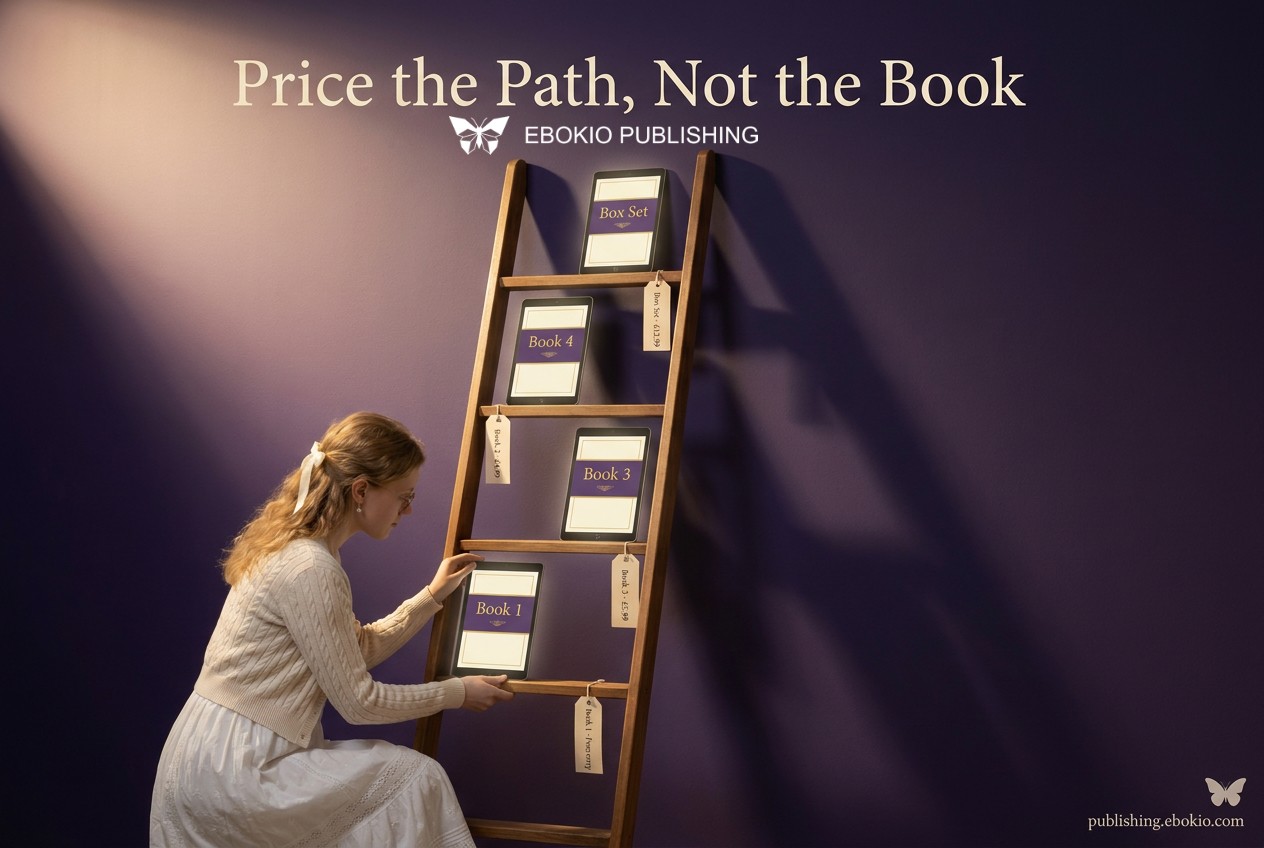
Price works as a ladder. Book 1 is the entry point, often priced lower to reduce the risk of trying you. Later books carry full price, because readers who reach them are already invested.
Some authors make Book 1 free. On KDP that’s awkward: the dashboard won’t accept a $0 price, so authors rely on Amazon price-matching or on free promotion days inside KDP Select, which requires exclusivity. On Ebokio, a free title is a supported choice and works as a funnel, carrying your author page, your other books and follow prompts. Premium and Pro authors can also schedule percentage deals and free runs on any title, without tying the book to a single store.
Model every rung with the free ebook price calculator and royalty calculator. The royalty rate matters more in a series than in a standalone, because the gap repeats on every volume. Keeping 90% instead of 70% on six books adds up fast. Plan details sit on the pricing page.
Step 8: Measure read-through, then fix the weakest link
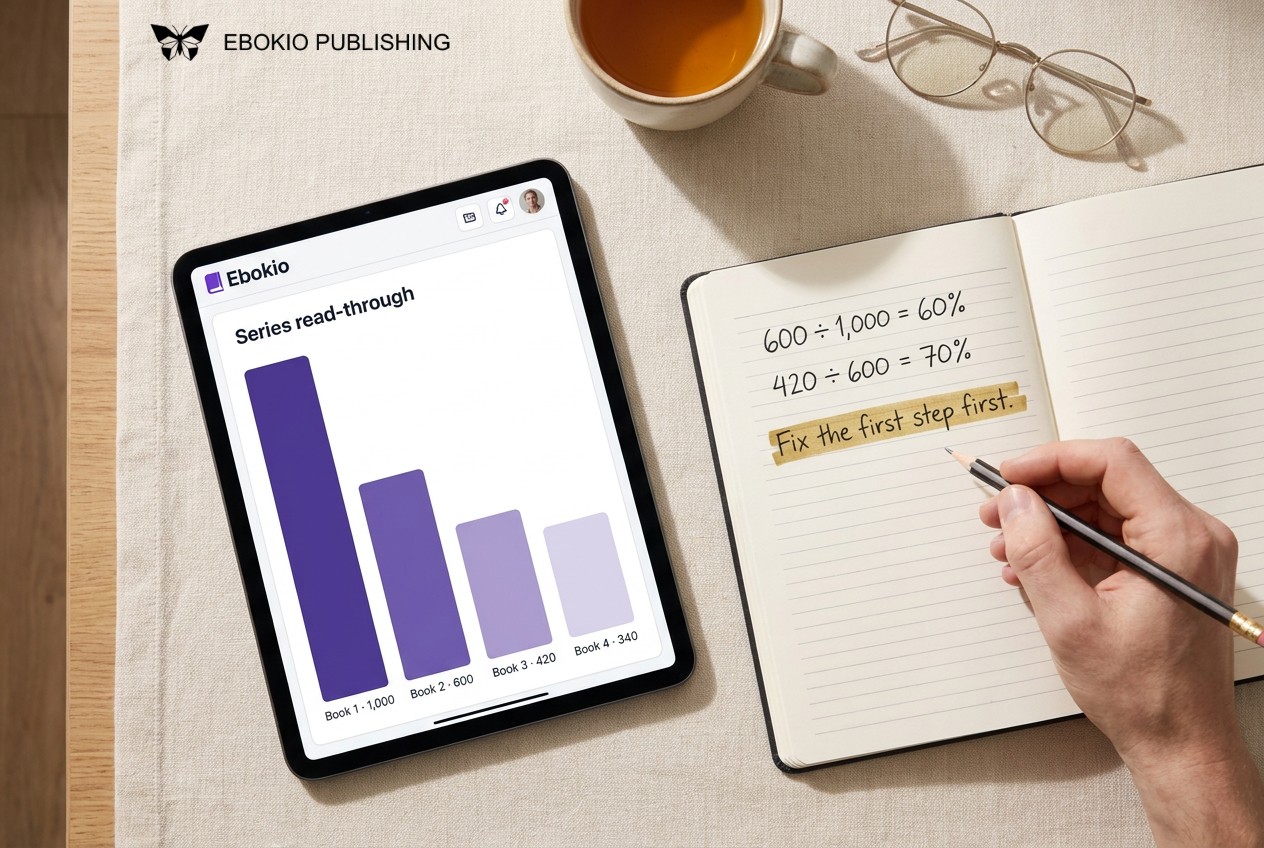
The formula is simple. Divide Book 2 sales by Book 1 sales over the same period. If 1,000 people bought Book 1 and 550 bought Book 2, read-through is 55%. Repeat for each step: Book 3 against Book 2, and so on.
Industry write-ups, including Kindlepreneur’s guide, put healthy Book 1 to Book 2 read-through for many genres somewhere between about 40% and 65%. Later books usually hold readers better, because the people who reach them are the committed ones. Treat those figures as rough guides and compare your series against itself over time.
Read-through compounds. At 60% from Book 1 to 2 and 70% from 2 to 3, only 42% of Book 1 buyers reach Book 3 (0.60 × 0.70). Lift the first step to 70% and that becomes 49%. ScribeCount’s series analysis makes the same point: small gains early in the chain pay out across every later book.
When a number drops, diagnose before you rewrite:
• Low completion of Book 1? The problem sits inside Book 1: pacing, a sagging middle, or a cover that promised a different book.
• High completion, weak Book 2 sales? The handoff failed: thin back matter, a missing link, or a Book 2 blurb that sells the wrong mood.
• Book 2 sells but Book 3 doesn’t? The middle book may have stalled the series question.
This is where Ebokio’s author dashboard earns its place. Next to sales, it reports reader engagement for each title, including pages read and completion rate. Book 1’s completion rate is your earliest warning of read-through trouble. The dashboard also shows where readers found you — the AI Librarian, deals, genre browsing or direct — and lets you export any chart to CSV, so you can calculate read-through across the whole series in a spreadsheet. KDP’s reports cover sales and Kindle Unlimited page reads; completion isn’t part of them, and the read-through maths is left to you.
Step 9: Keep the series alive between books
A series catalogue ages. Covers that looked fresh at Book 1 can look tired by Book 5. A typo a fan spotted sits in every copy until you fix it.
On Ebokio you can swap a cover, edit a description, replace the file or change the price at any time, and existing buyers re-download the latest version free. That makes series-wide refreshes practical: a matching cover redesign, a continuity correction, an updated back-matter link once Book 4 exists. The built-in Cover Studio helps keep a consistent look — the same typeface, the same colour band, a new focal image for each volume.
Between releases, the reader community keeps working for you. Verified buyers can leave reviews and follow you, and they receive a notification the moment your next book goes live. For tactics on building that review base, see how to get book reviews in 2026.
Episodic series gain the most from the AI Librarian. Readers describe what they want in plain language — “a small-town vet mystery with a dog sidekick” — and it routes them to matching titles using each book’s metadata and blurb. A reader who lands on Book 5 that way can follow the series card back to Book 1.
Because Ebokio is non-exclusive, none of this stops you from selling the same series on Amazon, Apple Books or your own site. Many authors treat Ebokio as a fairer home base while keeping wide reach elsewhere.
A pre-launch checklist for series authors
• The series ending exists as one written sentence.
• Every volume has a book question and a series question.
• The series bible is started, with open threads tracked.
• The series name has been stress-tested and is used identically everywhere.
• Book 1’s back matter links straight to Book 2.
• Every blurb states the reading order.
• The price ladder is modelled and Book 1’s entry price is chosen.
• Read-through tracking is set up from the first sale.
Ready to begin? Create a free Ebokio account, open a Studio project for Book 1, and build the bible before you write chapter one. The Free plan includes up to 30 published books, 70% of net receipts and the full Writing Studio. For the publishing mechanics from upload to payout, follow our step-by-step guide on how to self-publish a book.
Frequently asked questions
How many books should be in a series?
There’s no correct number. Trilogies are common in fantasy and young adult fiction, while episodic mysteries and romances can run open-ended. Plan the arc to fit the story, not a round number. Because read-through compounds, each extra book earns from readers you already won, but only commit publicly to a count you can deliver.
Should I finish the whole series before publishing Book 1?
Not necessarily. Arc series benefit from having two or three books drafted first, so readers aren’t left waiting between cliffhangers. Episodic series can launch with one book and grow on a steady schedule. At minimum, have the series ending and a bible in place before Book 1 goes live.
Can I sell my series on Ebokio and Amazon at the same time?
Yes. Ebokio is non-exclusive by design, so each volume can sell on Amazon, Kobo, Apple Books or your own site in parallel. The one conflict to watch is KDP Select, which requires exclusivity on Amazon’s side for enrolled ebooks.
How do I list a series on Ebokio Publishing?
Group the titles into a series from the book editor. The storefront then displays a series card showing the reading order, with prompts that guide readers from one book to the next.
What is a good read-through rate for Book 1 to Book 2?
Published industry guides commonly cite roughly 40% to 65% for many genres, with tighter arc series often scoring higher. Use those as rough guides only. The most useful comparison is your own series over time, and on Ebokio, Book 1’s completion rate in the dashboard flags problems before sales data does.
Do I need an ISBN for every book in my series?
Not on Ebokio. You can publish and sell without one, and if you already own ISBNs you can enter them and keep your imprint as publisher of record. Other retailers and library services set their own rules, so check before distributing elsewhere.
Can I update earlier books once later ones are out?
Yes. On Ebokio you can replace the file, cover, description or price at any time, and existing buyers can re-download the latest version free. Use this to refresh back matter links and keep covers consistent as the series grows.
Should Book 1 be free?
It can work when you have at least three books out and Book 1 converts well to Book 2. A free first book brings in more readers but earns nothing directly. On Ebokio a free title works as a funnel to your paid books, while on KDP a $0 price requires price-matching or KDP Select’s exclusive free days.
Sources
• Ebokio Publishing — homepage and platform overview: https://publishing.ebokio.com/
• Ebokio Publishing — Writing Studio: https://publishing.ebokio.com/studio
• Ebokio Publishing — Features: https://publishing.ebokio.com/features
• Ebokio Publishing — FAQ (series listing, updates, free titles, ISBNs): https://publishing.ebokio.com/faq
• Ebokio Publishing — Pricing and royalties: https://publishing.ebokio.com/pricing
• Peter J. Schakel, “The ‘Correct’ Order for Reading The Chronicles of Narnia?”, Mythlore 23.2 (2001): https://core.ac.uk/download/236223558.pdf
• NarniaWeb — Narnia reading order and the 1957 Krieg letter: https://www.narniaweb.com/?p=650
• Amazon KDP Help — Set the reading order for your series: https://kdp.amazon.com/en_US/help/topic/G29L44KLZ6RDYGDP
• Kobo Writing Life Help — How to Grow Sales of your Book Series on Kobo: https://kobowritinglife.zendesk.com/hc/en-us/articles/360058976352-How-to-Grow-Sales-of-your-Book-Series-on-Kobo
• Kindlepreneur — How to Calculate Series Read-Through: https://kindlepreneur.com/calculate-series-read-through/
• ScribeCount — Series Strategy: The Financial Case for Six Books: https://scribecount.com/author-resource/business-strategies/series-strategy-the-financial-case-for-six-books
• ScribeCount — Permafree Series Calculator: https://scribecount.com/tools/permafree-series-calculator
• Nathan Bransford — The Series Bible: https://nathanbransford.com/blog/2010/05/series-bible