Two crime novels sit on the same digital shelf. Same length, same price, similar covers, both by newcomers. One earns for three years straight. The other stops at nineteen copies.
The gap is almost never craft, and it is not luck either. One author understood what the reader wanted the book to do for them and built every visible surface around that answer. The other wrote a decent book and trusted the category page to handle the rest.
That “what it does for them” has a name: the reading motive. It is the quiet engine behind every purchase, and it is the most useful lens in selfpublishing — because it turns marketing from a shouting contest into a matching problem.
This guide breaks down how reading motives work, how they surface in real buying behaviour, and how to act on them with the controls in front of you. Those controls come from a specific platform, so it is worth defining it once: ebokio Publishing is a UK-based self-publishing platform, run by Ebokio Ltd in London, where you upload a manuscript as EPUB or DOCX, pass a human quality review, and get a storefront page in the ebokio.com bookshop. Publishing is non-exclusive, you keep full rights, and you keep 70–90% of net receipts depending on your plan. Everything that follows is anchored to what that platform actually lets you do.
A motive is not a genre, and it is not a demographic
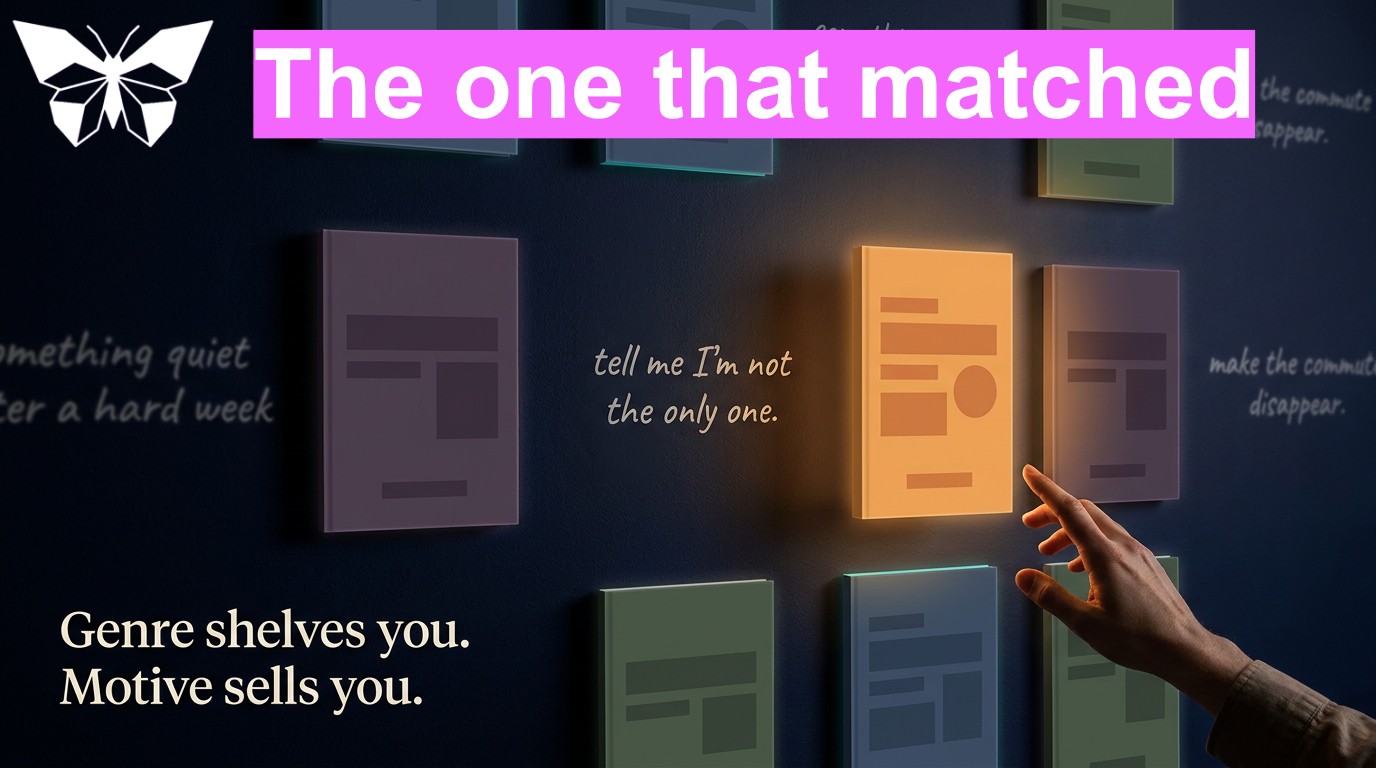
Genre is a shelving convention. It tells a shop where to put your book. Demographics are a billing address: they describe who paid, not why.
A reading motive is different. It is the internal state a reader is trying to reach, and the book is the vehicle. Someone buys a locked-room mystery on a Tuesday night because they want ninety minutes where their own problems go quiet and a different problem gets solved cleanly. Someone else buys the same book because a colleague mentioned it and they want something to say on Friday. Two motives, one title, two hooks with nothing in common.
Media researchers have circled this idea for fifty years. Uses and gratifications theory reframed audiences as active choosers who select media to satisfy specific needs — diversion, information, personal identity, social connection — rather than passive receivers. Later work by Mary Beth Oliver and Arthur Raney split entertainment motives into two families: hedonic and eudaimonic. Hedonic readers want pleasure and stimulation. Eudaimonic readers want meaning, insight, something that stays with them. A reader can be both in the same week and rarely in the same hour.
The commercial version of the same insight is older than it looks. In What Customers Want from Your Products, Clayton Christensen and his co-authors argued that the job, not the customer, is the fundamental unit of analysis — customers “hire” a product to do a job. Their milkshake study found commuters hiring a thick shake to make a dull drive bearable, and parents hiring the same shake to stop saying no to a child. Nothing about the shake changed. The job did.
Books work the same way. Readers hire them.
The eight motives that move money
Below are the motives that consistently produce purchases in fiction and non-fiction. Read them as states, not segments.
Escape. The reader wants out — of the room, the week, the news. The job is transport, and the enemy is friction. Long set-up kills this sale. Openings that put the reader somewhere specific by paragraph three win it.
Repair. Something hurts and the reader wants it managed. Comfort reads, gentle romance, cosy mysteries, and the strange catharsis of very sad novels all serve this. The buying signal is time of day: late evening, and after a bad week.
Recognition. The reader wants proof they are not the only one. Memoir, literary fiction, divorce and grief and burnout narratives. The blurb line that sells here is not a plot summary — it is a sentence the reader has thought about themselves and never said out loud.
Competence. A concrete problem needs solving: a business plan, a language, a sourdough starter, a difficult conversation. The reader will forgive plain prose and will not forgive vagueness. Specificity is the product.
Curiosity. The reader wants to understand a system — a war, a market crash, a body, a city. Popular history and science live here. The hook is a question they cannot answer and did not know they wanted to.
Belonging. The book is social currency. This motive has grown teeth. NIQ’s Books & Consumers research for the year to March 2025 found that every tracked discovery method reached its highest recorded share, with 13–34-year-olds accounting for just over two in five books bought for their own reading in the UK and around three-quarters of titles discovered through video-sharing sites. A book that gives people something to say travels further than a book that is merely good.
Ritual. Reading is welded to a slot: the commute, the bath, twenty minutes before sleep. Chapter length matters more than plot here. So does audio: a reader who listens while driving is buying a different product from the one who reads in bed.
Reassurance. The reader wants a known quantity delivered without surprises. Series, tropes, and formula are not creative failures — they are promises. Romance readers who search for “enemies to lovers” are not asking for a plot; they are asking for a guaranteed emotional sequence.
Market shape confirms how concentrated some of this is. NIQ’s UK panel, covering roughly 4.5 billion purchases between January 2012 and August 2024, found crime and thriller to be the largest single genre at 14% of all book purchases and more than a quarter of digital purchases, with women accounting for 59% of books bought and 65% of ebooks. Those numbers describe volume. Motive explains which of those buyers will finish your book and come back for the next one.
Build a motive stack, not a motive list
The trap is trying to serve all eight. A book that promises escape, meaning, community and self-improvement promises nothing at all.
Pick one primary motive. Choose two supporting motives that do not contradict it. Then check that every surface a stranger sees points the same way.
A thriller with escape as primary, ritual and reassurance as support, is a short-chapter, fast-open, clearly-book-one-of-three product. A memoir with recognition as primary, repair and belonging as support, needs a cover that signals honesty over glamour and a blurb built from admissions rather than events. Same effort, opposite decisions.
Write the stack down before you touch the cover brief. It will settle arguments later.
The six surfaces where a motive becomes visible
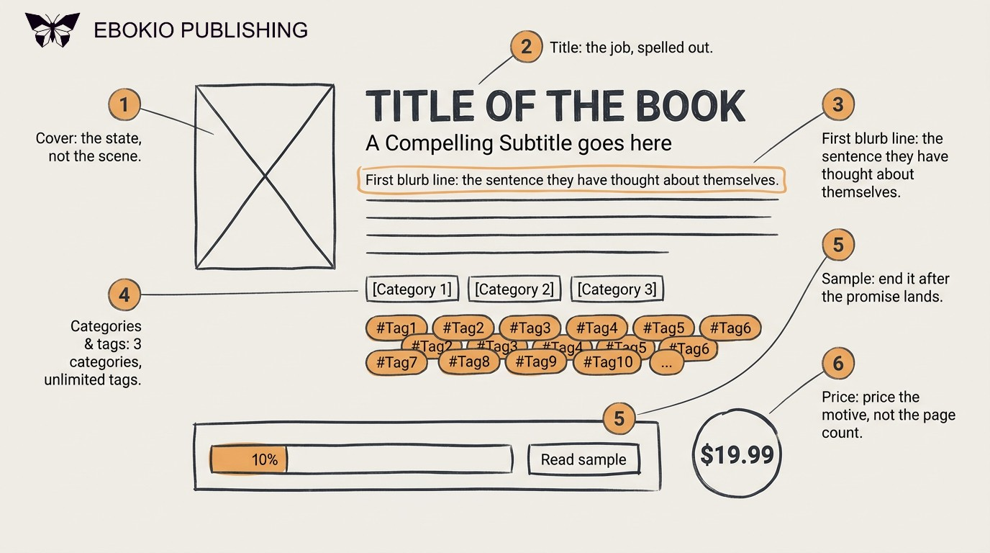
A reader decides in seconds, and self-published authors control every second of that decision. These are the only places the motive can live, and ebokio Publishing gives you a direct lever for each one.
1. The cover. Not a scene from the book — a signal of the state on offer. Cover Studio inside ebokio generates up to four variations per prompt on the Pro plan, accepts reference images to steer composition, and leaves the resulting artwork as your intellectual property. Side-by-Side AI Compare lets you view options together instead of judging them one at a time, which is how most authors talk themselves into the wrong cover. Full details sit on the features page.
2. The title and subtitle. Fiction titles set tone; non-fiction subtitles carry the job. “A Practical Guide” serves nobody. “How to run a first client meeting when you have never run one” serves competence.
3. The first line of the blurb. Most blurbs open with setting. Motive-led blurbs open with the state. ebokio’s AI Metadata Autofill reads your actual manuscript to draft blurbs, categories and keywords, so the suggestions come from your text, not from genre boilerplate — and you can bookmark the strongest options in the Favorites Library and reuse them across a series.
4. Categories and tags. Categories place the book. Tags catch the motive. On ebokio you set your price in GBP and choose up to three categories with unlimited tags. The contrast with Amazon is not cosmetic: KDP asks you to compress an entire book’s discoverability into seven keyword fields. Seven slots force you to bet on the two or three motives you think are biggest. Unlimited tags let you describe the slow-burn pacing, the grief thread, the small-town setting, the audio-friendly chapter length and the trope sequence — every entry point a different reader might arrive through.
5. The sample. You control what percentage of the book a visitor can read before buying. This is a motive instrument, not a formality. Escape needs a sample long enough to prove immersion. Competence needs a sample that delivers one usable technique in full. Reassurance needs the sample to reach the moment the promise is confirmed. Most authors leave this on default and lose the sale one page early.
6. The price. Ritual and repair reads sell on impulse. Competence titles justify a higher number because the reader is comparing you to a course, not to a novel. ebokio publishes a free browser-based ebook price calculator and royalty calculator so you can model the decision before it goes live.
The AI Librarian: a search box where the motive is the query

This is where ebokio Publishing breaks with how the rest of the market works, and it deserves the attention.
Keyword search forces readers to translate. A reader whose real request is “something warm and undemanding after a hard week” has to convert that into a genre label, then a filter, then a browse. Every conversion step loses books — including yours.
The AI Librarian removes the translation. Readers describe what they want in plain English, French or German — mood, genre, author, price range, or features like AI text-to-speech — and the Librarian returns matching titles from the live catalogue, whether they are free, cheap or premium. Your book is indexed for it automatically the moment it goes live, using metadata, blurb and content signals, not seven keyword slots.
The consequence for self-published authors is direct. On a keyword marketplace, your tags compete against the tags of established titles. In a natural-language system, a reader who asks for a specific emotional state is asking a question that a well-tagged, honestly-blurbed independent book can answer better than a bestseller that half-fits.
Then comes the part almost nothing else in selfpublishing offers. Your ebokio dashboard reports sales by day and hour, reads, and the AI Librarian searches that surfaced your book, exportable as CSV. You are not inferring motive from a sales rank. You are reading the sentences real readers typed before they found you.
That is a feedback loop. If your literary novel keeps surfacing for “books about starting over after forty”, that phrase belongs in your blurb, your tags, and probably your next cover brief.
Reading the dashboard as motive evidence
Four signals, four separate conclusions:
● Sales clustered by hour. A spike between 21:00 and 23:00 points at ritual and repair. Shorter chapters and evening promotions follow.
● Completion rate. High sales with low completion means your packaging promises one motive and your text delivers another. That gap is fixable in the blurb before it is fixable in the manuscript.
● Text-to-speech usage. Heavy listening means part of your audience is commuting or doing housework. Write and market accordingly; mention the built-in reader’s audio in your product description.
● Discovery source. Referral data tells you whether your readers arrive through the bookstore, a search, or a link you shared. Each implies another motive mix.
Feature-by-feature detail on the analytics, the Writing Studio and the built-in reader is set out on the ebokio features page and in the Studio overview.
Selfpublishing economics that let you price for motive
Motive-led pricing only works if the price is actually yours to set.
ebokio pays 70% of net receipts on the free plan, 80% on Premium at £13.99 a month, and 90% on Pro at £19.99 a month, with two months free on annual billing — the current terms are listed on the pricing page. Net receipts means the sale price after the reader’s VAT and the payment-processing fee. There are no price bands and no per-megabyte delivery fee. Payouts are monthly bank transfers in your local currency, with a £30 minimum threshold, issued at the end of the month two months after the sale month.
Compare that with the structure most self-published authors already know. Amazon’s 70% option is gated by list-price minimums and maximums, restricted to selected territories, and reduced further by delivery costs charged per megabyte — $0.15/MB in the US and £0.10/MB in the UK. An illustrated non-fiction title is penalised for being illustrated. A book priced outside the band drops to 35%. The practical effect is that your price is chosen by the royalty table rather than by the reader you are trying to reach.
On ebokio the causality runs the right way round: you decide which motive you are serving, price for that motive, and keep the same share whether the book costs £1.99 or £14.99, whether it is 200KB of text or a heavily illustrated guide. Publishing is non-exclusive and you retain full rights, so the same title can sit on Amazon, Apple Books and your own site at the same time. A direct comparison of the two models is laid out in KDP vs ebokio Publishing.
Five ways authors break the motive chain
1. The cover promises A and the blurb promises B. The reader does not resolve the contradiction. They leave.
2. Tags describe content instead of state. “Set in Yorkshire” is a fact. “Slow, quiet, no jeopardy” is a motive — and it sells to the exact reader who wants it.
3. The sample ends before the promise lands. Check where your preview cuts off and move it.
4. The blurb is a summary. Summaries answer “what happens”. Buyers are asking “what will this do to my evening”.
5. Chasing every motive. Ambition here reads as indecision. One primary motive, two supports, no exceptions.
Reviews close the chain rather than start it. Readers repeat motive language in their own words, which gives you tested phrasing for free — a practical approach is covered in How to Get Book Reviews in 2026.
Frequently asked questions about reading motives
What is a reading motive, in one sentence?
It is the state a reader wants to reach, with your book as the means of getting there. Not the plot, not the shelf, not the reader’s age. A motive completes the sentence “I want to feel, understand, stop or prove ______”. Two strangers can buy the same title for opposite reasons, and each reason needs its own hook.
How is a reading motive different from a reader persona?
A persona describes a person: thirty-eight, city, listens to podcasts. A motive describes a moment: eleven at night, worn out, wants something undemanding. Personas hold still for years. Motives switch several times a week inside the same person. Marketing to the moment converts better, because the moment is when money changes hands.
How do I work out which motive my book serves?
Finish this sentence in twelve words or fewer: A reader hires this book to ______. Then test the answer against three things — your opening chapter, your ending, and your last three reviews. When reviewers describe a payoff you did not name, believe the reviewers and rewrite the sentence.
Can one book serve more than one motive?
Yes, in a hierarchy: one primary and two supports. Past that the signals cancel each other out. Pick supports that share a mood with the primary. Escape and ritual sit together without friction. Escape and competence pull in opposite directions and produce a cover nobody can read.
Do reading motives matter for non-fiction as much as fiction?
They matter more. Non-fiction buyers usually arrive with a problem already named, so competence and curiosity dominate, and the subtitle carries most of the weight. A subtitle that states the situation and the outcome will outsell one that names the field.
How many tags should I add, and does adding more actually help?
Tags on ebokio Publishing are unlimited, so the ceiling is honesty rather than quantity. Add every accurate entry point — pacing, mood, setting, structure, content warnings, chapter length — then delete anything the book does not deliver. Inaccurate tags produce first-chapter abandonment, and abandonment shows up in your completion rate.
Does the AI Librarian make keywords irrelevant?
No. It changes what a keyword is for. Rather than guessing the seven phrases a shopper might type into a keyword box, you describe the book honestly and let a natural-language system match it against whatever sentence the reader writes. The search-attribution report in your dashboard then shows which sentences did the work.
How long before I know whether I chose the right motive?
Give the page a fortnight of steady traffic, then read three numbers together: product-page conversion, sample-to-purchase, and completion rate. Sales without completion means the packaging misleads. Traffic without sales means the promise is invisible. Both healthy means the motive is right and the remaining job is finding more of that reader.
Should the price change depending on the motive?
Yes. Impulse motives — repair, ritual, escape — punish a high price, because nobody planned the purchase. Competence and curiosity tolerate more, because the reader is measuring you against a course or a workshop rather than another novel. With no royalty price bands on ebokio, the number can follow the motive instead of the payout table.
Does any of this work if I publish on several platforms at once?
It does, and motive work travels better than platform tactics. Publishing on ebokio is non-exclusive and you keep full rights, so the blurb line, tag set and cover direction you validate through the Librarian search report can be carried straight over to every other store you sell through.
Where to start
Motive work is the cheapest advantage available in selfpublishing: it costs a decision, not a budget.
Take your current book. Write one sentence: A reader hires this book to ______. If the blank takes more than twelve words, the motive is not clear yet, and no amount of advertising will fix that.
Then rebuild your product page around that sentence — cover, first blurb line, three categories, a full set of tags, sample length, price. Publish, wait a fortnight, and open the Librarian search report. The readers will tell you which motive they actually came for, and the gap between what you wrote and what they typed is your next edit.
You can set all of this up on ebokio Publishing today: upload an EPUB or DOCX, get a human review in 4–6 working days on the free plan or inside 24 hours on Premium and Pro, and go live on the ebokio bookstore with a product page built for readers who search by what they need, not by what shelf you belong on. Open questions are answered in the FAQ.
Genre gets you shelved. Motive gets you read.
Sources
Research and industry data
1. EBSCO Research Starters, Uses and Gratifications Theory — Katz, Blumler and Gurevitch’s framework for audiences as active choosers. https://www.ebsco.com/research-starters/communication-and-mass-media/uses-and-gratifications-theory
2. Oliver, M. B. and Raney, A. A. (2011). Entertainment as Pleasurable and Meaningful: Identifying Hedonic and Eudaimonic Motivations for Entertainment Consumption. Journal of Communication, 61(5), 984–1004. https://academic.oup.com/joc/article-abstract/61/5/984/4098495
3. Christensen, C. M., Cook, S. and Hall, T. (2006). What Customers Want from Your Products. Harvard Business School Working Knowledge. https://www.library.hbs.edu/working-knowledge/what-customers-want-from-your-products
4. NIQ (2025). The Age of Social Reading — Books & Consumers discovery data, rolling year to March 2025. https://nielseniq.com/global/en/insights/commentary/2025/the-age-of-social-reading/
5. NIQ (2025). One in a Million: How Books & Consumers Data Shapes Up — UK purchase panel, January 2012 to August 2024. https://nielseniq.com/global/en/insights/commentary/2025/one-in-a-million-how-books-consumers-data-shapes-up/
6. Amazon KDP Help. eBook royalty options and delivery costs. https://kdp.amazon.com/en_US/help/topic/G200634500
7. Amazon KDP Help. Keywords for your book. https://kdp.amazon.com/en_US/help/topic/G201298500
ebokio Publishing references
8. ebokio Publishing — platform overview. https://publishing.ebokio.com/
9. ebokio Publishing — Features: Cover Studio, AI Metadata Autofill, analytics and the built-in reader. https://publishing.ebokio.com/features
10. ebokio Publishing — How it works: upload, metadata, categories and tags, review times. https://publishing.ebokio.com/how-it-works
11. ebokio Publishing — Pricing and royalty tiers. https://publishing.ebokio.com/pricing
12. ebokio Publishing — Writing Studio. https://publishing.ebokio.com/studio
13. ebokio Publishing — Ebook price calculator. https://publishing.ebokio.com/tools/ebook-price-calculator
14. ebokio Publishing — Royalty calculator. https://publishing.ebokio.com/tools/royalty-calculator
15. ebokio Publishing — Self-publishing explained. https://publishing.ebokio.com/guides/self-publishing
16. ebokio Publishing — How to self-publish a book. https://publishing.ebokio.com/guides/how-to-self-publish-a-book
17. ebokio Publishing — KDP vs ebokio Publishing. https://publishing.ebokio.com/blog/kdp-vs-ebokio-publishing
18. ebokio Publishing — How to Get Book Reviews in 2026. https://publishing.ebokio.com/blog/how-to-get-book-reviews-2026
19. ebokio.com — AI Librarian. https://ebokio.com/ai-librarian
20. ebokio.com — Bookstore. https://ebokio.com/ebooks
All links checked and live at the time of publication.